-
Graphene Nanoplatelets for Si-Oxide Battery Anodes — University of Waterloo, 2015
Jun 09, 2026 | ACS MATERIAL LLCLi, M. et al. (2015). Fabrication of graphene nanoplatelets-supported SiOx-disordered carbon composite and its application in lithium-ion batteries. *Journal of Power Sources*.
Journal of Power Sources · 2015
University of Waterloo researchers used ACS Material graphene nanoplatelets to support a SiOx-carbon anode delivering 630 mAh/g with ~100% retention over 250 cycles.
About this research
Researchers at the University of Waterloo fabricated a graphene nanoplatelets-supported SiOx-disordered carbon composite (SiOx-C/GNPs) using graphene nanoplatelets supplied by ACS Material, demonstrating a stable reversible lithium-ion capacity of about 630 mAh g⁻¹ at 100 mA g⁻¹ with nearly 100% retention after 250 cycles. The composite was built by a Stöber-type self-assembly process followed by high-temperature treatment, anchoring a thin SiOx-C film onto the graphene flakes. The work, published in the Journal of Power Sources in 2015, offers a scalable route to mitigate the volume-expansion failure mode that limits silicon-based anodes for next-generation lithium-ion batteries.
High-capacity anodes are central to increasing the energy density of lithium-ion batteries, and silicon-based materials are among the most promising candidates because of their very high theoretical specific capacity and accessible lithiation potentials. The persistent obstacle is the large volume change during alloying/dealloying with lithium, which fractures particles and disrupts the conductive network, causing rapid capacity fade. Silicon suboxides (SiOx) reduce this volume change because Li2O and lithium silicates formed during initial lithiation buffer expansion, but SiOx itself is a poor electronic conductor. Pairing SiOx with a conductive, mechanically compliant carbon scaffold is therefore a logical design direction, and graphene nanoplatelets are particularly attractive for this role because they combine high conductivity with a layered morphology that can accommodate strain.
The ACS Material graphene nanoplatelets were the structural and electronic backbone of the composite. The paper reports that the GNPs have a flake thickness of 2–10 nm and an average lateral particle size of about 5.0 μm. In a typical synthesis, 0.25 g of graphene nanoplatelets were dispersed by pulse sonication in a mixture of cetyltrimethylammonium bromide (CTAB, 0.24 wt%), ethanol and deionized water. Ammonium hydroxide and triethoxyethylsilane (EtSi(OEt)3) were then added dropwise, and the mixture was stirred at room temperature for 12 h. CTA⁺ cations adsorb on the negatively charged GNP surface, organize into micellar assemblies, and template the polymerization of negatively charged oligomeric silicate species directly onto the graphene. After washing and vacuum drying, the precursor was heat-treated in a tube furnace at 1000 °C in flowing argon for 3 h, producing a continuous SiOx-disordered carbon film anchored on the GNP surface rather than discrete particles. A control sample (SiOx-C) without GNPs was made for comparison.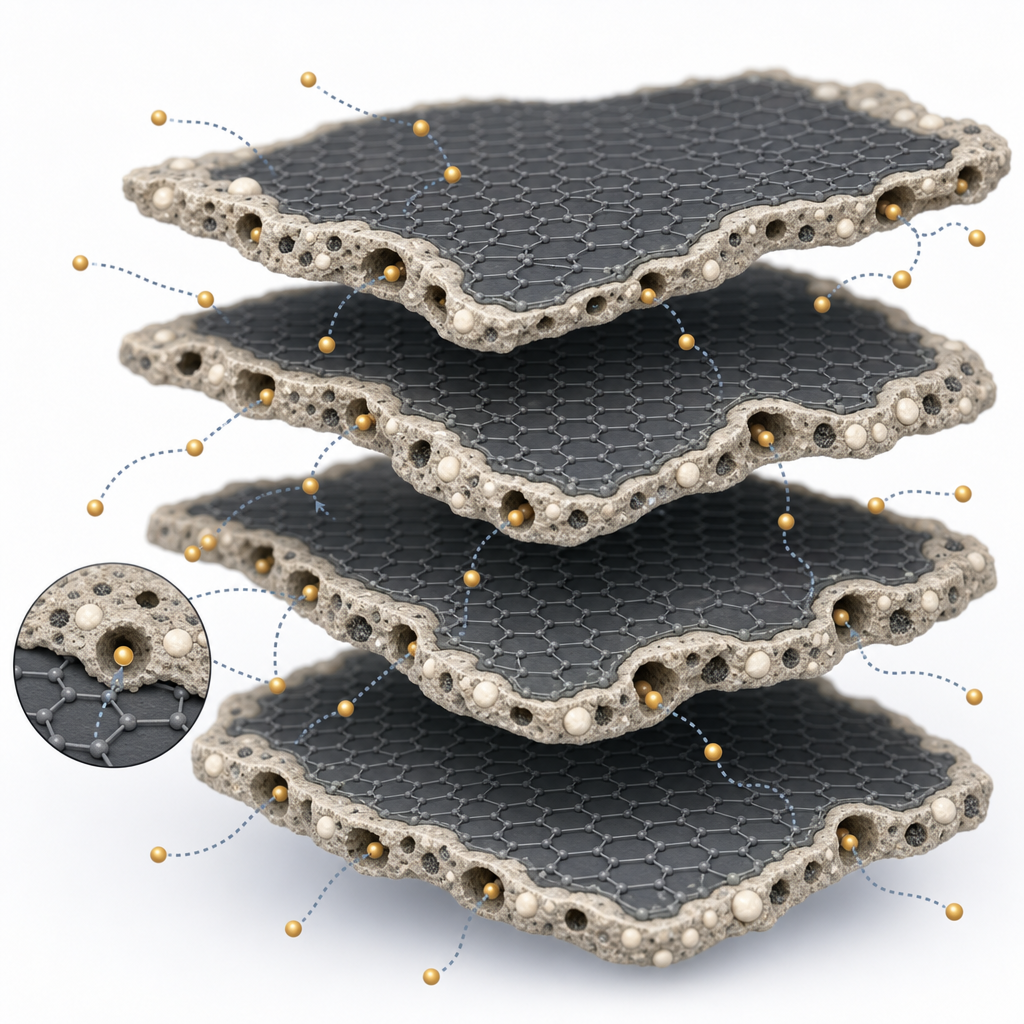
Characterization confirmed the targeted architecture and quantified performance. Elemental analysis showed that the combined disordered carbon and GNP content in SiOx-C/GNPs reached about 44.5 wt%, and EDS gave a mean stoichiometry of x ≈ 1.21 in SiOx. FTIR identified the expected Si–O–Si and Si–O modes at 1097, 789 and 470 cm⁻¹, and XRD showed an amorphous-to-low-crystalline SiOx signature alongside the retained graphite-like graphene peaks. BET measurements showed the GNP surface area of 28.2 m² g⁻¹ dropped to 10.5 m² g⁻¹ after SiOx-C deposition, while a clear hysteresis loop and pore-size peaks at ~2.6, 7 and 14 nm indicated mesopores and macropores up to 180 nm that can accommodate SiOx swelling. Electrochemical testing in 2026 coin cells used 75 wt% active material, 10 wt% acetylene black, 15 wt% sodium alginate binder, and 1 M LiPF6 in EC/DMC with 2% VC and 5% FEC additives. The SiOx-C/GNPs electrode delivered ~630 mAh g⁻¹ at 100 mA g⁻¹ on the total composite mass, retained essentially 100% of that capacity after 250 deep cycles, and showed strong rate capability. Lithium-extraction plateau voltages were only slightly higher than commercial graphite, which preserves cell voltage and overall energy density. The authors attribute the performance to four design features: high electronic conductivity from the GNP network, short Li-ion and electron transport paths through the thin SiOx-C film, elastic free volume from inter-flake gaps and pores, and a robust chemical/mechanical interface between SiOx and graphene.
The results are relevant to high-energy-density lithium-ion cells for electric vehicles, portable electronics and grid storage, where silicon-oxide-based anodes are an active commercial direction. The synthesis avoids the complicated nanostructuring usually required for elemental silicon, instead exploiting a wet-chemistry Stöber route with off-the-shelf graphene nanoplatelets, which makes scale-up more practical. The paper also points to broader applicability of the GNP-templated, surfactant-directed coating strategy to other high-capacity but conductivity-limited oxide or sulfide anode chemistries, and to electrode architectures that need engineered porosity for volume accommodation.
For researchers developing silicon-oxide, silicon-carbon, or other expansion-prone anode chemistries, this paper illustrates how commercially available graphene nanoplatelets can serve as both a conductive matrix and a templating substrate within a simple solution-based workflow. Graphene nanoplatelets in the 2–10 nm thickness range, along with related materials in the ACS Material graphene series, are available to support similar lithium-ion battery, supercapacitor and composite-electrode studies.How ACS Material products were used
- Graphene Nanoplatelets (2-10nm) (Graphene Series) — “Graphene nanoplatelets (0.25 g, ACS Material) were dispersed in a mixture containing cetyltrimethylammonium bromide (CTAB, 0.24%wt), ethanol and deionized water by pulse sonication... According to the data from ACS Material (US), the GNPs have a flake thickness of 2–10 nm with an average lateral particle size of about 5.0 μm.”
Product Performance in this Study
The ACS Material graphene nanoplatelets served as the conductive scaffold onto which SiOx-disordered carbon was anchored. They provided electronic conductivity, short ion/electron transport paths and elastic accommodation of SiOx volume changes, enabling ~630 mAh g⁻¹ reversible capacity with nearly 100% retention over 250 cycles.
Related product categories
Frequently asked questionsHow do graphene nanoplatelets improve silicon oxide anodes in lithium-ion batteries?
Graphene nanoplatelets provide a high-conductivity, mechanically compliant scaffold that compensates for the poor electronic conductivity of SiOx and accommodates volume changes during lithiation. In this study, anchoring a SiOx-disordered carbon film onto 2–10 nm thick GNPs delivered ~630 mAh g⁻¹ at 100 mA g⁻¹ and retained nearly 100% capacity over 250 deep cycles, far surpassing SiOx-C without GNPs.
What thickness of graphene nanoplatelets is suitable for battery anode composites?
The authors used graphene nanoplatelets with a flake thickness of 2–10 nm and an average lateral size of about 5.0 μm. This thickness range balances high in-plane conductivity, large accessible surface area for coating, and enough flexibility between layers to create mesopore and macropore space that buffers SiOx volume expansion during cycling.
Why are CTAB and Stöber chemistry used to coat graphene nanoplatelets with SiOx?
CTAB forms positively charged micelles that adsorb electrostatically on the negatively charged graphene surface and template silicate oligomers from EtSi(OEt)3 under ammonia. The Stöber-type hydrolysis-condensation then deposits a uniform SiOx layer that, after 1000 °C argon annealing, becomes a continuous SiOx-disordered carbon film firmly anchored to the GNPs rather than dispersed particles.