-
Graphene Nanoplatelets for Si3N4 Toughening — Hungarian Academy of Sciences, 2019
Jun 30, 2026 | ACS MATERIAL LLCTapasztó, O. et al. (2019). The effect of graphene nanoplatelet thickness on the fracture toughness of Si3N4 composites. *Ceramics International*.
Ceramics International · 2019
Researchers used ACS Material graphene nanoplatelets to toughen Si3N4 ceramics, doubling fracture toughness to 10.5 MPa·m^1/2 with thinner few-layer GNPs.
About this research
Researchers led by the Institute of Technical Physics and Materials Science at the Hungarian Academy of Sciences demonstrated that ACS Material graphene nanoplatelets, when further exfoliated into few-layer graphene nanoplatelets (FL-GNPs), can double the fracture toughness of Si3N4 ceramic composites. Using spark plasma sintering with 3 wt% FL-GNP filler, the team achieved a fracture toughness of 10.5 ± 0.2 MPa·m^1/2 compared with 5.1 ± 0.3 MPa·m^1/2 for monolithic Si3N4 and 6.6 ± 0.4 MPa·m^1/2 for conventional GNP composites. The work clarifies how nanoplatelet thickness and dispersion govern toughening efficiency in structural ceramics.
Silicon nitride is a workhorse structural ceramic for cutting tools, bearings, turbine components, and high-temperature applications, but its inherent brittleness limits reliability under impact loading. Adding graphene-based fillers has emerged as a powerful route to reinforce Si3N4, with reported improvements in electrical conductivity, flexural strength, tribological behavior, and fracture toughness. Prior literature suggests graphene oxide delivers nearly twice the toughening of unoxidized graphene nanoplatelets, attributed to thinner flakes and surface functionalization. However, graphene oxide is far less effective in enhancing tribological properties. This trade-off motivates the central question: can the toughening advantage of GO be matched using unoxidized graphene nanoplatelets by simply reducing their thickness? Resolving this question is critical for industries that need ceramic components which are simultaneously tough and wear-resistant, such as advanced bearings, machining inserts, and aerospace structural parts.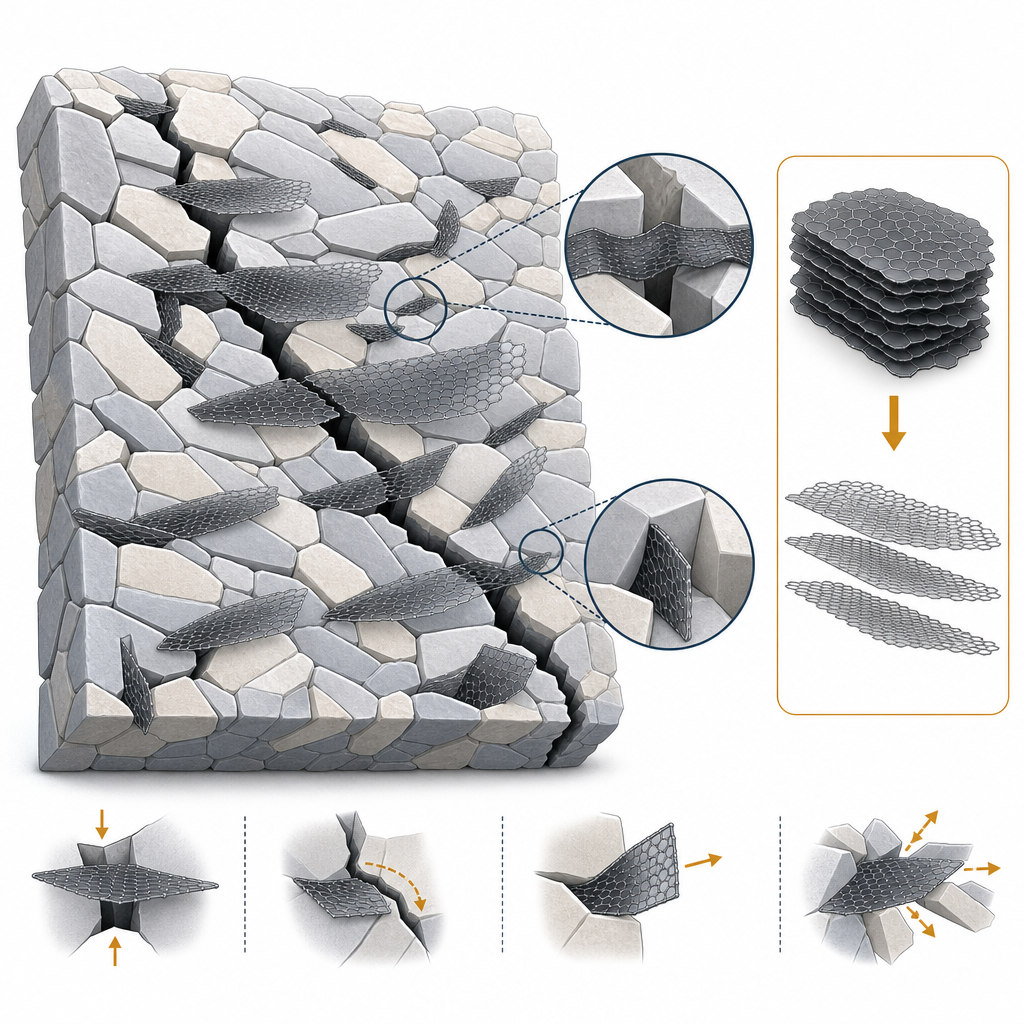
The ACS Material graphene nanoplatelets were specified with a nominal thickness of 6–8 nm and average lateral dimensions of about 25 µm, supplied as a commercial powder. In the baseline composite, the as-received GNPs were dispersed with Si3N4 (Ube SN-ESP) powder, Al2O3 (Alcoa A16) and Y2O3 (H.C. Starck grade C) sintering aids, and attritor-milled in ethanol at 4000 rpm for 5 h. To produce thinner FL-GNPs, 30 mg of the ACS Material GNP powder was processed in a planetary mill at 225 rpm for 30 min together with 90 mg of melamine. The melamine acted as an intercalating exfoliation aid; after milling, the solid mixture was dispersed in 20 ml water, sonicated for 30 min, and washed to remove residual melamine. The resulting FL-GNPs and the unmodified GNPs were then incorporated at 3 wt% and 5 wt% loadings into the ceramic matrix and densified by spark plasma sintering. This direct comparison isolates the role of nanoplatelet thickness while keeping chemistry, processing route, and matrix composition constant.
At 3 wt% loading, the FL-GNP composite reached a Vickers hardness of higher values than the conventional GNP composite while delivering a fracture toughness of 10.5 ± 0.2 MPa·m^1/2—a 100% increase over monolithic Si3N4 (5.1 ± 0.3 MPa·m^1/2) and a 60% increase over the Si3N4/3 wt% conventional GNP composite (6.6 ± 0.4 MPa·m^1/2). At 5 wt% filler content, both GNP and FL-GNP composites yielded a roughly 50% increase in toughness over the monolithic ceramic. Hardness trends were equally instructive: while hardness decreased as filler content rose, composites reinforced with 5 wt% FL-GNPs retained a Vickers hardness of 12.8 ± 0.2 GPa, about 30% higher than the 9.8 ± 0.2 GPa measured for the matched conventional GNP composite. The authors attribute these gains to the higher aspect ratio of the FL-GNPs, which enables more homogeneous dispersion, a larger interface area for crack bridging and deflection, and reduced porosity in the sintered ceramic matrix. The result effectively closes the toughness gap previously reserved for graphene oxide fillers, but without sacrificing the tribological advantages of unoxidized graphene.
These findings have direct implications for the design of next-generation structural ceramics. Si3N4 components with simultaneously high toughness, hardness, and wear resistance are attractive for cutting tools, ball bearings, engine components, and aerospace structural ceramics where catastrophic brittle failure must be avoided. The melamine-assisted ball milling route shown here is a low-cost, scalable post-processing step that can be applied to commercial GNP powders, offering a practical bridge between laboratory results and industrial production. The work also points toward optimizing filler loading—3 wt% FL-GNP appears to be a sweet spot where toughness is maximized without excessive hardness loss—and suggests future studies on tribological testing, thermal conductivity, and machinability of the FL-GNP composites.
For researchers working on graphene-reinforced ceramics, polymers, or coatings, the ACS Material graphene nanoplatelets used in this study are available through the Graphene Series catalog and serve as a well-characterized starting material for exfoliation, dispersion, and composite development. The paper underscores the value of starting with a consistent, commercially specified GNP feedstock when developing reproducible toughening protocols. Whether the goal is doubling fracture toughness in structural ceramics or producing few-layer graphene for other composite systems, having a defined-thickness, defined-lateral-size graphene nanoplatelet enables systematic comparison of processing variables and outcomes.How ACS Material products were used
- Industrial Thin Layer Graphene Nanoplatelets (Graphene Series) — “As filler phase we used commercially available graphene nanoplatelets (ACS Material) with a nominal thickness of 6–8 nm and average lateral dimensions of about 25 µm.”
Product Performance in this StudyThe ACS Material graphene nanoplatelets served as both the conventional filler and the precursor to thinner few-layer graphene nanoplatelets (FL-GNPs). The 3 wt% FL-GNP composite derived from these GNPs doubled the fracture toughness of monolithic Si3N4 (from 5.1 to 10.5 MPa·m^1/2).
Related product categories
Frequently asked questionsHow do graphene nanoplatelets improve the fracture toughness of Si3N4 ceramics?
Graphene nanoplatelets toughen Si3N4 ceramics primarily through crack bridging, crack deflection, and pull-out mechanisms at the graphene–ceramic interface. Thinner, higher-aspect-ratio nanoplatelets disperse more homogeneously in the matrix, creating a larger interfacial area for these mechanisms to act and reducing porosity. In this study, 3 wt% few-layer GNPs raised fracture toughness from 5.1 to 10.5 MPa·m^1/2, doubling that of monolithic Si3N4.
Why are few-layer graphene nanoplatelets better fillers than thicker GNPs?
Few-layer graphene nanoplatelets have a higher aspect ratio than thicker GNPs of the same lateral size, which enables more homogeneous dispersion in the ceramic matrix and a larger interface area for load transfer and crack bridging. The thinner nanoplatelets also leave smaller residual pores after spark plasma sintering. As a result, FL-GNP composites achieve higher fracture toughness and retain higher Vickers hardness than conventional GNP composites at equal filler loading.
What is melamine-assisted ball milling and why is it used to exfoliate graphene nanoplatelets?
Melamine-assisted ball milling uses melamine as a solid intercalating agent during planetary milling of graphene nanoplatelets. The melamine molecules insert between graphene layers, lowering the energy needed to mechanically separate them and limiting damage to the basal plane. After milling, melamine is removed by water washing. The technique is scalable, avoids harsh oxidants, and produces thinner few-layer graphene nanoplatelets from commercial GNP feedstocks suitable for ceramic and polymer composites.