-
Graphene Nanoplatelets for Supercapacitors - Texas A&M, 2020
Jun 24, 2026 | ACS MATERIAL LLCHope, J. T. et al. (2020). Scalable production of graphene nanoplatelets for energy storage. *ACS Applied Nano Materials*. https://doi.org/10.1021/acsanm.0c02209
College Station · ACS Applied Nano Materials · 2020
Texas A&M and ExxonMobil scale up electrochemical graphene production and benchmark supercapacitor performance against ACS Material graphene nanoplatelets.
About this research
Researchers based at College Station, working jointly with ExxonMobil Chemical Company, used ACS Material graphene nanoplatelets (Lot No. GNNP005, 2–10 nm thick, ~5 µm lateral size) as one of the commercial benchmarks for evaluating a new scalable electrochemical exfoliation process that produced graphene nanoplatelets reaching energy densities up to 0.81 Wh/kg in symmetric supercapacitors. The paper introduces a second-generation compressed, permeable reactor that delivers high-yield electrochemically exfoliated graphene (EEG) from graphite under constant applied pressure, and validates the EEG against several commercially available graphene grades in identical electrode architectures.
The motivation for this work lies in the long-standing scalability problem of high-quality graphene. Liquid-phase exfoliation typically yields under 1%, while Hummers-type oxidation introduces defects and oxygen functionalities that degrade conductivity. Electrochemical exfoliation offers a promising middle path, but earlier reactors suffered from electrode disintegration as graphite expanded. Without a reliable supply of low-defect, high-conductivity graphene nanoplatelets at scale, applications in supercapacitors, electrical double-layer capacitors (EDLCs), conductive composites, and flexible electronics remain cost-constrained. The paper therefore addresses a central bottleneck for graphene commercialization in energy storage markets.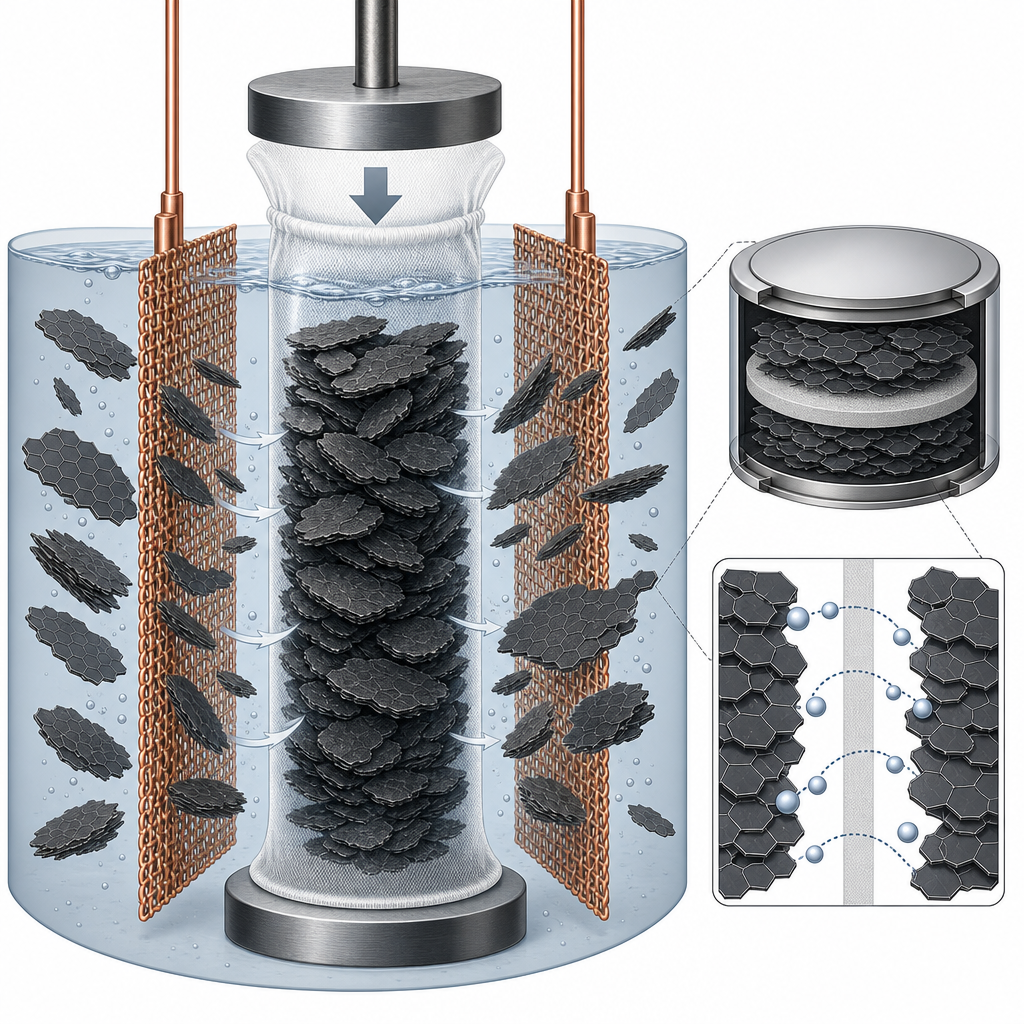
ACS Material graphene nanoplatelets entered the workflow as a comparison active material for supercapacitor electrodes. The authors prepared electrodes composed of 80 wt% active graphene, 10 wt% acetylene black, and 10 wt% PTFE binder, dispersed in ethanol and roll-pressed into ~20 µm films on a flat glass surface, dried overnight at 60 °C. Three commercial graphene grades were tested under identical conditions: ACS Material (Lot No. GNNP005, 2–10 nm thickness, ~5 µm diameter), a graphene supermarket nanopowder (AO-3, ~80 m²/g, ~12 nm thick, ~4500 nm lateral), and Knano TA-001A (~5–8 µm particle size). Electrochemical testing used a two-electrode Swagelok cell with platinum disk current-collector interfaces, a Celgard 3501 PP separator, and 1 M H2SO4 electrolyte. Cyclic voltammetry on a Gamry Reference 3000 potentiostat was used to extract specific capacitance, and Raman spectra of the ACS Material sample are included alongside those of the other commercial benchmarks in the supporting information.
The new EEG reactor design uses a cellulose dialysis membrane bag packed with nitric-acid-pretreated graphite, weighted externally with 0.5–1.5 kg to maintain electrical percolation, and operated in 0.1 M (NH4)2SO4 electrolyte. Key process findings include: yield rises from 5.2% to 12.0% when copper-mesh counter electrodes are placed on both faces rather than only the top; Pt mesh and graphite foil working electrodes give comparable yields of 26.9% and 24.4% respectively; and yield decreases with bed thickness due to water diffusion limitations into the graphite interior, while reactor length can be extended (tested 100–265 mm) without yield loss, supporting industrial scale-up. Reaction kinetics show that ~12% yield is reached in the first 30 minutes and climbs to 45% after 6 hours before bag rupture. Critically, feedstock matters: natural Sigma-Aldrich graphite flake gave only 10% yield, expandable graphite (Asbury grade 3772) gave 26%, and microwave-pretreated expandable graphite reached 57%. In symmetric supercapacitor cells, EEG delivered an energy density of 0.81 Wh/kg with ~90% capacitance retention after 5000 cycles, while the three commercial graphene benchmarks (including ACS Material) ranged from 0.25 to 0.47 Wh/kg under the same test conditions. CV curves retained near-rectangular EDLC shapes even at 500 mV/s scan rates, confirming low defect density and adequate porosity.
The demonstrated reactor enables practical, kilogram-scale electrochemical production of low-defect graphene nanoplatelets for supercapacitors, conductive inks, polymer composites, EMI shielding, anticorrosion coatings, and battery additives. Because the system tolerates a range of graphite feedstocks and cheap graphite-foil electrodes, it lowers material cost while keeping defect density low enough for sp2-dominated electrochemical performance. The patent filing by Texas A&M and ExxonMobil signals direct industrial intent. Follow-up directions include integrating the reactor with continuous post-processing (shear mixing, freeze-drying) and exploring high-d-spacing feedstocks for further yield improvement. The benchmarking framework also sets a useful methodology for the broader graphene supply community to compare nanoplatelet products on an equal-electrode basis.
For researchers selecting a commercial graphene reference, ACS Material's industrial thin-layer graphene nanoplatelets (such as the GNNP005 grade used here) provide a well-characterized, reproducible baseline for supercapacitor, composite, and conductive-ink studies. ACS Material offers a range of graphene nanoplatelet thicknesses and lateral sizes, along with reduced graphene oxide and graphene dispersions in NMP or water, supporting head-to-head comparisons in energy-storage R&D. Procurement and lab teams working on EDLC electrodes, conductive additives, or graphene-polymer composites can use catalog SKUs in the Graphene Series as standard benchmarks against in-house or alternative materials.How ACS Material products were used
- Industrial Thin Layer Graphene Nanoplatelets (Graphene Series) — “ACS Materials, graphene nanoplatelets, Lot No. GNNP005 2, 2−10 nm in thickness, ∼5μm in diameter”
Product Performance in this StudyThe ACS Material graphene nanoplatelets (Lot No. GNNP005) served as one of three commercial graphene benchmarks against which the authors' electrochemically exfoliated graphene (EEG) was compared in symmetric supercapacitor cells. The comparison provided context for assessing EEG performance under identical electrode architecture and electrolyte conditions.
Related product categories
Frequently asked questions
How do commercial graphene nanoplatelets perform in symmetric supercapacitors?
In this study, three commercial graphene nanoplatelet grades, including ACS Material Lot GNNP005, were tested in identical 80/10/10 active/acetylene-black/PTFE electrodes with 1 M H2SO4 electrolyte. Energy densities ranged from 0.25 to 0.47 Wh/kg, while electrochemically exfoliated graphene from the same lab reached 0.81 Wh/kg. All samples showed near-rectangular CV curves indicating good EDLC behavior.
Why does the feedstock graphite type matter for electrochemical exfoliation yield?
Yield depends strongly on the interlayer d-spacing of the parent graphite. Sigma-Aldrich graphite flake gave only 10% yield, Asbury expandable graphite grade 3772 gave 26%, and microwave-pretreated expandable graphite reached 57%. Larger d-spacing eases electrolyte intercalation and reduces the energy barrier for layer separation during electrochemical exfoliation, directly improving graphene yield from the same reactor.
What grade of graphene nanoplatelets is suitable for supercapacitor benchmarking?
Thin-layer graphene nanoplatelets in the 2–10 nm thickness range and several-micron lateral size, such as ACS Material Lot GNNP005, are well suited as supercapacitor benchmarks. They form rectangular EDLC cyclic voltammograms in aqueous H2SO4 and tolerate scan rates up to 500 mV/s. Their consistent thickness and lateral size enable fair comparison against new graphene grades under identical electrode architectures.