-
Graphene Nanoplates for MnO2 Supercapacitors - E-JUST, 2017
Jun 15, 2026 | ACS MATERIAL LLCRashed, A., & El-Moneim, A. (2017). Two steps synthesis approach of MnO 2 /Graphene nanoplates/Graphite composite electrode for supercapacitor application. *Materials Today Energy*. https://doi.org/10.1016/j.mtener.2017.02.004
Materials Today Energy · 2017
Researchers at Egypt-Japan University used ACS Material graphene nanoplates to build MnO2/GNPs-PVDF/graphite supercapacitor electrodes reaching 855 F g-1.
About this research
Researchers at Egypt-Japan University of Science and Technology used graphene nanoplates (GNPs) supplied by ACS Material to construct a MnO2/GNPs-PVDF/graphite composite electrode that achieved a specific capacitance of 855 F g-1 at 1.3 mA cm-2 with 105% capacitance retention after 2000 cycles. The paper, published in Materials Today Energy in 2017 by A.E. Rashed and A.A. El-Moneim, introduces a two-step synthesis approach in which a GNPs-PVDF conductive layer is first pasted onto flexible graphite, after which a thin nanostructured MnO2 film is anodically deposited on top. The architecture outperformed both direct MnO2 deposition on graphite and previously reported one-pot MnO2-GNPs-PVDF composites.
Supercapacitors are increasingly central to grid storage, regenerative braking, and portable electronics because they deliver high power density, fast charging, and long cycle life. MnO2 is one of the most promising pseudocapacitive materials because of its high theoretical capacitance (about 1370 F g-1), low cost, abundance, and environmental compatibility. However, its intrinsically low electrical conductivity (10^-3 to 10^-4 S m-1) and limited mechanical stability constrain practical performance. Hybridizing MnO2 with conductive carbons such as CNTs or chemically reduced graphene oxide has helped, but those carbons suffer from defects, mass-production constraints, and high cost. The challenge addressed in this paper is how to combine a stable, scalable carbon support with a well-dispersed MnO2 active layer in a way that maximizes both rate capability and cycle life.
The ACS Material GNPs were chosen for their combination of single-layer-graphene-like electronic properties and graphitic stability. As specified in the Experimental section, the GNPs have a thickness of 5-10 nm, a specific surface area of 50-100 m2 g-1, and an electrical conductivity of 80,000 S m-1, and are produced by microwave-assisted intercalation followed by ultrasonication and milling. To fabricate the electrode, 92 wt% GNPs and 8 wt% PVDF were dispersed in 1-methyl-2-pyrrolidone by sonication for 24 h, pasted onto flexible graphite, pressed at 10 MPa, and vacuum-dried at 120 °C overnight. The resulting GNPs-PVDF film acted as a three-dimensional, mechanically adherent conductive scaffold. A thin MnO2 layer (100 µg cm-2) was then anodically deposited at +1.0 V vs Ag/AgCl from 0.25 M manganese acetate. Raman analysis gave an ID/IG ratio of 0.439 for the GNPs, far lower than typical reduced graphene oxide (1.2-1.5), confirming the low defect density that the authors credit for the electrode's stability.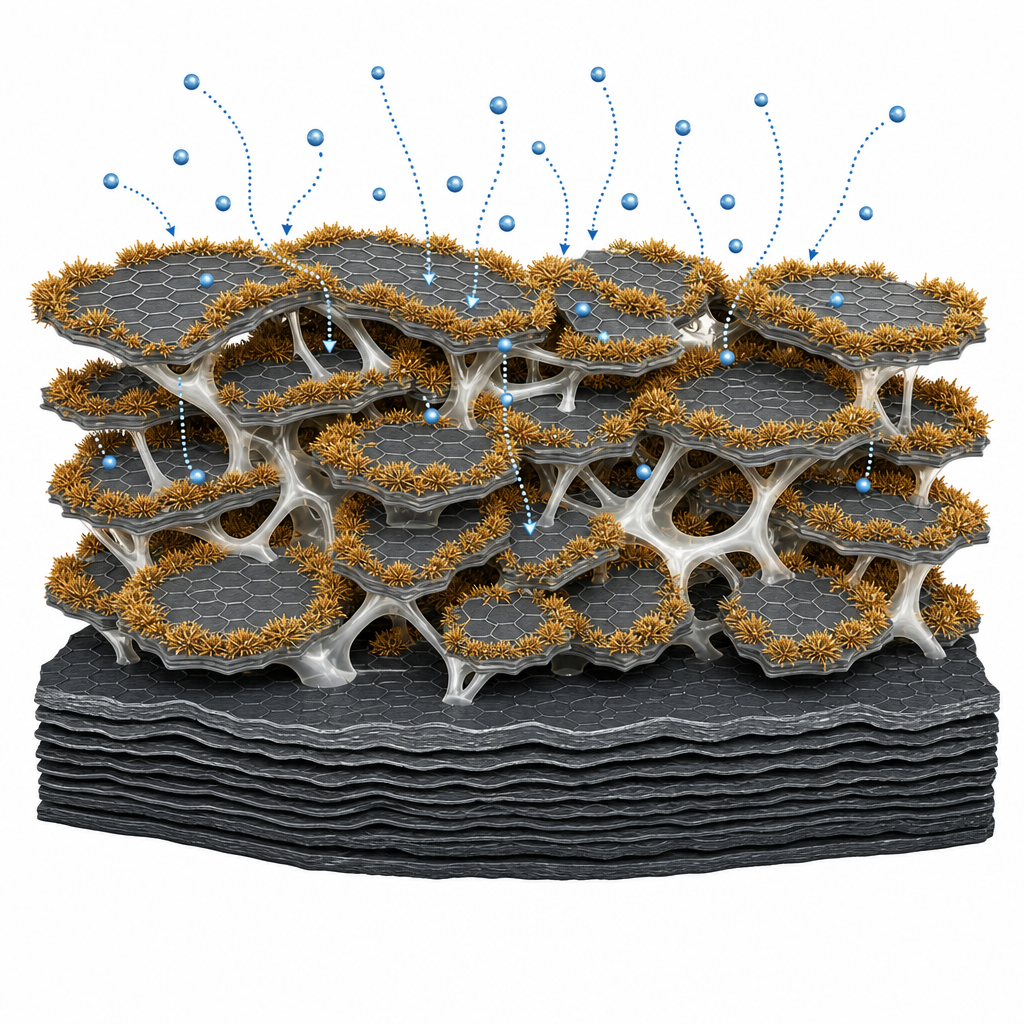
Electrochemical testing in 0.5 M Na2SO4 revealed clear gains from the two-step architecture. Cyclic voltammetry at 10 mV s-1 gave specific capacitances of 12.5, 378.8, and 530.7 F g-1 for GNPs-PVDF, MnO2/graphite, and MnO2/GNPs-PVDF, respectively. Galvanostatic discharge at 1.3 mA cm-2 showed even stronger contrast: 4.6, 326, and 855 F g-1 for the three electrodes. Rate capability was also improved: MnO2/GNPs-PVDF retained 61% of its initial capacitance as the current density increased from 1.3 to 6.5 mA cm-2, compared with 50% for MnO2/graphite. Electrochemical impedance spectroscopy measured an equivalent series resistance of 0.672 Ω and a charge-transfer resistance of 0.9 Ω for the GNPs-supported electrode, versus 1.03 Ω and 6.99 Ω for direct MnO2 on graphite. After 2000 charge-discharge cycles at 3.8 mA cm-2, the MnO2/GNPs-PVDF electrode retained 105% of its initial capacitance, while bare MnO2/graphite retained only 77.9%. FTIR confirmed a MnO2-GNPs bond interaction (Mn-O stretching shifted from 568 to 553 cm-1) that the authors propose stabilizes the oxide film.
The demonstrated electrode is directly relevant to flexible energy storage devices, wearable electronics, and high-power supercapacitor modules for hybrid vehicles and renewable energy buffering. Because the GNPs are produced from intercalated graphite through scalable ultrasonication and milling, the authors emphasize that the entire fabrication route is compatible with mass production, in contrast to chemically reduced graphene oxide approaches that rely on hazardous reductants. Follow-on work indicated in the paper includes exploiting the mechanical flexibility of the underlying graphite substrate, optimizing PVDF content for self-strengthening behavior during cycling, and integrating the electrode into bendable device formats.
For researchers developing hybrid pseudocapacitor electrodes, conductive coatings for energy storage, or graphene-polymer composite films, the GNPs used in this study correspond to the Industrial Thin Layer Graphene Nanoplatelets product within the ACS Material graphene series. The product's well-documented thickness, conductivity, and low defect density make it a practical starting material for analogous MnO2, RuO2, or conducting-polymer supercapacitor architectures.How ACS Material products were used
- Industrial Thin Layer Graphene Nanoplatelets (Graphene Series) — “GNPs (ACS Material Co.) were synthesized by exfoliating intercalated graphite using a microwave oven followed by ultrasonication and milling. This process creates GNPs of 5–10 nm in thickness, specific surface area of 50–100 m2 g-1 and an electrical conductivity of 80000 Sm-1.”
Product Performance in this StudyThe graphene nanoplates from ACS Material served as the conductive support framework that enabled the MnO2 film to reach a specific capacitance of 855 F g-1 and a capacitance retention of 105% after 2000 cycles, substantially outperforming direct MnO2 deposition on graphite.
Related product categories
Frequently asked questionsHow do graphene nanoplates improve MnO2 supercapacitor electrode performance?
Graphene nanoplates act as a highly conductive, mechanically stable three-dimensional scaffold for electrodeposited MnO2. In this work, the GNPs-PVDF support increased specific capacitance from 326 F g-1 (MnO2 on bare graphite) to 855 F g-1 at 1.3 mA cm-2, lowered charge-transfer resistance from 6.99 Ω to 0.9 Ω, and improved 2000-cycle retention from 77.9% to 105% by facilitating ion access and stabilizing the MnO2 film through Mn-O-C bond interactions.
What is the role of PVDF in a graphene nanoplate composite electrode?
PVDF binds the graphene nanoplates into a continuous, adherent film on the graphite current collector. In this study, an 8 wt% PVDF loading with 92 wt% GNPs dispersed in NMP produced a three-dimensional conductive network strong enough to survive 10 MPa pressing and subsequent anodic deposition. PVDF also provides flexibility, chemical stability, and a small volume-expansion-driven self-strengthening effect during prolonged charge-discharge cycling.
Why are graphene nanoplates preferred over reduced graphene oxide for energy storage electrodes?
Graphene nanoplates retain a highly graphitic structure with far fewer defects than chemically reduced graphene oxide. Raman ID/IG values of 0.439 for the GNPs used here, versus 1.2-1.5 for reduced graphene oxide, indicate higher conductivity and chemical stability. GNPs are also produced by scalable microwave-assisted exfoliation and ultrasonication of intercalated graphite, avoiding hazardous reductants and enabling lower-cost mass production for supercapacitor and battery applications.