-
Graphene Nanosheets for Hot-Carrier Luminescence - Nanjing University, 2013
Jul 08, 2026 | ACS MATERIAL LLCChen, Q. et al. (2013). Enhanced hot-carrier luminescence in multilayer reduced graphene oxide nanospheres. *Scientific reports*.
Scientific reports · 2013
Nanjing University researchers used ACS Material single-layer graphene as a reference to show >10× hot-carrier luminescence enhancement in rGO nanospheres.
About this research
Researchers at Nanjing University demonstrated that multilayer reduced graphene oxide (rGO) nanospheres exhibit more than tenfold enhancement in hot-carrier luminescence relative to planar graphene nanosheets supplied by ACS Material, which served as the benchmark reference in this femtosecond photoluminescence study published in Scientific Reports in 2013. The work, led by Q. Chen, C. Zhang, M. Xiao and colleagues, shows that intentionally curling graphene layers into ~300 nm hollow spheres reshapes carrier scattering pathways rather than the band structure itself, yielding a substantial gain in up-converted emission intensity under 800 nm fs pulse excitation. The finding opens a structural, rather than chemical, route to engineering graphene-based light sources.
Why this research matters lies in graphene's notoriously poor radiative efficiency. Because graphene is gapless, photoexcited hot carriers normally cool to the lattice temperature via electron-electron and electron-phonon interactions long before radiative recombination can occur, giving a quantum yield on the order of 10⁻¹². Conventional strategies to brighten graphene rely on chemical modification—graphene oxide, fluorographene, nitrogen doping—that distorts the electronic structure and sacrifices the high carrier mobility prized for optoelectronics. A morphology-based approach that preserves the sp² carbon framework while boosting emission is therefore highly attractive for optical labeling, imaging, ultrafast lasers, and broadband emitters.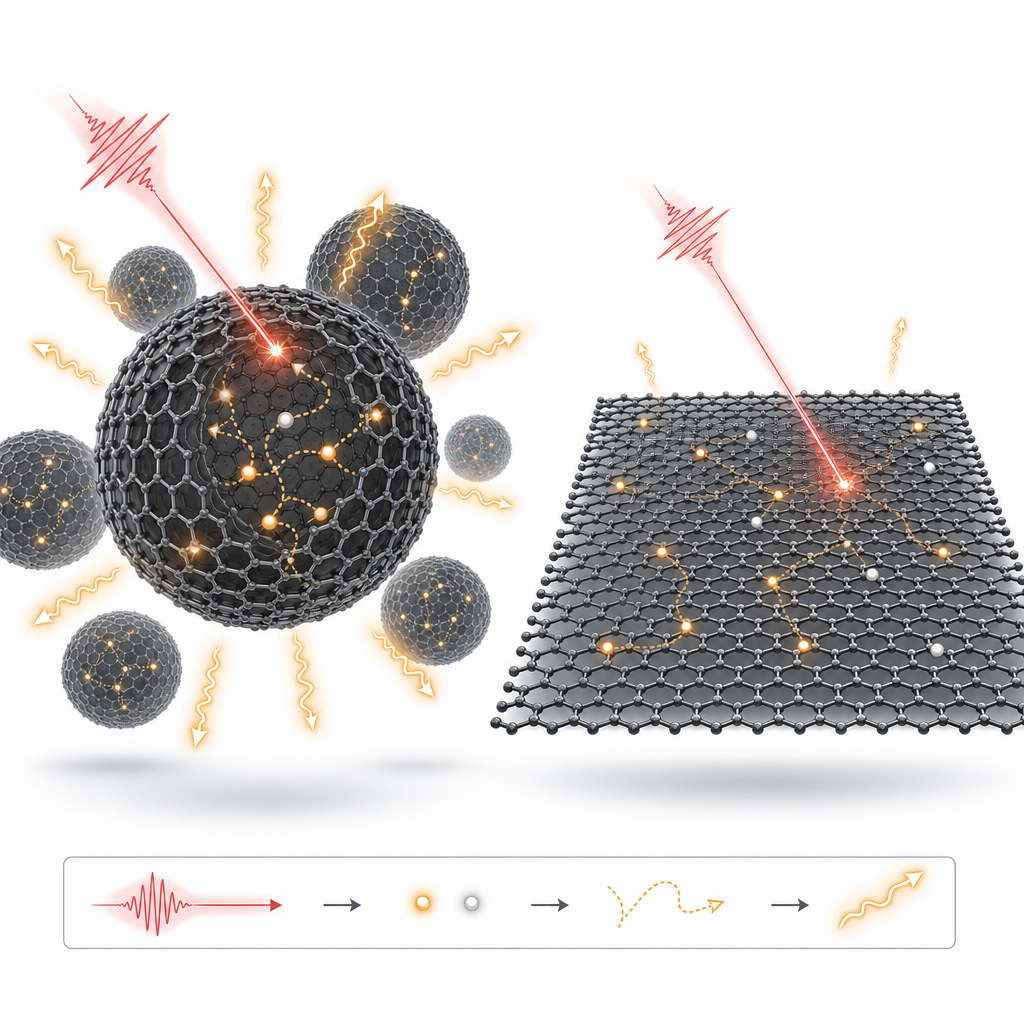
The role of ACS Material's single-layer graphene was central to interpreting the experiment. The team explicitly states that the reference sample of planar graphene nanosheets was purchased from ACS Material with purity ~99.8% and a single-layer ratio of ~80%. The nanosheets were dispersed in PMMA solution and spin-coated onto silica substrates under exactly the same protocol as the rGO nanospheres, then probed with identical 90 fs pulses from a Ti:sapphire regenerative amplifier at 800 nm. Steady-state spectra, two-pulse correlation traces, and 600/700 nm pump-probe measurements were acquired on both samples. Because the ACS Material graphene retains a pristine planar geometry and high single-layer fraction, it provided a clean upper bound on intrinsic hot-carrier emission from flat graphene, against which the curvature-induced enhancement in the rGO nanospheres could be quantified. The comparison enabled the authors to extract the Thomas–Fermi screening wavevector Q_TF as a function of fluence in both morphologies and to isolate the structural contribution.
Key results quantify the enhancement and its mechanism. The integrated up-converted emission from rGO nanospheres scales as P^2.7 with excitation fluence and is more than ten times stronger than the planar ACS Material reference at 1.47 mJ/cm². The spectra fit the Liu–Wu–Shen model I(ω) ∝ ω[ω₀² − (ω − ω₀)²]/[ω − ω₀ + v_F Q_TF]⁴, confirming a hot-carrier emission mechanism. Strikingly, the nanospheres show a power-dependent redshift while the planar graphene shows the expected blueshift, and the extracted Q_TF in nanospheres decreases with fluence—opposite to the planar case—consistent with reduced screening in a chirality J~5 multilayer system. Two-pulse correlation reveals biexponential decay with a fast component of ~0.16 ps (electron-electron plus strongly coupled optical phonons) and a slow component of ~0.77 ps (weakly coupled phonons), whose amplitude grows from ~4% at 0.5 mJ/cm² to ~18% at 2.0 mJ/cm², indicating strengthened electron-phonon coupling. Pump-probe traces at 600 and 700 nm show the 600 nm peak arriving 20–40 fs later than 700 nm, ruling out two-photon absorption and confirming that carrier scattering is the dominant up-conversion channel. Photoexcited carrier densities reach ~10¹³ cm⁻².
Applications and outlook flow naturally from the result. Efficient up-converted emission from curved graphene structures is promising for nonlinear optical labeling, bio-imaging, and broadband light sources where conventional luminophores photobleach. The structural-engineering principle—using curvature to introduce ripples, orbital rehybridization, and disorder-assisted supercollision scattering—offers a route to graphene lasers and LED-relevant emitters that does not destroy the sp² network. The findings also feed back into fundamental studies of carrier–phonon coupling, multilayer screening, and supercollision cooling that are central to graphene electronics and photodetectors.
For researchers working on graphene photonics, 2D material spectroscopy, or photocatalytic carbon nanostructures, the single-layer graphene reference used here is available from ACS Material's Graphene Series catalog. Reproducible single-layer fractions and well-characterized purity make such reference samples useful as planar controls when evaluating new morphologies, dopants, or hybrid architectures against intrinsic graphene behavior.How ACS Material products were used
- Single Layer Graphene (reference graphene nanosheets) (Graphene Series) — “The reference sample of graphene nanosheets is purchased from a commercial source (ACS Material) with purity of ~99.8% and a single-layer ratio of ~80%.”
Product Performance in this StudyThe ACS Material single-layer graphene nanosheets served as the planar reference against which the curled rGO nanospheres were benchmarked. They exhibited the conventional blueshift behavior and ~10× lower hot-carrier luminescence efficiency, providing the critical baseline that validated the nanosphere enhancement.
Related product categories
Frequently asked questionsHow does curling graphene into nanospheres enhance hot-carrier luminescence?
Curling planar graphene into hollow ~300 nm spheres introduces curvature, ripples, and disorder that boost carrier scattering. Enhanced electron-electron and electron-phonon scattering drives more carriers into higher-energy states before they cool, producing radiative recombination in the up-converted frequency range. In multilayer reduced graphene oxide nanospheres this yields more than tenfold emission enhancement compared with planar graphene nanosheets under identical femtosecond excitation conditions.
Why is a single-layer graphene reference important when studying new graphene morphologies?
A well-characterized planar single-layer graphene reference provides the intrinsic baseline against which new morphologies are judged. Without it, enhancements attributed to curvature, doping, or hybridization cannot be quantitatively separated from sample-to-sample variation. In this study, ACS Material single-layer graphene with ~99.8% purity and ~80% single-layer ratio served as that benchmark, enabling extraction of the screening wavevector Q_TF and the tenfold luminescence enhancement factor.
What is hot-carrier luminescence in graphene and why is it useful?
Hot-carrier luminescence is up-converted broadband emission produced when photoexcited carriers scatter to higher-energy states and recombine radiatively before cooling to the lattice temperature. Because pristine graphene is gapless, this scattering-driven process is the dominant route to efficient light emission. It is useful for nonlinear optical labeling, bio-imaging, ultrafast pulse characterization, and as a foundation for graphene-based lasers and broadband emitters.