-
Graphene Nanosheets in A6061 Composites - University of Tokyo, 2020
Jun 29, 2026 | ACS MATERIAL LLCHsieh, C. et al. (2020). Mechanical and tribological characterization of nanostructured graphene sheets/A6061 composites fabricated by induction sintering and hot extrusion. *Materials Science and Engineering: A*. https://doi.org/10.1016/j.msea.2020.138998
Materials Science and Engineering: A · 2020
University of Tokyo researchers used ACS Material graphene nanosheets to reinforce A6061 aluminum, raising compressive strength 50.4% and cutting wear 17.2%.
About this research
Researchers at The University of Tokyo report a graphene-reinforced aluminum alloy composite fabricated with graphene nanosheets (GNSs) supplied by ACS Material LLC, producing a 50.4% increase in compressive strength and a 17.2% reduction in wear rate at only 0.25 wt% graphene loading. The work, published in Materials Science and Engineering: A (2020) by Hsieh, Ho, Wang, Sugiyama, and Yanagimoto, combines ultrasonic processing, high-frequency induction heat sintering (HFIHS), and hot extrusion to disperse the nanosheets uniformly throughout an A6061 matrix without ball milling, which has historically damaged graphene reinforcements.
Metal matrix composites (MMCs) reinforced with carbon nanomaterials are an active research target for lightweight transportation components, electrical connectors, and structural parts that must combine high specific strength with good wear resistance. Graphene is attractive because its in-plane stiffness and intrinsic lubricity exceed those of graphite and carbon nanotubes, yet most published graphene/aluminum composites have shown only modest gains because van der Waals attraction causes the nanosheets to agglomerate during mixing and sintering, and because elevated processing temperatures can drive formation of brittle aluminum carbide (Al4C3). Solving the dispersion problem without sacrificing the integrity of the graphene reinforcement is therefore the central engineering challenge that this paper addresses.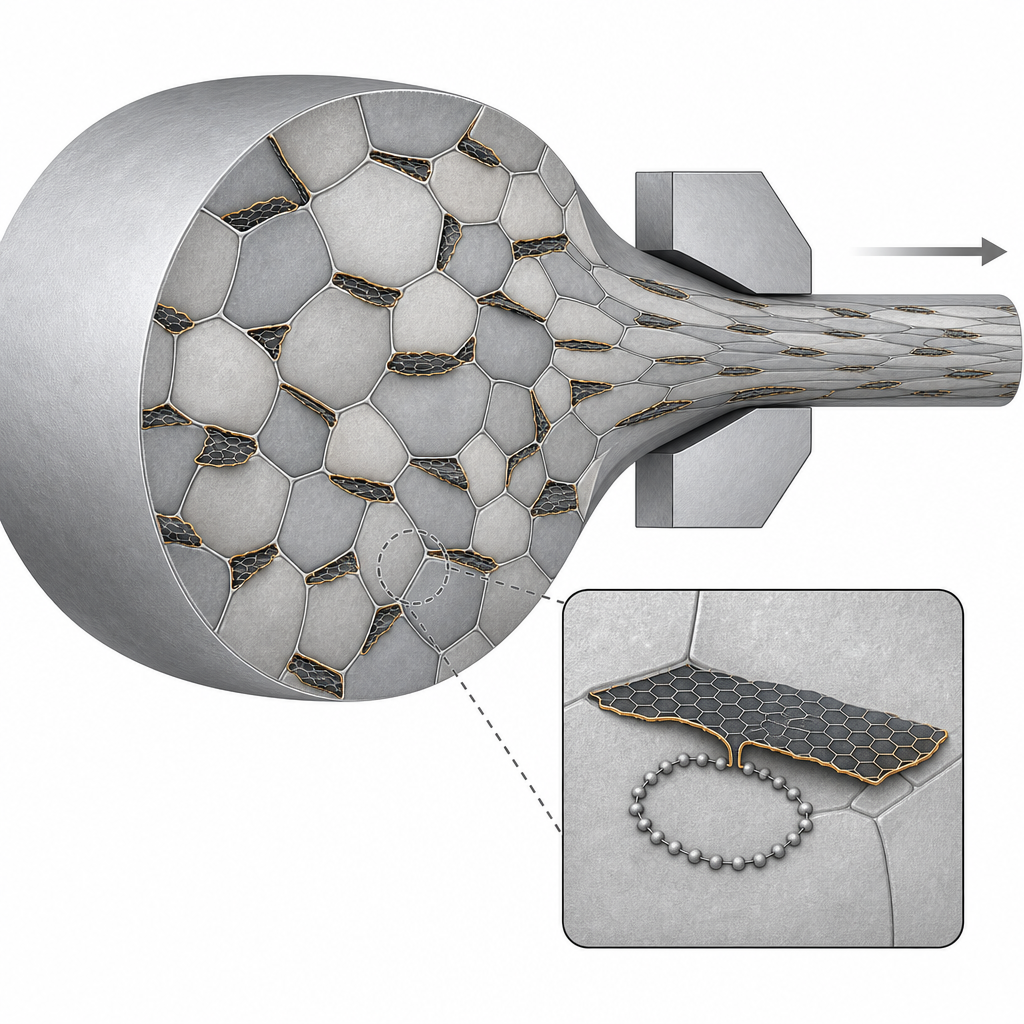
The ACS Material graphene nanosheets used in this study consisted of 1-5 atomic graphene layers with a Brunauer-Emmett-Teller (BET) surface area of 650-750 m²/g, produced by thermal exfoliation reduction and hydrogen reduction. The authors explicitly state that the as-received GNSs were used in their original form without any surface modification, isolating the contribution of the nanosheet morphology itself. Two compositions, 0.25 wt% and 0.5 wt% GNSs, were prepared by adding the nanosheets to ethanol, dispersing them with a Q500 ultrasonic homogenizer for 30 min in pulse mode, then mixing in spherical A6061 powder (average particle size 10 µm). Composite powders were consolidated by HFIHS, which uses an induction coil to reach sintering temperature within minutes and thereby suppress grain growth and Al4C3 formation. Billets were then hot extruded to produce dense bulk specimens for mechanical and tribological testing.
The headline results at 0.25 wt% GNS loading are a 50.4% increase in compressive strength, a 13.3% increase in Vickers hardness, a 21.7% reduction in friction coefficient, and a 17.2% reduction in wear rate, all measured against the same A6061 alloy extruded without graphene. X-ray diffraction and microstructural analysis confirmed that no aluminum carbide formed during HFIHS, an important practical outcome because Al4C3 is hygroscopic and embrittling. The graphene additions stimulated recrystallization, restricted grain growth, and disturbed the strong preferential extrusion texture, producing a finer and more isotropic microstructure that contributes to the strength and wear performance. A modified strengthening model that includes load transfer, thermal mismatch dislocation, Orowan, and grain refinement contributions reproduced the measured yield strength of the 0.25 wt% composite. At 0.5 wt% GNSs, however, agglomeration of the nanosheets dominated, the modified model overpredicted the measured yield strength, and the mechanical properties deteriorated, defining a clear loading window for this composite system.
The combination of property gains and the absence of Al4C3 makes the process relevant to several application areas. Lightweight high-strength A6061-based components are used in automotive structural parts, aerospace fittings, bicycle frames, and electrical bus bars, all of which benefit from improvements in strength-to-weight ratio and sliding wear behavior. The same powder-metallurgy route, namely ultrasonic dispersion followed by induction sintering and hot extrusion, can be extended to other aluminum, copper, and magnesium matrices reinforced with 2D carbons. Follow-up work suggested by the paper includes fatigue testing, characterization of interfacial bonding at the atomic scale, and optimization of the GNS loading near the 0.25-0.5 wt% transition.
For researchers working on aluminum matrix composites, tribological coatings, or nanostructured structural materials, the relevant product is the Industrial Thin Layer Graphene Nanoplatelets category at ACS Material, which corresponds to the few-layer high-surface-area GNS grade used in this paper. The study illustrates that dispersion quality, not raw graphene loading, governs whether nanosheet reinforcements actually translate into bulk property improvements, and that an appropriately processed few-layer graphene from a consistent commercial source can meaningfully strengthen an industrially relevant aluminum alloy.How ACS Material products were used
- Industrial Thin Layer Graphene Nanoplatelets (Graphene Series) — “Commercially obtained GNSs (ACS Material LLC, USA) composed of 1–5 atomic graphene layers and a Brunauer–Emmett–Teller (BET) surface area of 650–750 (m2/g) were used as the reinforcement material.”
Product Performance in this StudyThe 1-5 layer GNSs from ACS Material acted as the reinforcement phase in the A6061 aluminum matrix composite. At 0.25 wt% loading the GNSs were homogeneously dispersed and delivered substantial mechanical and tribological improvements, while 0.5 wt% led to agglomeration and property degradation.
Related product categories
Frequently asked questionsHow do graphene nanosheets improve the mechanical properties of A6061 aluminum?
Graphene nanosheets reinforce A6061 through several combined mechanisms: load transfer from the aluminum matrix to the stiff carbon sheets, generation of thermal-mismatch dislocations on cooling, Orowan looping around the dispersed nanosheets, and grain refinement caused by graphene restricting recrystallized grain growth. In the University of Tokyo study, 0.25 wt% loading produced a 50.4% increase in compressive strength and a 13.3% increase in Vickers hardness.
Why does high-frequency induction heat sintering avoid Al4C3 formation in graphene-aluminum composites?
High-frequency induction heat sintering reaches consolidation temperature within minutes by inducing eddy currents directly in the metal powder. The short dwell time at high temperature limits the diffusion-controlled reaction between aluminum and carbon that produces brittle aluminum carbide. X-ray diffraction in this study confirmed no detectable Al4C3, preserving the graphene reinforcement and avoiding the embrittlement and moisture sensitivity associated with Al4C3 in conventional sintering.
What is the optimal graphene loading for A6061 metal matrix composites?
In this work, 0.25 wt% graphene nanosheets gave the best balance, producing a 50.4% rise in compressive strength, a 21.7% drop in friction coefficient, and a 17.2% reduction in wear rate. Raising the loading to 0.5 wt% caused agglomeration driven by van der Waals attraction, which degraded mechanical properties and broke the agreement between experimental data and the modified strengthening model.