-
Graphene Oxide Aptamer Assay for Thrombin — University of North Dakota, 2020
Jun 30, 2026 | ACS MATERIAL LLCXing, Y. et al. (2020). Graphene/gold nanoparticle composites for ultrasensitive and versatile biomarker assay using single-particle inductively-coupled plasma/mass spectrometry. *Analyst*.
Analyst · 2020
University of North Dakota researchers used ACS Material single-layer graphene oxide to build a spICP-MS thrombin assay with a 4.5 fM detection limit.
About this research
Researchers at the University of North Dakota used single-layer graphene oxide purchased from ACS Material to construct a graphene oxide/gold nanoparticle (GO/AuNP) composite that enables ultrasensitive thrombin detection by single-particle inductively coupled plasma mass spectrometry (spICP-MS), achieving a 4.5 fM limit of detection. In the assay, thrombin-binding aptamers on 20 nm AuNPs are non-specifically adsorbed onto GO sheets through π–π stacking. When thrombin is present, the aptamer folds into a G-quadruplex and releases the AuNPs, which are then counted particle-by-particle by spICP-MS. The result is a quantitative, amplification-free assay that converts a biomolecular recognition event into discrete gold isotope counts.
Ultrasensitive biomarker detection remains a central challenge in clinical chemistry. Sub-picomolar concentrations of bloodborne biomarkers — circulating tumor nucleic acids, viral antigens, and coagulation enzymes such as thrombin — frequently fall below the practical detection floor of conventional fluorescence platforms. GO-based fluorescence resonance energy transfer (FRET) sensors have advanced this field, but background emission from complex matrices, fluorophore photobleaching, and instrumental noise have limited their reach. Replacing the fluorescent signal with elemental particle counts on spICP-MS sidesteps these issues. Combined with the well-established aptamer–GO desorption chemistry, this strategy promises a generalizable route to sub-picomolar detection of many disease-relevant analytes without enzymatic amplification.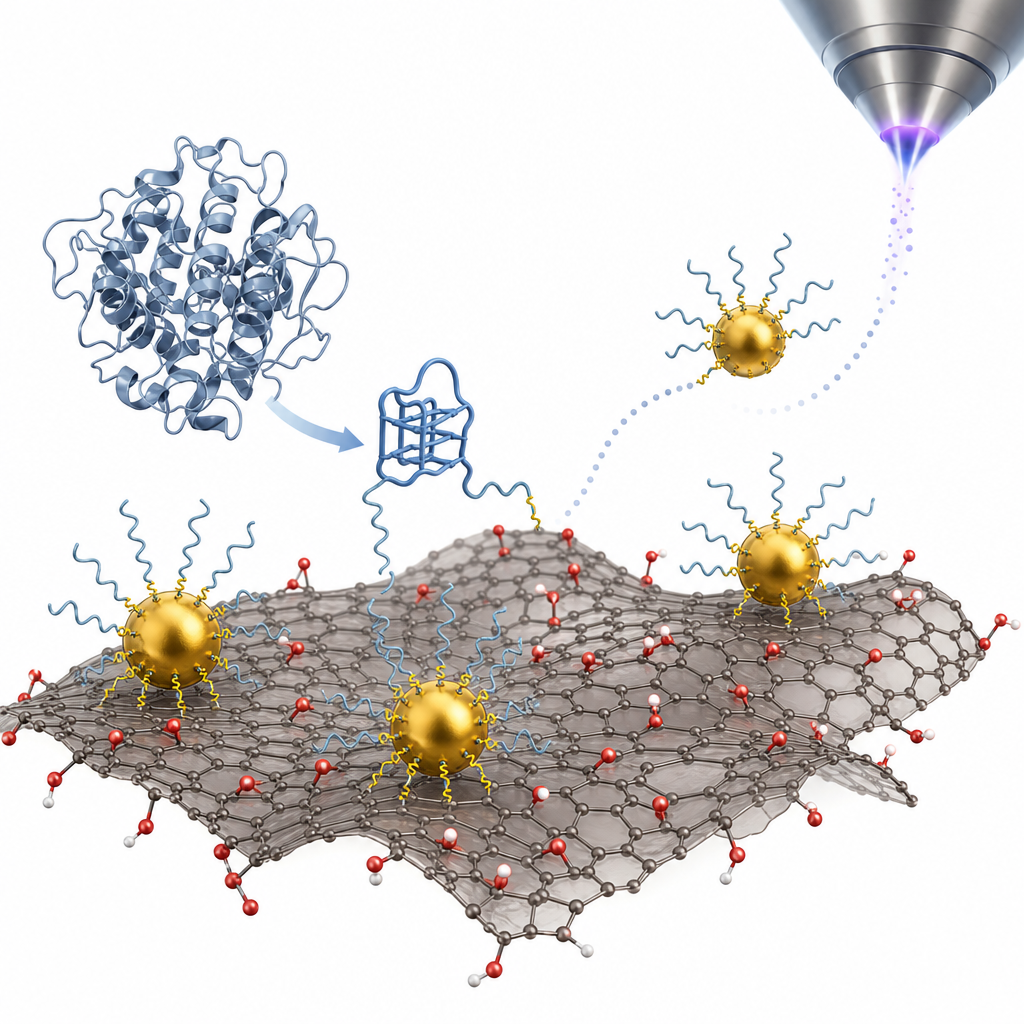
The single-layer graphene oxide from ACS Material (Pasadena, CA) acts as the recognition scaffold of the assay. The authors mixed 50 μL of 400.0 μg mL⁻¹ GO with thiolated-aptamer-functionalized 20 nm AuNPs in PBS buffer (10 mM, 0.5 mM MgCl₂, pH 7.4) for 30 min with shaking, then vacuum-filtered the GO/AuNP composites through a 0.22 μm membrane and re-dispersed them ultrasonically. The high specific surface area and abundant aromatic domains of single-layer GO are essential here, because efficient π–π stacking between the ssDNA aptamer bases and the GO basal plane is what holds the AuNP reporters in place prior to target binding. Zeta-potential and TEM characterization confirmed successful GO/AuNP composite formation. The GO must be exfoliated to true single-layer thickness to maximize ssDNA adsorption capacity and ensure complete, low-background quenching of any residual fluorescence — properties that motivated the choice of ACS Material's single-layer GO grade.
Thrombin titrations showed a clean linear response of released AuNP count rate versus log[thrombin] across four orders of magnitude, from 10 fM to 100 pM, with a detection limit of 4.5 fM calculated from 3σ of the blank. This sensitivity is competitive with the best aptamer-based thrombin assays reported in the literature and is achieved without polymerase chain reaction or rolling-circle amplification. Selectivity was tested against bovine serum albumin (BSA) and immunoglobulin G (IgG) at concentrations far exceeding the thrombin level; neither produced significant AuNP release, confirming that the response is driven by specific aptamer–thrombin recognition rather than non-specific protein adsorption. The assay also performed reliably in fetal bovine serum, a complex matrix relevant to clinical samples, with reproducibility characterized by acceptably low relative standard deviations across replicate measurements. By counting individual AuNP events at short dwell times on a Thermo Scientific iCAP Qc ICP-MS, the method translates one binding event into one discrete count, eliminating the background-limited signal averaging that constrains fluorescence detection.
The combination of GO and spICP-MS opens a versatile platform for many biomarker classes. Because the recognition element is ssDNA, the same GO/AuNP architecture can be adapted to any aptamer or complementary sequence, addressing nucleic acid biomarkers (circulating tumor DNA, microRNAs, viral RNA), enzyme biomarkers beyond thrombin, metal ions, and small molecules. Foreseeable applications include early cancer screening, infectious disease diagnostics, and point-of-need coagulation monitoring, where femtomolar sensitivity enables earlier intervention. The authors highlight clinical diagnostics as the primary translational target and note that multiplexing should be feasible by using AuNPs alongside other metal nanoparticle isotopes, each tagged with a distinct aptamer, exploiting the multi-element capability of ICP-MS.
For researchers building aptasensors, GO-based FRET probes, or hybrid 2D-material/nanoparticle bioassays, the single-layer graphene oxide product line available from ACS Material provides the quality of exfoliation and surface chemistry required for reliable ssDNA adsorption and clean particle release. This paper demonstrates that selecting a well-defined single-layer GO source is not incidental to assay performance — it directly affects the capacity for aptamer loading, the cleanliness of the spICP-MS background, and ultimately the achievable detection limit. The same material is suitable for parallel platforms in biosensing, drug-delivery scaffolds, and 2D heterostructure research.How ACS Material products were used
- Single Layer Graphene Oxide Dispersion (Graphene Series) — “Single layer graphene oxide was purchased from ACS Material (Pasadena, CA).”
Product Performance in this StudyThe single-layer graphene oxide from ACS Material served as the central scaffold for adsorbing aptamer-modified gold nanoparticles via π–π stacking, enabling target-triggered release and ultrasensitive thrombin detection down to 4.5 fM.
Related product categories
Frequently asked questionsWhy use graphene oxide instead of fluorescent quenchers for aptamer biosensing?
Graphene oxide adsorbs ssDNA strongly through π–π stacking and quenches fluorophores efficiently, but its key advantage in this study is that it serves as a reusable scaffold for aptamer-modified gold nanoparticles. Replacing optical readout with single-particle ICP-MS removes fluorescence background and photobleaching limits, enabling femtomolar detection limits unattainable by conventional GO-FRET sensors in complex biological matrices such as serum.
What detection limit can single-particle ICP-MS achieve for thrombin assays?
Using a GO/AuNP aptasensor read by single-particle ICP-MS, the authors achieved a thrombin detection limit of 4.5 fM with a linear range spanning 10 fM to 100 pM. Because each gold nanoparticle release event corresponds to one discrete count, the signal-to-noise ratio scales favorably at ultralow target concentrations, outperforming fluorescence-based aptasensors built on the same GO platform.
What grade of graphene oxide is suitable for aptamer-based biomarker assays?
Single-layer graphene oxide is preferred because complete exfoliation maximizes the basal-plane area available for ssDNA π–π stacking, ensuring high aptamer-AuNP loading and clean target-triggered release. The authors used single-layer GO purchased from ACS Material at 400 μg mL⁻¹ working concentration. Multilayer or partially exfoliated GO would reduce adsorption capacity and could increase non-specific signal.