-
Graphene Oxide for Li/S Battery Binders - LBNL, 2018
Jun 09, 2026 | ACS MATERIAL LLCHwa, Y. et al. (2018). Aqueous-Processable Redox-Active Supramolecular Polymer Binders for Advanced Lithium/Sulfur Cells. *Chemistry of Materials*. https://doi.org/10.1021/acs.chemmater.7b03870
Lawrence Berkeley National Laboratory · Chemistry of Materials · 2018
Lawrence Berkeley National Laboratory researchers used ACS Material single-layer graphene oxide dispersion to build redox-active PBI-binder Li/S cathodes.
About this research
Researchers at Lawrence Berkeley National Laboratory, working with collaborators at UC Berkeley and the Joint Center for Energy Storage Research, used ACS Material single-layer graphene oxide (GO) dispersion to build sulfur–graphene oxide nanocomposite cathodes for advanced lithium/sulfur batteries paired with a water-processable, redox-active perylene bisimide (PBI) supramolecular polymer binder. The work, published in Chemistry of Materials in 2018, demonstrates that a fully aqueous electrode-processing route combined with an electroactive PBI binder (denoted Li4·1 in its lithiated form) yields Li/S cells with strong cycling stability, high rate capability, and tolerance to elevated sulfur mass loadings near 3.0 mg cm⁻².
Lithium/sulfur batteries are attractive for next-generation energy storage because sulfur offers a theoretical capacity roughly five times higher than conventional layered oxide cathodes, at low material cost. The persistent obstacles are well known: rapid capacity fade caused by dissolution and shuttling of intermediate lithium polysulfides, large volume changes during cycling, and reliance on PVDF binders processed in toxic N-methyl-2-pyrrolidone (NMP). Replacing PVDF/NMP with water-based binder systems is desirable for greener manufacturing and lower cost, but most aqueous binders are electrochemically inert and do not chemically anchor polysulfides. A binder that is simultaneously aqueous-processable, mechanically robust, polysulfide-binding, and redox-active inside the operating voltage window would address several of these issues at once.
The authors used ACS Material’s aqueous single-layer graphene oxide dispersion (10 mg/mL) as the conductive 2D host for sulfur. Following a published procedure, 18 mL of the GO dispersion was diluted to 180 mg of GO in 180 mL of water, mixed with cetyltrimethylammonium bromide (CTAB), and combined with a sodium polysulfide (Na₂Sₓ) solution. Acidification with formic acid precipitated elemental sulfur directly onto the GO sheets, yielding the S-GO-CTA nanocomposite that was filtered, washed, and heat-treated at 155 °C in argon. Electrodes were then cast from water by mixing S-GO-CTA, Super P carbon, and either the neutral PBI binder (1) or its pre-lithiated form Li4·1 (formed by stoichiometric addition of LiOH) in a 70:22:8 (or 72:20:8 at higher loading) mass ratio onto aluminum foil or aluminum foam. The PBI core undergoes a reversible two-electron redox at 2.5 V vs. Li/Li⁺, and Li4·1 self-assembles in water via π–π stacking and ion pairing into a supramolecular polymer that wraps the S-GO-CTA particles.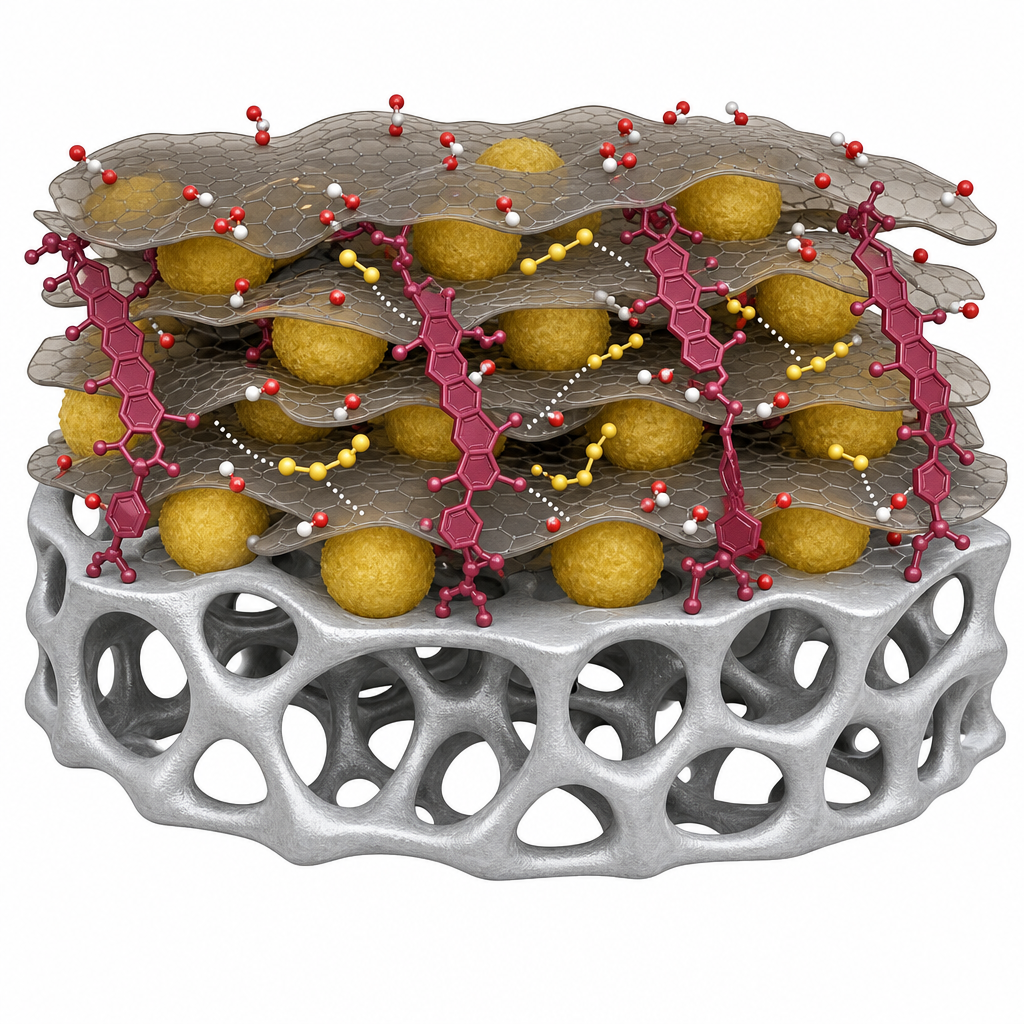
Electrochemical and physical characterization showed clear advantages of the lithiated, water-soluble Li4·1 binder over the neutral PBI 1. Peel-force testing showed that the Li4·1 electrode had markedly higher adhesion to the Al current collector than the PBI 1 electrode. SEM imaging confirmed a more uniform, crack-free coating with Li4·1. After one month of immersion in a 1.0 M LiTFSI + 0.50 M LiNO₃ electrolyte using PYR14TFSI:DOL:DME (1:1:1, v/v/v), the Li4·1 electrode remained intact while the unlithiated PBI 1 electrode visibly delaminated. In coin cells at a sulfur loading of about 1.0 mg cm⁻², Li4·1 cells showed reversible cyclic voltammetry between 1.70 and 2.80 V, stable galvanostatic cycling at C-rates up to 3.0 C, and recovery of capacity when the rate was returned to 0.20 C. Polysulfide absorption tests with 0.008 M Li₂S₆ in DOL/DME demonstrated that the PBI binder pulled polysulfides out of solution far more effectively than PVDF, consistent with the binder’s known ability to host polysulfide intermediates via the PBI core. High-loading electrodes at ~3.0 mg S cm⁻² on Al foam, with an electrolyte-to-sulfur weight ratio of 8, retained meaningful capacity over extended cycling, while PVDF controls cast from NMP performed worse under matched conditions.
The findings point to practical paths for Li/S manufacturing. Water-based slurry casting eliminates NMP, simplifies safety handling, and is compatible with aluminum foam current collectors useful for high-loading thick electrodes. The redox-active supramolecular binder concept can be extended to other conversion-type cathodes (selenium, organosulfur, and oxygen-redox materials) where polysulfide-like intermediates plague long-term cycling. The work also reinforces the role of graphene oxide as more than a passive conductive filler: when integrated with surfactants and redox-active binders, GO provides nucleation sites for sulfur and helps confine intermediates within the cathode.
For researchers replicating or extending this study, ACS Material supplies the aqueous single-layer graphene oxide dispersion used here, along with related grades of GO powder, reduced graphene oxide, and 2D battery-relevant materials. The paper provides a clear example of how a commercially available aqueous GO dispersion can be incorporated into a complete electrode-fabrication workflow, from polysulfide precipitation to high-loading cell assembly, without requiring custom synthesis of the carbon scaffold.How ACS Material products were used
- Single Layer Graphene Oxide Dispersion (Graphene Series) — “18 mL of single layer graphene oxide dispersion (GO, ACS materials, 10 mg/mL) in water was diluted to form a GO suspension (180 mg of GO in 180 mL of ultrapure water).”
Product Performance in this StudyThe aqueous single-layer graphene oxide dispersion served as the conductive 2D scaffold for the S-GO-CTA nanocomposite cathode. Its aqueous processability and uniform exfoliation enabled homogeneous sulfur deposition and supported high sulfur loadings, directly enabling the high-capacity, long-cycling Li/S electrodes reported.
Related product categories
Frequently asked questionsWhy use graphene oxide in a lithium/sulfur cathode?
Graphene oxide provides a flexible, conductive 2D scaffold that hosts sulfur with intimate electrical contact and helps confine soluble lithium polysulfide intermediates. Its oxygen-containing functional groups also support uniform sulfur nucleation during in situ precipitation from Na2Sx solutions. In this study, an aqueous single-layer GO dispersion enabled fully water-based slurry processing of S-GO-CTA cathodes, eliminating the need for NMP and supporting high sulfur loadings up to 3.0 mg/cm².
How does the PBI supramolecular binder improve Li/S cycling?
The pre-lithiated PBI binder Li4·1 is water-soluble and self-assembles via π–π stacking and ion pairing into a supramolecular polymer that wraps the S-GO-CTA particles. It is mechanically adhesive, chemically stable in the electrolyte, and electrochemically active at 2.5 V vs. Li/Li+. The PBI core also absorbs polysulfides far better than PVDF, suppressing shuttle losses and improving rate capability and cycle life.
What grade of graphene oxide is best for aqueous battery slurries?
Aqueous single-layer graphene oxide dispersions, typically 10 mg/mL, are well-suited for water-based slurry casting because they remain stable in water, exfoliate readily, and integrate cleanly with surfactants and water-soluble binders. The single-layer form maximizes accessible surface area for sulfur deposition and provides uniform film formation during doctor-blade casting onto aluminum current collectors.