-
Graphene Oxide for Li–S Battery Cathodes — Lawrence Berkeley National Laboratory, 2017
Jun 12, 2026 | ACS MATERIAL LLCHwa, Y. et al. (2017). Freeze-dried sulfur–graphene oxide–carbon nanotube nanocomposite for high sulfur-loading lithium/sulfur cells. *Nano Letters*. https://doi.org/10.1021/acs.nanolett.7b03831
Lawrence Berkeley National Laboratory · Nano Letters · 2017
LBNL builds a freeze-dried sulfur–graphene oxide–CNT nanocomposite using ACS Material single-layer GO dispersion for high-loading Li/S cells.
About this research
Researchers at Lawrence Berkeley National Laboratory used ACS Material single-layer graphene oxide (GO) dispersion (10 mg/mL in water) to construct a freeze-dried sulfur–graphene oxide–cetyltrimethyl ammonium–carbon nanotube (S–GO–CTA–CNT) nanocomposite that delivers stable cycling at high areal sulfur loadings in lithium/sulfur batteries. Published in Nano Letters (2017), the study demonstrates that combining ACS Material's GO with a cationic surfactant (CTAB), in-situ acidification of sodium polysulfide, and a final freeze-drying step produces a porous, mechanically robust electrode that tolerates sulfur contents up to 75 wt% and areal loadings of 11.5 mg/cm². The result directly addresses the long-standing gap between coin-cell demonstrations and practical Li/S energy density targets.
Lithium/sulfur chemistry promises a theoretical specific energy near 2,600 Wh/kg, but practical cells are throttled by the dissolution of intermediate lithium polysulfides into the electrolyte, by mechanical pulverization of sulfur during cycling, and by the difficulty of building thick, high-loading cathodes that retain electronic conductivity. Most published Li/S cells operate at modest sulfur loadings (1–2 mg/cm²) where these problems are masked. Achieving more than 4–5 mg/cm² of sulfur while preserving cycle life is the threshold the field needs to cross for Li/S to be competitive with state-of-the-art lithium-ion at the pack level for EVs, drones, and grid storage. Architectures that physically and chemically trap polysulfides while remaining electronically wired are therefore a central research priority.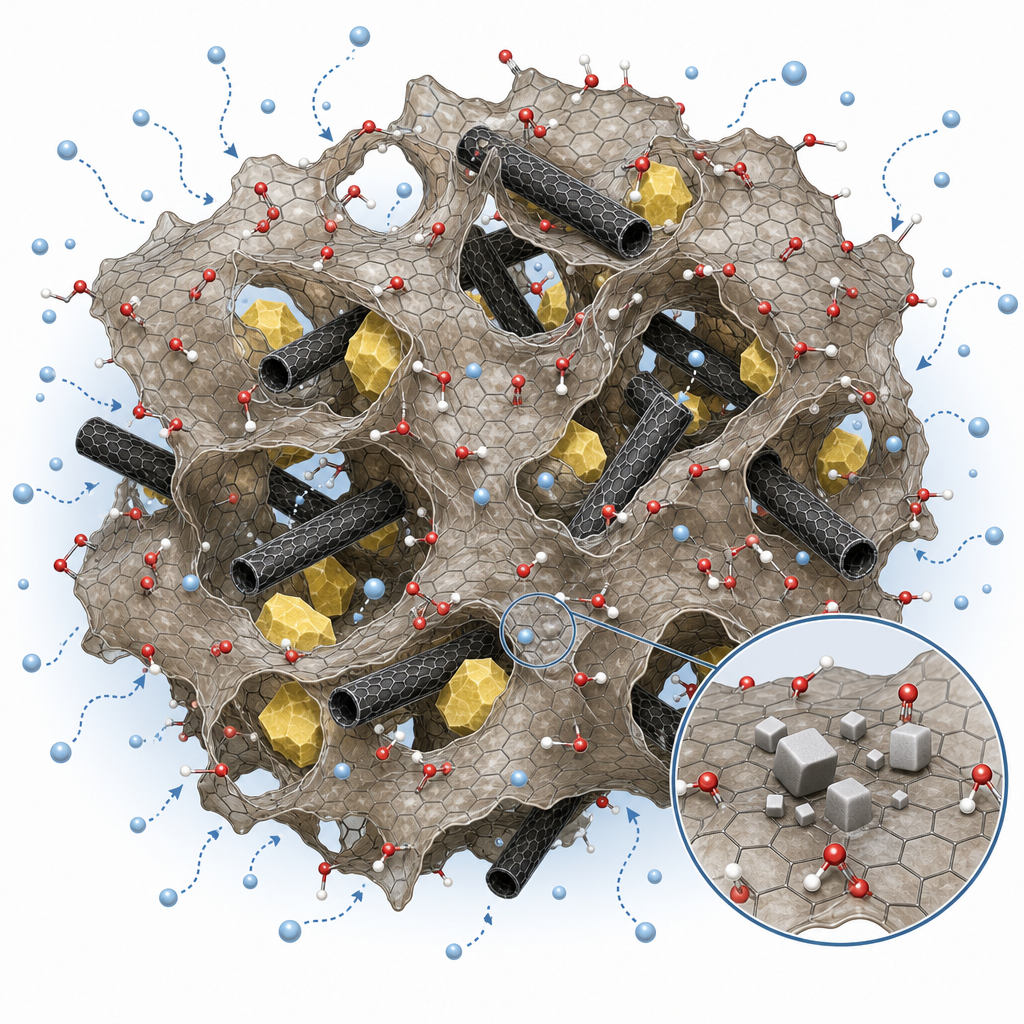
The ACS Material single-layer graphene oxide dispersion enters the synthesis as the 2D host scaffold. Per the published methods, 18 mL of the 10 mg/mL GO dispersion was diluted into 180 mL of water to give a 1 mg/mL suspension containing 180 mg GO. Cetyltrimethyl ammonium bromide (CTAB, 2.5 mmol) was added to electrostatically decorate the negatively charged GO sheets. A separately prepared sodium polysulfide (Na2Sx) solution was then mixed with the GO–CTAB suspension and stirred overnight, after which slow addition to 2 M formic acid acidified the system and precipitated sulfur in close contact with the GO sheets. A dispersion of OCSiAl carbon nanotubes (2 mg/mL with Triton X-100) was introduced as a conductive 1D filler. The wet composite was rinsed to neutral pH, frozen at −85 °C, and lyophilized; the freeze-drying step preserves a porous, low-density network instead of the dense filtrate cakes obtained from vacuum drying. A final 155 °C, 12 h Ar anneal redistributes sulfur. ACS Material's GO supplied the conformable, oxygen-functionalized 2D substrate on which this entire polysulfide-trapping architecture is built.
Electrochemical testing of the S–GO–CTA–CNT electrodes showed strong performance across multiple loading regimes. A 64 wt% S electrode at an areal loading of 11.5 mg/cm² (E/S ratio of 8) delivered stable voltage profiles, demonstrating that the freeze-dried porous network supports lithium-ion and electrolyte access even in thick cathodes. A 70 wt% S electrode at 2.3 mg/cm² (E/S = 45) showed the expected two-plateau S/Li2S voltage profile with sustained reversible capacity over cycling. Most importantly, a 70 wt% S electrode at 4.2 mg/cm² and a practical E/S ratio of 10 retained capacity over extended cycling — a combination of high loading and lean electrolyte that is rarely reported simultaneously. In situ graphene-liquid-cell TEM (using CVD graphene transferred onto Au Quantifoil grids) directly imaged Li2S crystal nucleation and growth on the composite between 118 s and 230 s of lithiation, and selected-area electron diffraction confirmed the crystalline Li2S end product. XPS deconvolution verified S–C and S–O bonding contributions from CTA-mediated GO functionalization, while TGA confirmed the sulfur contents reported for each electrode formulation.
The approach unlocks several application directions. High areal loading and lean electrolyte are prerequisites for cell-level energy densities above 400 Wh/kg, relevant to electric aviation, long-range EVs, and unmanned aerial systems where weight dominates design. The freeze-drying/CTAB chemistry is scalable and uses inexpensive precursors (Na2S, elemental S, formic acid, CTAB), making it amenable to roll-to-roll cathode manufacturing. The authors point to further work on the lithium-metal anode interface and on electrolyte formulations matched to the porous freeze-dried architecture, since at high loadings the anode and electrolyte — rather than the cathode — become the principal capacity-limiting components. The graphene-liquid-cell TEM methodology demonstrated here is also broadly transferable to other conversion-type battery chemistries.
For researchers working on Li/S cathodes, polysulfide-trapping hosts, or 2D-material composite electrodes, ACS Material's single-layer graphene oxide dispersion is available in the same 10 mg/mL aqueous format used in this study, alongside other graphene oxide grades and carbon nanotube products that map directly onto the precursors employed by the LBNL team. The paper provides a well-characterized template for reproducing the freeze-dried S–GO–CTA–CNT chemistry and for benchmarking alternative GO sources, surfactant systems, and conductive additives in high-loading lithium/sulfur cell development.How ACS Material products were used
- Single Layer Graphene Oxide Dispersion (10 mg/mL in water) (Graphene Series) — “18 mL of single layer graphene oxide dispersion (GO, ACS materials, 10 mg/mL) in water was diluted to form a GO suspension (180 mg of GO in 180 mL of ultrapure water).”
Product Performance in this StudyThe ACS Material single-layer graphene oxide dispersion served as the primary 2D scaffold for trapping sodium polysulfide and CTAB, ultimately producing a freeze-dried S–GO–CTA–CNT nanocomposite that enabled high sulfur loadings (up to 11.5 mg/cm²) and stable lithium/sulfur cycling.
Related product categories
Frequently asked questionsWhy use freeze-drying instead of vacuum drying for sulfur–graphene oxide cathodes?
Vacuum drying tends to collapse graphene oxide sheets into dense filtrate cakes that block electrolyte access in thick electrodes. Freeze-drying preserves a porous, low-density 3D network of GO and CNT around sulfur particles, which is essential for ion transport and accommodating sulfur volume changes at high areal loadings. In this LBNL study, freeze-drying enabled stable cycling at 11.5 mg/cm² sulfur loading, which is difficult to achieve with conventional drying methods.
What sulfur loading is needed for lithium-sulfur batteries to be commercially competitive?
Most academic Li/S cells operate at 1–2 mg/cm² of sulfur, which is too low for cell-level energy densities to surpass state-of-the-art lithium-ion. Practical Li/S batteries generally require sulfur loadings above 4–5 mg/cm² combined with lean electrolyte ratios (E/S ≤ 10) to reach the 400 Wh/kg targets relevant to EVs and electric aviation. This study demonstrated stable cycling at 4.2 mg/cm² with E/S = 10, and voltage profiles at 11.5 mg/cm².
How does graphene oxide trap polysulfides in lithium-sulfur batteries?
Graphene oxide sheets carry oxygen-containing functional groups (hydroxyl, carboxyl, epoxide) that chemically bind soluble lithium polysulfide intermediates and physically confine them within the carbon scaffold. In the LBNL cathode, single-layer GO from ACS Material was further functionalized via cetyltrimethyl ammonium (CTA) cation interactions, creating additional S–C and S–O bonding sites confirmed by XPS, which together suppress the polysulfide shuttle and improve cycle life.