-
Graphene Oxide for Li/S Battery Cathodes - LBNL, 2015
Jul 10, 2026 | ACS MATERIAL LLCSong, M., Zhang, Y., & Cairns, E. J. (2015). Effects of cell construction parameters on the performance of lithium/Sulfur cells. *AIChE Journal*. https://doi.org/10.1002/aic.14947
The Molecular Foundry, Lawrence Berkeley National Laboratory Berkeley CA 94720 · AIChE Journal · 2015
Lawrence Berkeley National Laboratory used ACS Material graphene oxide dispersion to build CTAB-modified S-GO cathodes delivering 787 mAh/g after 800 cycles.
About this research
Researchers at The Molecular Foundry, Lawrence Berkeley National Laboratory Berkeley CA 94720 used a commercial graphene oxide (GO) water dispersion supplied by ACS Material to construct lithium/sulfur (Li/S) cell cathodes that sustained 800 charge–discharge cycles while delivering 787 mAh/g of sulfur. The work, published in AIChE Journal in 2015 by Song, Zhang, and Cairns, combines a CTAB-modified sulfur–GO (S-GO) nanocomposite with a pyrrolidinium ionic-liquid electrolyte and an elastomeric SBR/CMC binder to simultaneously suppress polysulfide dissolution, mitigate the ~76% volume change of the sulfur conversion reaction, and preserve electrode mechanical integrity over long cycling.
Lithium/sulfur batteries are one of the few practical pathways to exceed the ~225 Wh/kg ceiling of current lithium-ion cells, with a theoretical specific energy of 2680 Wh/kg and a sulfur theoretical capacity of 1675 mAh/g. Their commercialization, however, is blocked by three interlinked degradation mechanisms: dissolution of intermediate lithium polysulfides into organic electrolytes, the polysulfide shuttle that passivates the Li metal anode with insulating Li2S, and the large volumetric expansion/contraction during the S ↔ Li2S conversion. Approaches that address only one of these problems rarely achieve long cycle life at practical sulfur loadings. This paper is significant because it tackles all three mechanisms together at the active material, electrolyte, and binder level, providing a design template for high-energy rechargeable batteries aimed at electric vehicles and grid-scale storage.
The ACS Material graphene oxide dispersion (10 mg/mL) supplied the GO scaffold for the cathode active material. The team prepared a GO suspension by diluting 180 mg of the dispersion into 180 mL of ultrapure water, then added cetyltrimethyl ammonium bromide (CTAB) and a sodium polysulfide solution. Acidification with formic acid precipitated elemental sulfur directly onto the GO sheets, after which the composite was washed, vacuum-dried, and heat-treated at 155 °C under flowing argon. Oxygen-containing functional groups native to the GO provide weak chemical binding sites for sulfur and polysulfides, immobilizing them on the conductive carbon network during cycling. SEM and EDS confirmed a thin, conformal sulfur coating uniformly distributed on the GO, while TGA established sulfur contents up to 80 wt% in the final composite. The S-GO composite was then mixed with Super C65 carbon black and binder (PVDF or SBR/CMC) at 70:20:10, cast onto aluminum foil with a doctor blade, and assembled into CR2035 coin cells.
The electrochemical results validate each design choice. Four electrolyte formulations based on 1 M LiTFSI were compared; the optimized 1 M LiTFSI in PYR14TFSI/DOL/DME (2:1:1 v/v/v) with 0.1 M LiNO3 additive produced the best balance of polysulfide-shuttle suppression and rate capability, supporting cycling up to 2 C. Replacing the rigid PVDF binder (Young's modulus 2000–2900 MPa) with elastomeric SBR/CMC (2–10 MPa, elongation 250–700%) eliminated the early capacity fade observed with PVDF and reduced charge-transfer impedance after 100 cycles. With an 80 wt% sulfur composite (sulfur loading 0.6 mg/cm²) and the SBR/CMC binder, the cell delivered roughly 787 mAh/g of sulfur (~441 mAh/g of total electrode mixture, 0.47 mAh/cm²) at 0.05 C even after 800 cycles, with a capacity decay rate of only 0.062% per cycle at 1 C and coulombic efficiency of 95.9%. Notably, no lithium-dendrite shorting occurred over 800 cycles, suggesting that the PYR14TFSI ionic liquid also forms a protective surface film on the Li metal anode.
The results have direct implications for next-generation energy storage. By demonstrating that a graphene-oxide–anchored sulfur cathode can be paired with an ionic-liquid–based electrolyte and an elastomeric binder to deliver hundreds of stable cycles at high sulfur content, the study points toward Li/S cells suitable for electric vehicles, hybrid powertrains, and high-specific-energy electronics. Follow-up directions noted by the authors include further increasing sulfur loading and sulfur content beyond 80 wt%, optimizing LiNO3 concentration, and reducing the volume fraction of ionic liquid to lower cost. The compatibility of GO with diverse functionalization strategies also makes it a flexible platform for related conversion-type cathodes such as Li2S, selenium, and metal sulfides.
For researchers working on Li/S, Na/S, Li-air, or other conversion-chemistry batteries, this paper underscores the value of starting with a well-dispersed, reactive graphene oxide source. The graphene oxide water dispersion used here is available from ACS Material's graphene series, along with related products including single-layer GO flakes, large-size GO, and reduced graphene oxide. Selecting a GO with controlled flake size, oxidation level, and dispersion stability simplifies downstream sulfur loading and reproducibility, and is one practical step researchers can take to translate the cycling improvements reported in this study into their own electrode formulations.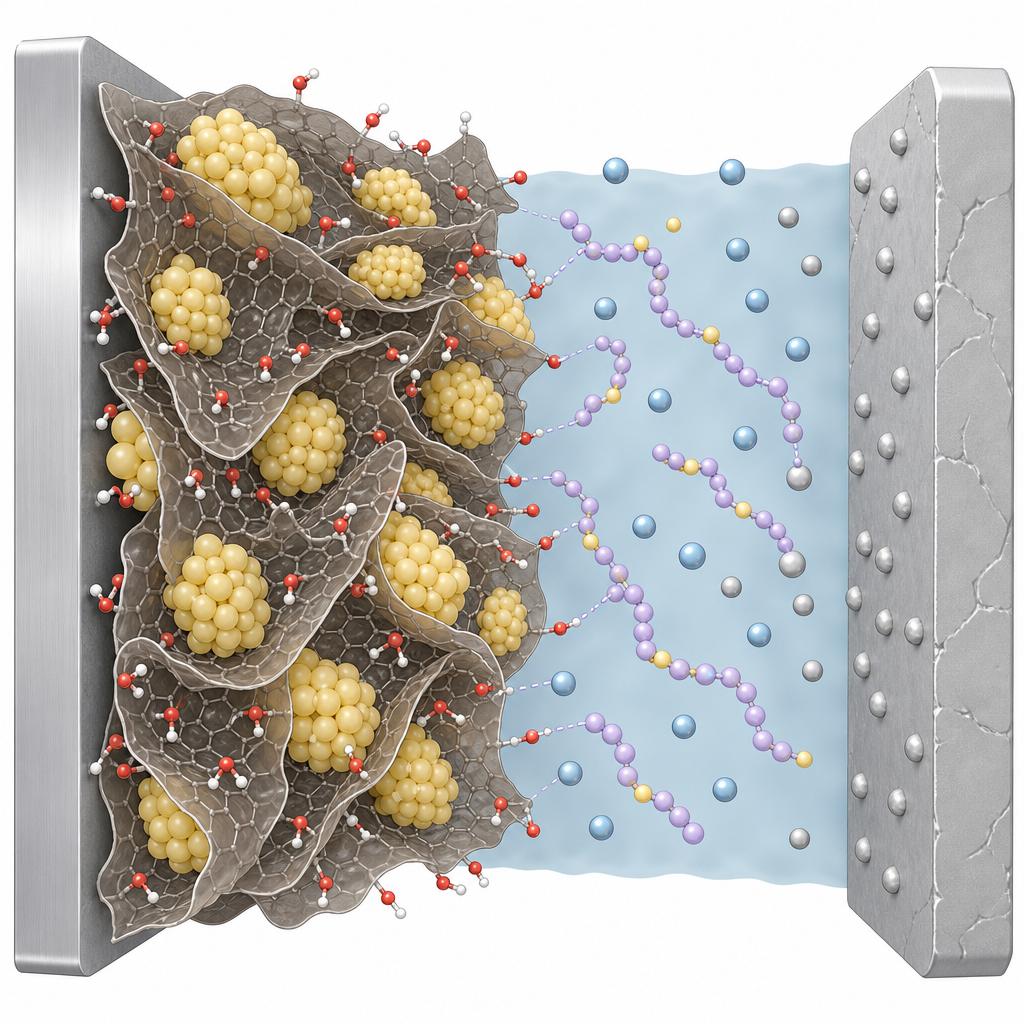
How ACS Material products were used
- Graphene Oxide Water Dispersion (10 mg/mL) (Graphene Series) — “Commercial GO–water dispersion (10 mg/mL, ACS Material) was used to form a GO suspension (180 mg of GO in 180 mL of ultrapure water).”
Product Performance in this Study
The ACS Material graphene oxide dispersion served as the sulfur immobilizer scaffold. Its oxygen-containing functional groups, combined with CTAB modification, bound polysulfides and enabled an 80 wt% sulfur composite that delivered 787 mAh/g after 800 cycles.
Related product categories
Frequently asked questions
How does graphene oxide improve lithium/sulfur battery cycle life?
Graphene oxide carries oxygen-containing functional groups such as hydroxyl, epoxy, and carboxyl that weakly bind elemental sulfur and dissolved lithium polysulfides. Sulfur deposited on GO sheets stays anchored on the conductive carbon network during charge–discharge, reducing the polysulfide shuttle. In this LBNL study, GO combined with CTAB modification, an ionic-liquid electrolyte, and an SBR/CMC binder enabled 800 cycles at 787 mAh/g of sulfur.
Why is an ionic-liquid electrolyte used in Li/S cells?
Conventional ether electrolytes dissolve lithium polysulfides readily, accelerating active-material loss and polysulfide shuttle. The pyrrolidinium ionic liquid PYR14TFSI exhibits much lower polysulfide solubility while remaining ionically conductive. Mixing it with DOL/DME and adding LiNO3 maintains low solubility for polysulfides yet keeps charge-transfer kinetics fast, enabling rate capability up to 2 C and stable cycling for hundreds of cycles.
What sulfur loading is needed for practical Li/S batteries?
To compete with commercial lithium-ion cells, the sulfur content of the cathode composite generally must exceed 70 wt%, with areal loadings in the multi-mg/cm² range. This study used 80 wt% sulfur in the S-GO composite at 0.6 mg/cm² and noted that further increases in sulfur content and loading, combined with thicker electrodes, are required to deliver the specific energy targets demanded by electric-vehicle applications.