-
Graphene Oxide for Li–S Battery Cathodes - University of California, 2016
Jun 09, 2026 | ACS MATERIAL LLCFrischmann, P. D. et al. (2016). Redox-Active Supramolecular Polymer Binders for Lithium–Sulfur Batteries That Adapt Their Transport Properties in Operando. *Chemistry of Materials*. https://doi.org/10.1021/acs.chemmater.6b03013
University of California · Chemistry of Materials · 2016
UC Berkeley team uses ACS Material graphene oxide to build sulfur–GO cathodes paired with PBI/PVDF binders, delivering high-rate Li–S battery performance.
About this research
Researchers at the University of California, working through Lawrence Berkeley National Laboratory's Joint Center for Energy Storage Research, employed single-layer graphene oxide from ACS Material as the structural scaffold for a high-performance lithium–sulfur battery cathode that combined a sulfur–graphene oxide (S–GO) nanocomposite with a redox-active perylene bisimide (PBI) supramolecular polymer binder. The headline result is a PBI/PVDF blended-binder cathode that sustained 700 mAh g⁻¹ of sulfur at 1.0 C with 86% capacity retention after 150 cycles and Coulombic efficiency above 99.8%, while in-operando electrochemical activation of the PBI network dramatically reduced cell impedance during cycling.
Lithium–sulfur cells are among the most attractive next-generation battery chemistries because sulfur offers a theoretical capacity of 1675 mAh g⁻¹—roughly six times that of LiCoO2—at very low cost and with low environmental impact. However, practical Li–S cells suffer from poor electronic and ionic transport in the sulfur cathode, polysulfide dissolution, and large volume changes during the S8↔Li2S conversion. Conventional binders such as polyvinylidene difluoride (PVDF) are passive and can block pores of conductive carbons, limiting Li2S deposition sites and undermining high-rate performance. The field has therefore searched for binders that are mechanically robust, polysulfide-trapping, and ideally electrochemically active. This paper addresses that need by introducing a supramolecular, redox-mediating binder that adapts its transport properties in operando.
The ACS Material single-layer graphene oxide dispersion (10 mg mL⁻¹ in water) was central to the active material preparation. Following a published method, 180 mg of GO was suspended in ultrapure water, treated with 2.5 mM cetyltrimethyl ammonium bromide (CTAB), and then mixed with a sodium polysulfide solution. Acidification with 2.0 M formic acid precipitated elemental sulfur onto the GO sheets, yielding a CTAB-modified S–GO nanocomposite containing approximately 80 wt% sulfur after vacuum drying and a 155 °C heat treatment under argon. The S–GO was then formulated with Ketjenblack conductive carbon and one of three binders—PBI nanowire networks, PVDF, or a 1:1 PBI/PVDF blend—at an 8:1:1 weight ratio in N-methyl-2-pyrrolidinone. The slurry was doctor-bladed onto aluminum foil at sulfur loadings of 0.8–1.0 mg cm⁻². The graphene oxide thus functioned as the conductive, polysulfide-anchoring 2D substrate that hosted the sulfur active material throughout cycling.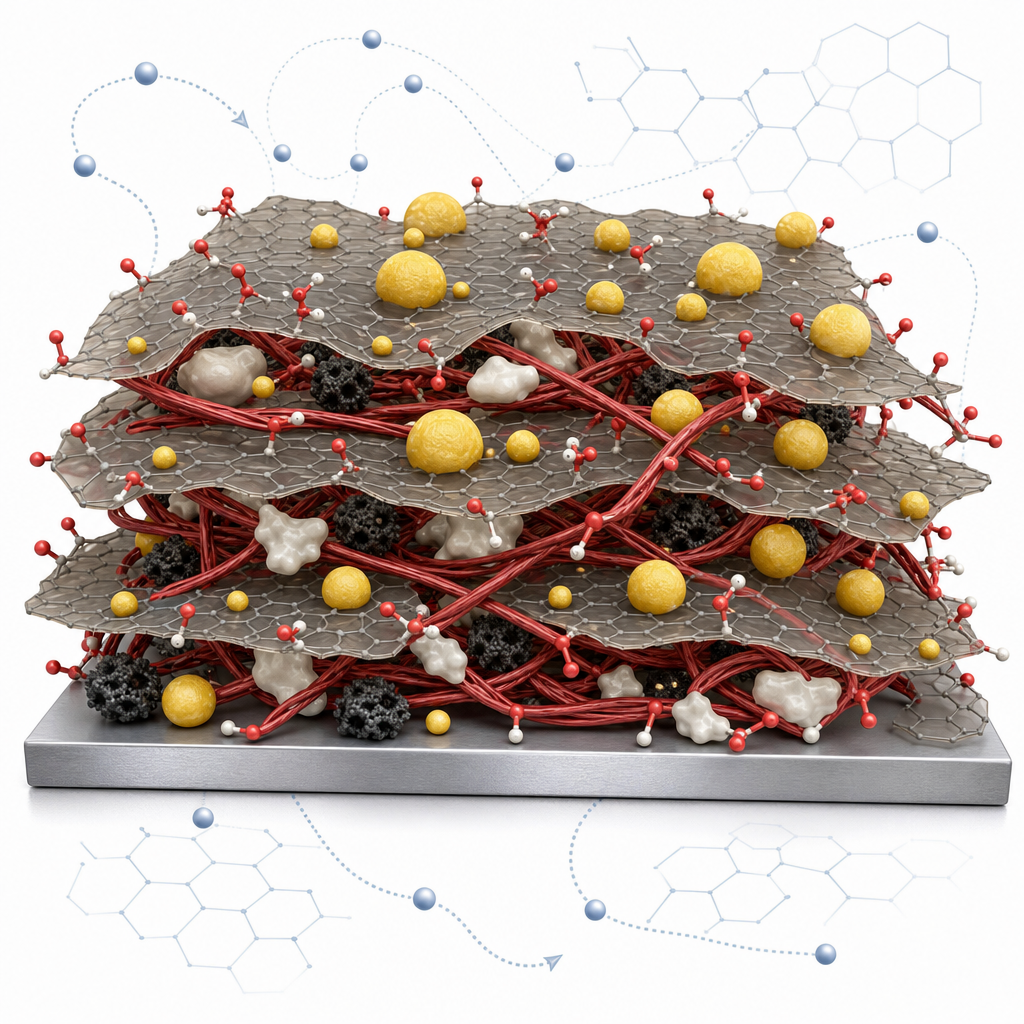
Electrochemical characterization revealed clear advantages from the redox-active binder strategy enabled by the S–GO scaffold. Cyclic voltammetry showed that the PBI/PVDF cathode exhibited the lowest overpotential, with sharp cathodic peaks at 2.3 V and 2.0 V and an anodic peak at 2.55 V, indicating fast sulfur redox kinetics. At 1.0 C discharge, the PBI cathode delivered 582 mAh g⁻¹ versus only 323 mAh g⁻¹ for the PVDF cathode, while the PBI/PVDF blend achieved the highest specific capacity of 700 mAh g⁻¹. In rate-capability tests from 0.1 C to 3.0 C, the PBI/PVDF cathode retained roughly 800 and 350 mAh g⁻¹ at 1.0 C and 3.0 C respectively and recovered to 1066 mAh g⁻¹ when returned to 0.1 C. Over 150 cycles at 1.0 C, the PBI/PVDF cathode held 600 mAh g⁻¹ (86% retention) with Coulombic efficiency above 99.8%. Galvanostatic intermittent titration showed the lowest polarization overpotentials for the PBI/PVDF blend, and electrochemical impedance spectroscopy demonstrated that once the PBI binder was electrochemically reduced near 2.5 V vs Li/Li⁺, the cell impedance dropped sharply and remained low—an in-operando activation that the authors attribute to complementary coordination of Li⁺ to reduced Li2-PBI and TFSI⁻ to PVDF microdomains.
The study provides a blueprint for designing high-power Li–S cells suitable for electric vehicles and aviation, where high specific energy and high rate must coexist. More broadly, the work demonstrates that 2D graphene oxide can be combined with supramolecular redox mediators to relieve transport bottlenecks in conversion-type electrodes. The same concept of redox-active supramolecular binders may be extended to silicon anodes and other high-capacity materials that undergo significant volume changes during cycling. Future directions highlighted by the authors include exploring additional redox-mediating polycyclic aromatics, optimizing binder microstructure, and engineering binder–electrolyte ion-coordination synergies.
For researchers working on lithium–sulfur batteries, sulfur–carbon hybrid cathodes, or 2D-material-based energy storage devices, the single-layer graphene oxide dispersion used here is available from ACS Material in dispersion, powder, and flake forms. Its reproducible exfoliation quality is well-suited to the construction of S–GO nanocomposites and other conversion-electrode architectures where uniform 2D substrates anchor active redox species. The paper's results demonstrate how careful pairing of a well-characterized graphene oxide source with adaptive binders can unlock measurable gains in rate capability and cycle life.How ACS Material products were used
- Single Layer Graphene Oxide Dispersion (Graphene Series) — “Graphene oxide (ACS Material) ... 18 mL of single layer graphene oxide dispersion (GO, 10 mg mL–1) in water was diluted to form a GO suspension”
Product Performance in this StudyThe ACS Material single-layer graphene oxide dispersion served as the scaffold for the CTAB-modified sulfur–graphene oxide (S–GO) nanocomposite that constituted the active cathode material. The GO supported uniform sulfur deposition and contributed to the high sulfur loading (80 wt%) and the high-rate Li–S cell performance demonstrated in this work.
Related product categories
Frequently asked questionsHow does graphene oxide improve lithium–sulfur battery cathode performance?
Graphene oxide provides a conductive two-dimensional scaffold that anchors elemental sulfur and traps soluble polysulfides through oxygen-containing surface groups. In this study, single-layer graphene oxide from ACS Material was used to form a CTAB-modified S–GO nanocomposite with 80 wt% sulfur, enabling uniform sulfur distribution, suppressed polysulfide shuttling, and high-rate cycling at 1.0 C with 86% capacity retention over 150 cycles.
What is a redox-active supramolecular binder in a Li–S battery?
A redox-active supramolecular binder is a self-assembled polymer network—here based on π-stacked perylene bisimide (PBI)—that not only holds active material together but also participates in the cathode redox chemistry. PBI is reversibly reduced near 2.5 V vs Li/Li⁺, generating Li2-PBI that mediates charge transfer to polysulfides and lowers cell impedance in operando.
Why combine PBI with PVDF binder in sulfur cathodes?
PVDF coordinates TFSI⁻ anions through its fluorine groups while PBI²⁻ coordinates Li⁺ cations through its carbonyls. This complementary ion coordination improves charge separation and ionic mobility within the composite cathode. The PBI/PVDF blend delivered the highest specific capacity (700 mAh g⁻¹ S at 1.0 C), best rate capability, and lowest sustained impedance among the binders tested.