-
Graphene Oxide for Li/S Battery Cathodes - USTC, 2016
Jul 09, 2026 | ACS MATERIAL LLCYe, Y. et al. (2016). X-Ray Absorption Spectroscopy Characterization of a Li/S Cell. *Nanomaterials*. https://doi.org/10.3390/nano6010014
University of Science and Technology of China · Nanomaterials · 2016
Researchers at USTC used ACS Material graphene oxide dispersion in CTAB-modified Li/S cathodes and probed degradation with S K-edge XAS over 1500 cycles.
About this research
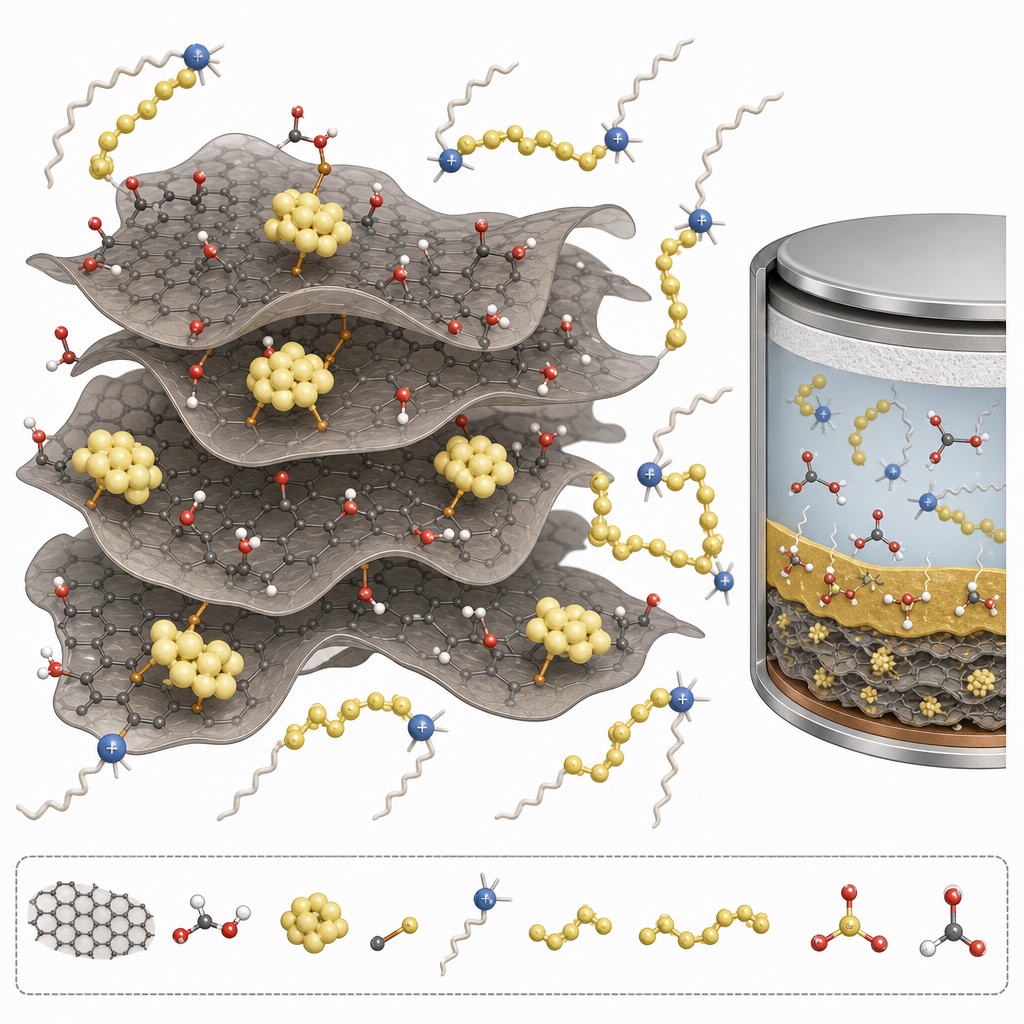
Researchers led by the University of Science and Technology of China, working with Lawrence Berkeley National Laboratory's Advanced Light Source, used ACS Material graphene oxide (GO) dispersion to fabricate CTAB-modified sulfur–graphene oxide (S-GO) cathodes for rechargeable lithium/sulfur (Li/S) cells and characterized them at every life-cycle stage using S K-edge and C K-edge X-ray absorption spectroscopy (XAS). The study, published in Nanomaterials, identifies how the surfactant cetyltrimethylammonium bromide (CTAB) reshapes polysulfide chemistry during synthesis and resolves the chemical origin of capacity fade in cells cycled up to 1500 times. The authors also introduce two in-situ/in-operando cell designs (a modified coin cell and a vacuum-compatible three-electrode cell) for soft- and tender-X-ray studies of Li/S electrochemistry.
Li/S batteries are attractive for electric vehicles and grid storage because elemental sulfur offers a theoretical specific capacity of 1675 mA·h/g, far above conventional intercalation cathodes. However, sulfur's low electronic conductivity, ~76% volume expansion on lithiation, and the notorious polysulfide shuttle effect cause rapid capacity decay and limit practical adoption. Hosting sulfur inside conductive carbon scaffolds (porous carbon spheres, hollow carbon, carbon nanofibers, and graphene oxide) is the leading mitigation strategy, with surface modifiers such as CTAB further suppressing polysulfide dissolution. Yet the chemical bonding evolution between sulfur, the GO scaffold, and the CTAB modifier across synthesis and long-term cycling has remained poorly resolved, blocking rational cathode optimization. Element-specific XAS, sensitive to oxidation state and local coordination, fills exactly this gap.
The ACS Material graphene oxide dispersion was the conductive host for the active sulfur. As described in the Experimental Section, "18 mL GO dispersed in water (10 mg/mL, ACS Material, Medford, MA, USA) was diluted in 162 mL ultrapure water to make the GO suspension." The GO suspension was combined with CTAB and a Na2Sx polysulfide solution, then acidified with formic acid to precipitate CTAB-S-GO nanocomposites. After vacuum drying at 50 °C for 24 h, the composite was heated at 155 °C for 12 h under flowing Ar to convert the precursor into C–S bonded active material. The composite was paired with SBR/CMC binder and a PYR14TFSI/DOL/DME/0.1 M LiNO3 electrolyte, then cycled at 1 C discharge / 0.25 C charge. The aqueous GO dispersion delivered high carrier mobility, large surface area, and oxygen functional groups that allowed formation of C–S linkages anchoring sulfur to the carbon scaffold during heat treatment.
S K-edge XAS on the Na2Sx solutions revealed that CTAB shifts the polysulfide chain-length distribution: the terminal/internal sulfur peak intensity ratio rose from 3.84 (Na2Sx alone) to 6.49 with CTAB, corresponding to chain lengths of x ≈ 4.7 and 6.1 respectively. The terminal-S signal dropped by ~50% while internal-S decreased only to ~90%, consistent with CTA+ cations binding the negatively charged chain ends and steering the precipitation pathway toward C–S bonded products (peak at 2473.7 eV) after 155 °C annealing. For cycled cathodes, S K-edge spectra showed progressive loss of S–S (2472.2 eV) and C–S (2473.7 eV) active species and growth of insulating SO3^2- (2478.0 eV), COSO2^- (2480.5 eV), and SO4^2- (2482.3 eV) peaks. The surface-sensitive TEY channel showed a much higher S–O / S–S ratio than bulk-sensitive TFY, demonstrating that the insulating SEI accumulates preferentially at the cathode–electrolyte interface. C K-edge XAS independently captured the loss of the GO σ* feature at 292.0 eV and growth of CO3^2- signatures, again surface-segregated. The insulating layer grew rapidly within the first ~500 cycles then plateaued, while active S loss continued at a roughly constant rate through 1500 cycles, identifying two distinct capacity-fade pathways.
These mechanistic insights directly inform cathode design for next-generation Li/S batteries, including electric-vehicle traction batteries that need both high specific energy and long cycle life. By distinguishing surface SEI accumulation from bulk active-sulfur loss, the work points toward interface-engineering strategies (artificial SEI layers, electrolyte additives, modified binders) as complementary to host-structure design. The vacuum-compatible three-electrode cell with a 100 nm Si3N4 window also enables soft-X-ray operando studies that were previously limited to solid-electrolyte systems, broadening characterization options for Li-ion, Li/S, and emerging Mg-ion chemistries. Future work will likely combine GO-based hosts with 3d-transition-metal additives, since metal L-edge XAS can resolve their electronic interactions with sulfur.
For researchers building sulfur cathodes, polysulfide-trapping composites, or graphene-based energy materials, the aqueous graphene oxide dispersion supplied by ACS Material is available in the Graphene Series catalog at concentrations and flake sizes suitable for wet-chemistry sulfur loading and surfactant-assisted synthesis. The reproducibility demonstrated in this XAS study, where GO oxygen functional groups participate in well-defined C–S bond formation, makes this grade a useful starting material for groups working on Li/S cells, supercapacitor electrodes, and other graphene-oxide-templated nanocomposites.How ACS Material products were used
- Graphene Oxide Dispersion in Water (10 mg/mL) (Graphene Series) — “18 mL GO dispersed in water (10 mg/mL, ACS Material, Medford, MA, USA) was diluted in 162 mL ultrapure water to make the GO suspension.”
Product Performance in this Study
The ACS Material aqueous graphene oxide dispersion served as the conductive scaffold for sulfur immobilization in the CTAB-modified S-GO cathode, which previously demonstrated up to 1500 charge/discharge cycles with a low decay rate of 0.039% per cycle. XAS confirmed that GO's oxygen-containing functional groups participated in C–S bond formation that helps anchor active sulfur.
Related product categories
Frequently asked questions
How does graphene oxide improve lithium/sulfur battery cathodes?
Graphene oxide acts as a conductive, high-surface-area host that immobilizes sulfur through its oxygen-containing functional groups. During heat treatment these groups form C–S covalent bonds, anchoring active sulfur and suppressing the polysulfide shuttle. The work referenced here used ACS Material aqueous GO dispersion to build CTAB-modified S-GO cathodes that previously delivered up to 1500 charge/discharge cycles with a capacity decay rate of only 0.039% per cycle.
What causes capacity fade in cycled Li/S cells?
S K-edge and C K-edge X-ray absorption spectroscopy on cathodes cycled 0, 500, and 1500 times revealed two parallel mechanisms. First, an insulating layer of SO3^2-, SO4^2-, and CO3^2- species accumulates rapidly during the first few hundred cycles at the cathode–electrolyte interface, blocking Li-ion diffusion. Second, the active S–S and C–S species are progressively lost throughout cycling, depleting the electrochemically available sulfur.
Why is CTAB added during S-GO cathode synthesis?
CTAB (cetyltrimethylammonium bromide) interacts with the terminal sulfur atoms of polysulfide chains in Na2Sx solution. XAS shows the terminal-to-internal S peak ratio shifts from 3.84 to 6.49 with CTAB, corresponding to longer polysulfide chains (x ≈ 4.7 to 6.1). This alters the precipitation pathway and yields S species that, after annealing at 155 °C, form stable C–S bonds with the graphene oxide host, improving sulfur immobilization.