-
Graphene Oxide for Pt Methanol Oxidation Catalyst - University of Wisconsin-Milwaukee, 2015
Jun 25, 2026 | ACS MATERIAL LLCHuang, T. et al. (2015). A high-Performance catalyst support for methanol oxidation with graphene and vanadium carbonitride. *Nanoscale*. https://doi.org/10.1039/c4nr05244g
Nanoscale · 2015
Researchers at the University of Wisconsin-Milwaukee used ACS Material graphene oxide to build a Pt/G–V(C,N) catalyst that outperforms commercial Pt/C in DMFCs.
About this research
Researchers at the University of Wisconsin-Milwaukee, working with collaborators at the University of Jinan, used graphene oxide supplied by ACS Material to construct a graphene–vanadium carbonitride (G–V(C,N)) hybrid that serves as a high-performance platinum catalyst support for methanol oxidation. Reported in Nanoscale (2015), the resulting Pt/G–V(C,N) catalyst delivered substantially higher catalytic activity for methanol electro-oxidation than a commercial carbon-black-supported Pt/C catalyst tested under identical conditions. The study demonstrates how pairing two-dimensional graphene with a transition metal carbonitride can simultaneously address the corrosion, agglomeration, and CO-poisoning issues that have long limited carbon-supported precious metal catalysts in direct methanol fuel cells.
Direct methanol fuel cells (DMFCs) are attractive power sources for portable electronics and transportation thanks to their high energy density, low operating temperature, and clean operation. Their broad commercialization, however, is held back by sluggish anode kinetics and the high loadings of platinum required to drive methanol oxidation. Traditional carbon-black supports such as Vulcan XC-72 are inexpensive and conductive, but they corrode under sustained electrochemical operation, releasing CO species that poison Pt and allowing Pt nanoparticles to agglomerate and lose active surface area. Transition metal carbides and nitrides have emerged as promising replacements because of their electronic conductivity, corrosion resistance, and synergistic interactions with Pt. Combining them with graphene further increases surface area, electron-transfer rates, and metal-support coupling, all of which are central to the fuel-cell catalyst community's effort to reduce Pt loading without sacrificing performance.
The ACS Material graphene oxide dispersion (10 mg mL⁻¹ in deionized water) was used directly as the 2D carbon scaffold for catalyst synthesis. In a typical preparation, 0.2 g of VCl3 was mixed with 8.0 mL of the GO dispersion under ultrasonication for 30 minutes, then transferred to a hydrothermal reactor and held at 200 °C for 8 hours to deposit V2O3 onto the graphene sheets. After washing and vacuum drying at 80 °C, the GO–V2O3 intermediate was annealed at 1000 °C under an ammonia flow (0.5 L min⁻¹) for 2 hours, which simultaneously reduced the graphene oxide and converted V2O3 to the vanadium carbonitride phase, yielding the G–V(C,N) support. Platinum (10 wt%) was then deposited on the support by reducing H2PtCl6 with ethylene glycol at 60 °C under sonication, followed by a final 400 °C annealing step. The graphene oxide thus functions as both a structural template and a carbon reservoir feeding the carbonitride formation.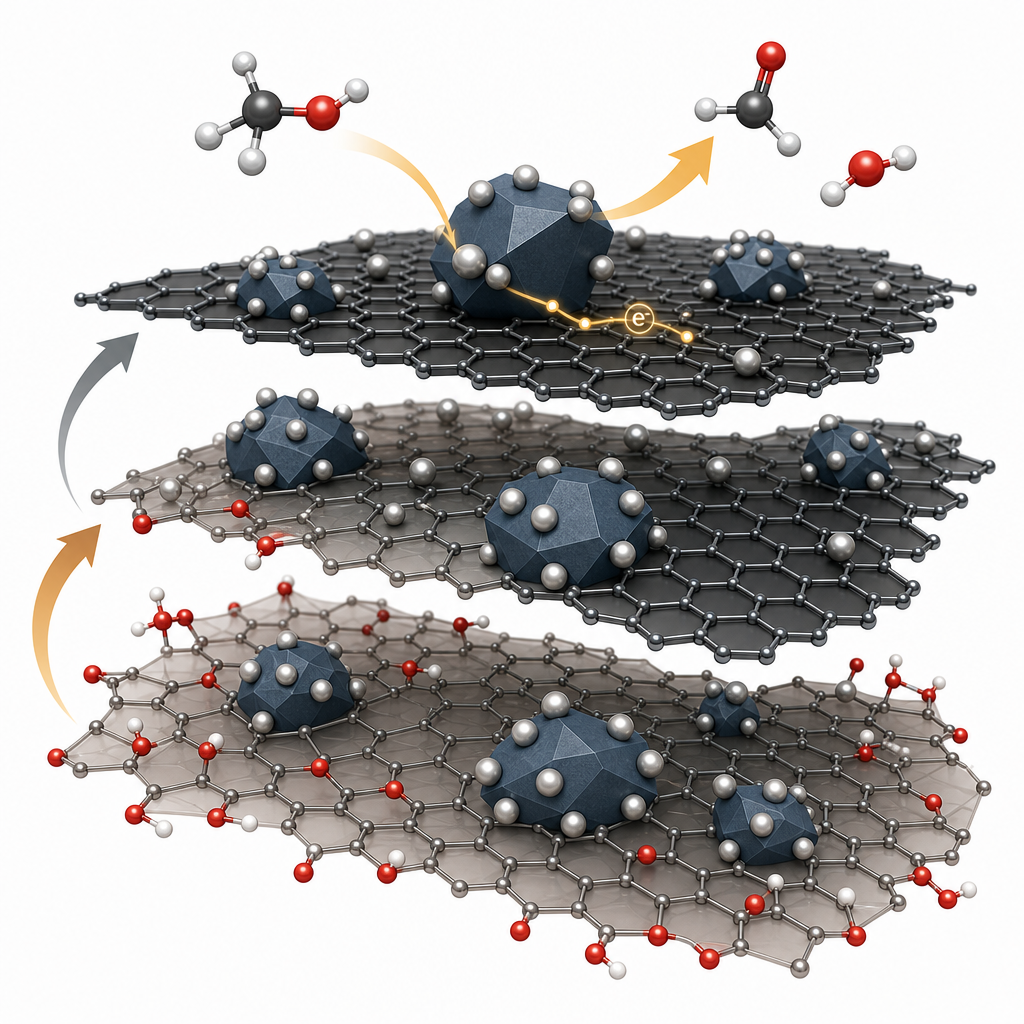
The Pt/G–V(C,N) hybrid was characterized by TEM, SEM, EDS elemental mapping, SAED, XRD, XPS, Raman, and DSC. ICP-AES confirmed compositions of approximately 10 wt% Pt, 35.3 wt% V, and 9.1 wt% N. Electrochemical testing was conducted in 1 M KOH using a three-electrode CHI 760E workstation with a glassy-carbon working electrode (3 mm diameter, 0.07 cm² area). Cyclic voltammograms collected at sweep rates between 5 and 100 mV s⁻¹ and methanol concentrations from 0.1 to 2.0 M showed that the Pt/G–V(C,N) catalyst produced markedly higher methanol oxidation current densities than the commercial 10 wt% Pt/C reference run under the same conditions. The combined graphene–carbonitride support also exhibited a lower onset potential and improved stability, consistent with stronger Pt–support interaction, suppressed CO intermediates, and a higher electrochemical surface area than carbon black alone could provide. Supporting information further documented Pt nanoparticle dispersion on the G–V(C,N) sheets and the structural integrity of the hybrid after annealing.
The results point to graphene–metal carbonitride hybrids as practical replacements for carbon black in DMFC anodes, where corrosion-induced Pt loss is a leading degradation pathway. The same synthesis strategy can be extended to other transition metal carbonitrides (Mo, W, Ti) and to bimetallic Pt-based alloys, supporting research on low-Pt-loading anodes, alkaline fuel cells, and electrocatalysts for related small-molecule oxidations such as ethanol, formic acid, and urea. The high N and V content also suggests utility in oxygen reduction electrocatalysis on the cathode side, opening a route to integrated bifunctional fuel-cell electrodes.
For researchers pursuing similar work, the graphene oxide aqueous dispersion used here is part of ACS Material's graphene product line, alongside reduced graphene oxide, single-layer graphene oxide powder, and large-flake GO grades suitable for hydrothermal and solvothermal nanocomposite synthesis. The reproducibility of the Pt/G–V(C,N) preparation depends strongly on the GO concentration, flake size, and oxidation level, so a consistent, well-characterized GO source is important for groups translating this catalyst chemistry to scaled DMFC testing.How ACS Material products were used
- Graphene Oxide Dispersion (10 mg/mL in DI water) (Graphene Series) — “8.0 ml graphene oxide (GO) (10 mg ml−1 in DI water, ACS Materials) were mixed with ultra-sonication for thirty minutes”
Product Performance in this StudyThe ACS Material graphene oxide dispersion served as the 2D carbon scaffold for hydrothermal growth of V2O3, which was subsequently nitrided to form the graphene–vanadium carbonitride (G–V(C,N)) hybrid support. The graphene component provided high surface area and electrical conductivity essential to the Pt/G–V(C,N) catalyst's enhanced methanol oxidation activity over commercial Pt/C.
Related product categories
Frequently asked questionsWhy use graphene oxide as a starting material for fuel cell catalyst supports?
Graphene oxide provides a 2D, high-surface-area, oxygen-rich scaffold that can be uniformly decorated with metal precursors in aqueous suspension. Upon thermal or chemical reduction it becomes electrically conductive graphene, which improves charge transport to Pt nanoparticles. The oxygen functional groups also anchor metal species so that subsequent annealing under reactive atmospheres yields well-dispersed carbide, nitride, or carbonitride phases on the graphene sheets.
How does vanadium carbonitride improve Pt-catalyzed methanol oxidation?
Vanadium carbonitride V(C,N) interacts electronically with Pt through metal–support coupling, which weakens the binding of CO intermediates that otherwise poison Pt during methanol oxidation. The carbide and nitride anions also help activate water at lower potentials, supplying oxygen species needed to oxidize adsorbed CO to CO2. Together with the conductive graphene backbone this raises both activity and durability relative to carbon-black-supported Pt/C catalysts.
What grade of graphene oxide is suitable for hydrothermal catalyst synthesis?
A well-exfoliated aqueous graphene oxide dispersion in the 5–10 mg mL⁻¹ range, with predominantly single-layer flakes and a high oxygen content, works well for hydrothermal deposition of metal oxides and subsequent conversion to carbides or nitrides. The dispersion used in this study was a 10 mg mL⁻¹ aqueous GO from ACS Material, which provided stable colloidal behavior throughout the 200 °C hydrothermal step needed to grow V2O3 on the graphene sheets.