-
Graphene Oxide for SnO2@SnS2 Li-ion Anodes - Louisiana State University, 2015
Jun 11, 2026 | ACS MATERIAL LLCXu, W. et al. (2015). Hierarchical Graphene-Encapsulated Hollow SnO2@SnS2 Nanostructures with Enhanced Lithium Storage Capability. *ACS Applied Materials & Interfaces*. https://doi.org/10.1021/acsami.5b06765
Louisiana State University · ACS Applied Materials & Interfaces · 2015
Louisiana State University researchers used ACS Material graphene oxide dispersion to build SnO2@SnS2@rGO hollow-sphere anodes delivering 583 mAh/g after 100 cycles.
About this research
Researchers at Louisiana State University, working with collaborators at Wuhan University of Technology, used a graphene oxide (GO) dispersion supplied by ACS Material, LLC to build hierarchical graphene-encapsulated hollow SnO2@SnS2 nanostructures that retain 583 mAh/g after 100 charge-discharge cycles at 200 mA/g as a lithium-ion battery anode. The hollow tin oxide cores were first prepared hydrothermally, then sulfurized to grow SnS2 nanosheets on the shells, and finally co-assembled with the ACS Material GO dispersion before reduction to rGO. The resulting SnO2@SnS2@rGO architecture combined the high theoretical capacity of SnO2 with the layered stability of SnS2 and the conductivity of rGO.
Why this research matters. Tin oxide and tin sulfide are attractive lithium-ion anode candidates because their theoretical capacities (around 782 mAh/g for SnO2 and 650 mAh/g for SnS2) far exceed the 372 mAh/g of commercial graphite anodes. The persistent obstacle is mechanical: tin-based anodes can swell up to ~250% during lithiation, leading to pulverization, delamination, and rapid capacity fade within tens of cycles. The field has therefore explored hollow nanostructures, layered sulfides, and carbon coatings to absorb stress and maintain electrical connectivity. A composite that simultaneously couples these three strategies—an inner void, a sulfide buffer, and a conductive graphene wrap—addresses the limitation in a way that is directly relevant to next-generation high-energy-density lithium-ion cells used in portable electronics and electric mobility.
How the ACS Material product was used. The authors used a 5 mL aliquot of GO dispersion colloid from ACS Material, LLC at 6 mol/L during the solvothermal step that grew SnS2 nanosheets onto preformed SnO2 hollow spheres. Specifically, 0.28 g of SnO2 hollow spheres were dispersed in 30 mL of isopropyl alcohol by sonication, after which 1.8 g of urea and the ACS Material GO dispersion were added; the mixture was sealed in a Teflon-lined autoclave and heated at 180 °C for 36 h. The light black product was then reduced in 100 mL of 10 mmol/L hydrazine hydrate solution for about three hours, converting the GO sheets to rGO that wrapped around each SnS2-coated hollow sphere. SEM, TEM, HRTEM, and EDS mapping confirmed that every SnO2@SnS2 sphere was fully encapsulated in an amorphous rGO film, while thermogravimetric analysis quantified the composite as 56 wt% SnS2 and 6 wt% rGO, with the remainder being SnO2.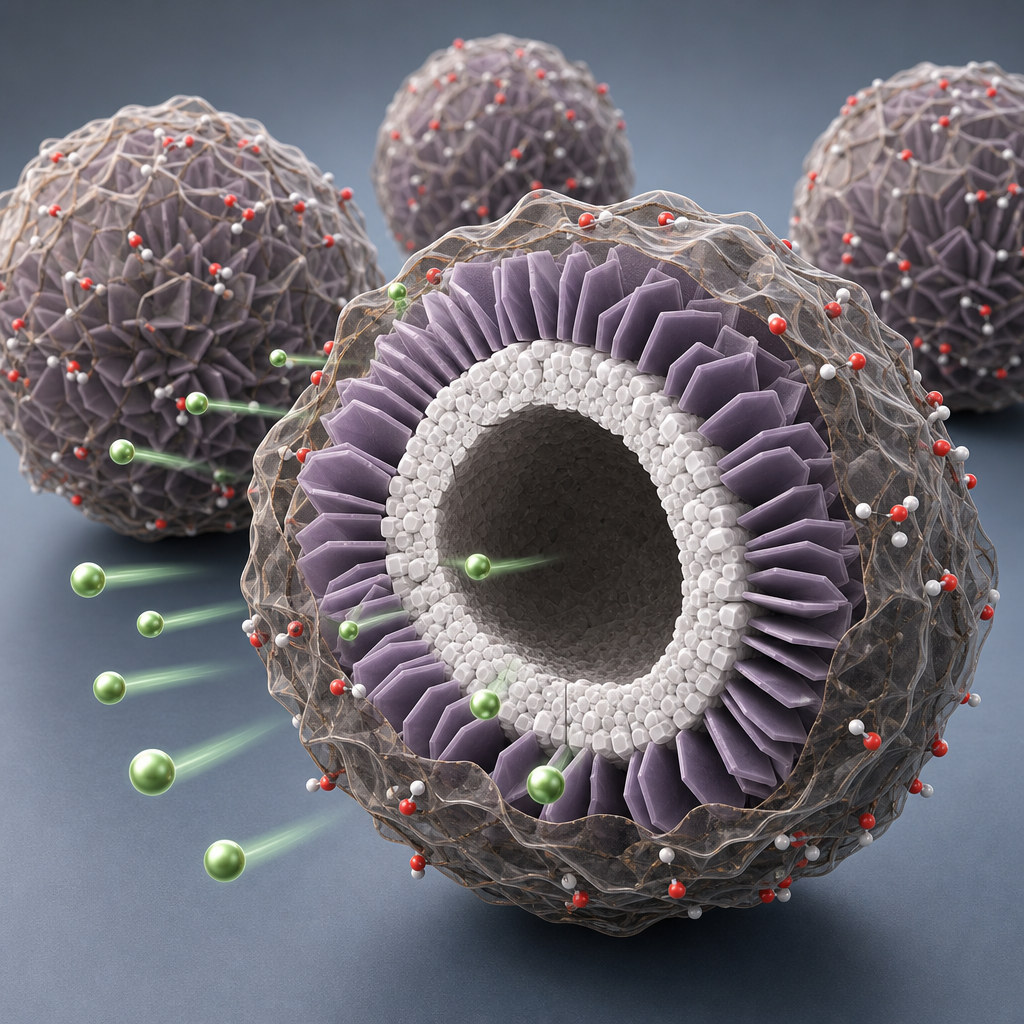
Key results. At a specific current of 200 mA/g, the SnO2@SnS2@rGO hollow spheres delivered an initial discharge capacity of 1150 mAh/g and retained 583 mAh/g after 100 cycles, corresponding to a capacity fade of only 0.273% per cycle from the 2nd to the 100th cycle. By comparison, bare SnO2 hollow spheres faded at 0.830% per cycle and SnS2 nanosheets at 0.393% per cycle. At a more demanding 500 mA/g, the composite still held 487 mAh/g after 100 cycles versus 345 mAh/g for SnO2@SnS2, 206 mAh/g for SnS2, and only 15 mAh/g for SnO2. Rate testing returned 1195, 722, 637, 527, and 436 mAh/g at 100, 200, 500, 1000, and 2000 mA/g respectively, with a recovered capacity of 664 mAh/g when the current was returned to 100 mA/g. Electrochemical impedance spectroscopy showed the lowest charge-transfer resistance (30 Ω) for the rGO-encapsulated sample, compared with 75 Ω, 80 Ω, and 50 Ω for the SnO2@SnS2, SnO2, and SnS2 references. BET surface area increased from 11.9 m²/g (SnO2) to 29.32 m²/g (SnO2@SnS2@rGO).
Applications and outlook. The hierarchical hollow core-shell strategy demonstrated here translates beyond tin-based chemistries: any conversion- or alloying-type anode that suffers from large volume swings—silicon, germanium, transition-metal sulfides, phosphides—could benefit from an analogous void/buffer/rGO encapsulation. In the near term, SnO2@SnS2@rGO is a candidate anode for higher-energy lithium-ion cells aimed at consumer electronics, drones, and grid-scale storage where graphite-level capacity is insufficient. The authors specifically point to the route as easy to prepare and scalable, suggesting industrial relevance. Adjacent opportunities include sodium-ion batteries (SnS2/graphene systems have shown promise) and hybrid pseudocapacitors that exploit fast Li+ access through layered sulfide networks.
Why this matters for researchers. The work shows that a commercially sourced graphene oxide dispersion can serve as the precursor for high-quality rGO conductive shells in complex hollow nanostructures, without requiring in-house Hummers-method synthesis. Graphene oxide dispersions and related single-layer GO products are available from ACS Material for groups developing next-generation electrode materials, conductive composites, and 2D-material heterostructures. Reliable, well-dispersed GO is particularly valuable when the target architecture demands uniform coverage on curved or porous substrates such as hollow oxide spheres.How ACS Material products were used
- Single Layer Graphene Oxide Dispersion (Graphene Series) — “Then, 1.8 g urea and 5 ml (6 mol/L) GO (ACS Material, LLC) dispersion colloid were added into the solution.”
Product Performance in this StudyThe graphene oxide dispersion from ACS Material was reduced in situ with hydrazine hydrate to form the rGO shell encapsulating SnO2@SnS2 hollow spheres. The rGO layer markedly improved electronic conductivity, suppressed pulverization, and lowered charge-transfer resistance (30 Ω) versus uncoated counterparts, enabling 583 mAh/g after 100 cycles at 200 mA/g.
Related product categories
Frequently asked questionsWhy is graphene oxide used to coat SnO2@SnS2 hollow spheres for lithium-ion battery anodes?
Graphene oxide, after reduction to rGO, provides a continuous conductive network that wraps each hollow sphere. This network lowers charge-transfer resistance, accommodates the large volume change of tin-based anodes during lithiation and delithiation, and prevents pulverization. In this study, the rGO shell helped SnO2@SnS2@rGO retain 583 mAh/g after 100 cycles at 200 mA/g and recover 664 mAh/g after high-rate cycling at 2000 mA/g.
How does the hierarchical SnO2@SnS2@rGO structure improve cycling stability compared with bare SnO2?
Bare SnO2 hollow spheres pulverize during repeated lithiation because of roughly 250% volume change, and showed 0.830% capacity fade per cycle in this work. Encapsulating them in SnS2 nanosheets and an rGO shell creates a buffer that absorbs mechanical stress and keeps electrical contact intact. The composite anode showed only 0.273% fade per cycle from cycle 2 to cycle 100, a roughly threefold improvement in cycling stability.
What is the role of the graphene oxide dispersion in the synthesis described?
Five milliliters of 6 mol/L graphene oxide dispersion from ACS Material, LLC was added to an isopropyl alcohol suspension containing SnO2 hollow spheres and urea. After solvothermal treatment at 180 °C and subsequent hydrazine reduction, the GO converted to rGO that uniformly coated SnS2-wrapped SnO2 spheres. Thermogravimetric analysis confirmed about 6 wt% rGO in the final composite, sufficient to enhance conductivity without diluting the active material excessively.