-
Graphene Oxide Hydrogel IgM Immunoassay — Osaka Prefecture University, 2017
Jun 30, 2026 | ACS MATERIAL LLCShirai, A. et al. (2017). Development of a single-step immunoassay microdevice based on a graphene oxide-containing hydrogel possessing fluorescence quenching and size separation …. *Analyst*.
Analyst · 2017
Researchers at Osaka Prefecture University used ACS Material single-layer graphene oxide to build a single-step IgM immunoassay microdevice with FRET quenching and size separation.
About this research
Researchers at Osaka Prefecture University, working in the Graduate School of Engineering, used single-layer graphene oxide dispersed in water purchased from ACS Material to develop a single-step immunoassay microdevice that detects human immunoglobulin M (IgM) in diluted human serum using a 2-hydroxyethyl methacrylate (HEMA)-based GO-containing hydrogel. The hydrogel simultaneously functions as a fluorescence quencher (via FRET) and as a size-selective barrier that excludes large antibody–antigen immunocomplexes. The device combines this hydrogel with a PDMS microchannel array pre-coated with a soluble film of FITC-labelled anti-human IgM antibody, so that sample introduction by capillary action triggers all of the assay steps spontaneously, with fluorescence read-out via a CCD-equipped microscope.
Immunoassays are central to clinical diagnostics, but conventional formats such as ELISA require multiple incubation and washing steps, expensive instrumentation, and trained operators. Homogeneous FRET-based formats using graphene oxide as a quencher remove some of those steps, yet typical assay times still reach 30 minutes and quenching efficiency suffers because the formed sandwich immunocomplex separates the dye from the GO surface. There is therefore strong interest in microdevices that allow rapid, single-step, wash-free quantification of immunoglobulins for point-of-care biosensing, environmental monitoring, and food safety. Two-dimensional carbon nanomaterials such as graphene oxide are particularly attractive because their sp2 domains act as efficient broadband fluorescence quenchers, while oxygen-containing surface groups enable water dispersibility and adsorption of biomolecules without covalent coupling.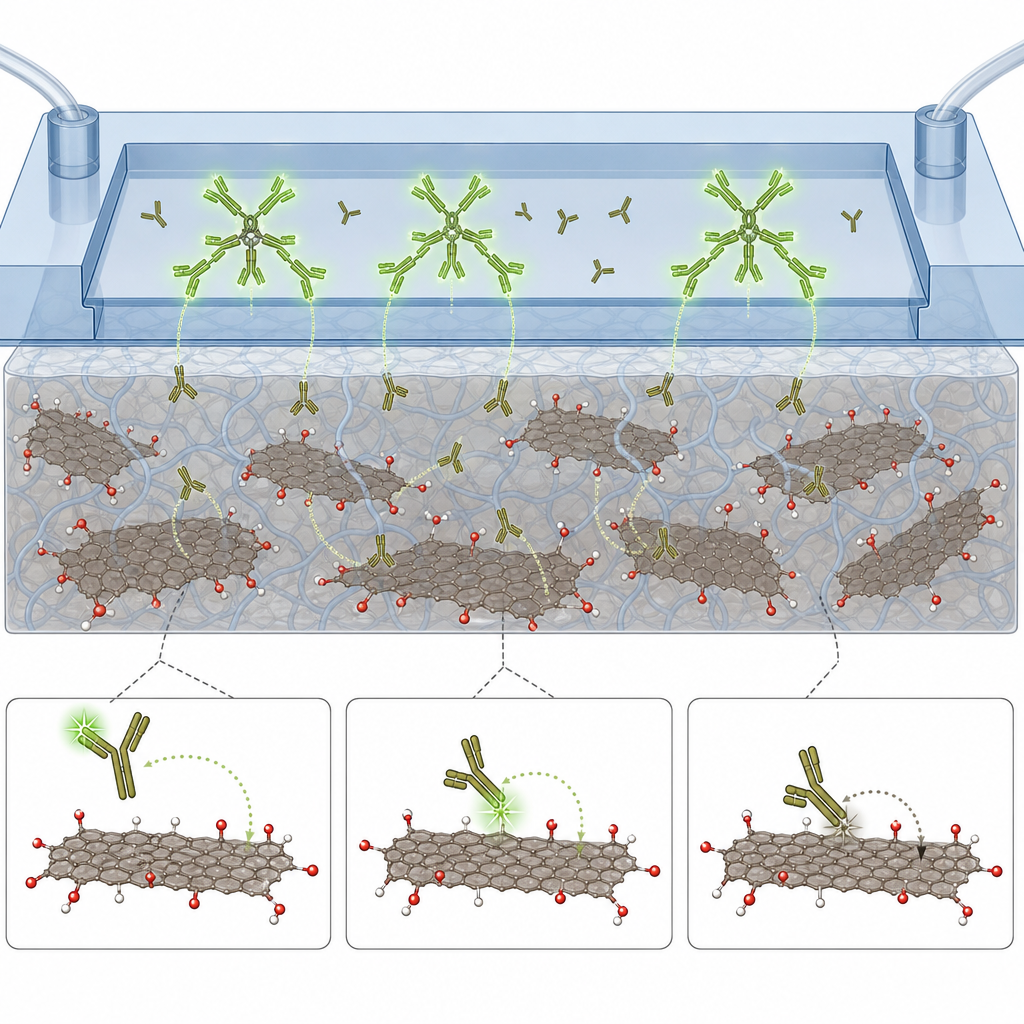
In this study the ACS Material single-layer graphene oxide aqueous dispersion was used as a starting material for the active layer of the device. To prepare the hydrogel, 300 µL of 10 mg/mL GO solution was combined with varying amounts of HEMA monomer (200–700 mg) in 500 µL of deionized water. After addition of 200 µL of 50 mg/mL ammonium peroxodisulfate as initiator, the mixture was cast onto a glass dish and polymerised at 70 °C for 1 h, then washed in pH 7.4 buffer. The resulting GO-loaded HEMA hydrogel film (1 cm × 1 cm) was bonded with transparent tape to a PDMS microchannel array (500 µm wide, 500 µm deep) whose channels were pre-coated by drying a mixture of FITC-labelled anti-human IgM antibody (5 µg/mL), PEG20000, PDMS-PEG and glycerol. The dual role of the ACS Material GO — quencher and size-selective adsorbent — sits at the core of the response mechanism.
When 1000-fold diluted control human serum was introduced into the device by capillary action, the dried antibody coating dissolved and reacted with IgM in the sample. Free FITC-labelled antibody could permeate into the HEMA-based GO-containing hydrogel, adsorb directly onto the GO surface, and be quenched; in contrast, the larger fluorescently labelled antibody–IgM immunocomplexes were excluded by the hydrogel mesh and retained in the microchannel, where their fluorescence was preserved. By tuning HEMA concentration (200–700 mg), the authors optimised the permeation cut-off so that only unbound antibody entered the gel. With this configuration the device produced a clear, IgM-concentration-dependent fluorescence response in approximately a single-step capillary fill, far faster than the ~30 min typical of homogeneous FRET immunoassays. Interference tests using BSA (0, 9, 90, 900 µg/mL) added to 5 µg/mL FITC-antibody solutions confirmed that non-specific protein binding did not substantially alter quenching, supporting selective IgM quantification. Compared with the authors' earlier antibody-GO conjugate format that achieved only 60–70% FRET efficiency due to immunocomplex-imposed spacer distance, the hydrogel size-exclusion strategy produced higher contrast between bound and free fluorophore populations.
The microdevice provides a practical route to multiplexed, single-step immunoassays in clinical, environmental, and food-safety settings where rapid serum protein quantification is needed without external pumps, wash buffers, or trained operators. Because the working principle relies only on capillary action and a passive hydrogel/PDMS chip, parallel capillary arrays could be configured for simultaneous detection of multiple immunoglobulins or other antigens. The same GO-hydrogel architecture is in principle extendable to point-of-care diagnostics for infectious disease markers, allergy IgE assays, and biothreat detection, as well as to research applications such as antibody–antigen binding kinetics. The authors note that further work on hydrogel composition and antibody coating chemistry should improve sensitivity and dynamic range.
For researchers seeking to reproduce or extend this work, ACS Material's single-layer graphene oxide dispersion (Graphene Series) is the type of building block used here, supplied as a water-borne dispersion compatible with HEMA polymerisation. Groups developing capillary-based or microfluidic immunoassays, FRET biosensors, hydrogel composites, and other 2D-carbon-enabled diagnostic platforms can readily adopt similar GO products from ACS Material as the quenching and size-filtering component in their devices.How ACS Material products were used
- Single Layer Graphene Oxide Dispersion (Graphene Series) — “Single layer graphene oxide, dispersed in water, was purchased from ACS MATERIAL (St. Medford, MA, USA).”
Product Performance in this StudyThe ACS Material single-layer graphene oxide dispersion served as the active fluorescence-quenching and size-separating component of the HEMA-based hydrogel, enabling a single-step homogeneous immunoassay for human IgM with rapid response and improved selectivity.
Related product categories
Frequently asked questionsHow does a graphene oxide hydrogel work as a fluorescence quencher in immunoassays?
Graphene oxide contains sp2 domains that absorb broadband visible light and act as an efficient FRET acceptor. When a fluorescently labelled antibody adsorbs onto the GO surface through pi–pi and electrostatic interactions, its emission is strongly quenched. Embedding GO in a hydrogel adds a size-exclusion function so that only small, unbound antibodies reach and are quenched by the GO, while larger antibody–antigen complexes remain fluorescent.
Why use single-layer graphene oxide instead of multilayer GO for biosensor hydrogels?
Single-layer graphene oxide offers a higher specific surface area, better aqueous dispersibility, and more uniform sp2/sp3 domain distribution than multilayer GO. This gives stronger fluorescence quenching per unit mass and produces more transparent, homogeneous hydrogels. Uniform dispersion also stabilises the antibody-binding sites across the polymer network, improving reproducibility in immunoassay readouts.
What is a single-step immunoassay microdevice and how is it different from ELISA?
A single-step immunoassay microdevice performs antibody binding, separation, and signal generation in one capillary-driven action without external pumps or wash steps. Sample introduction triggers spontaneous mixing with dried reagents, and detection occurs via fluorescence change. Unlike ELISA, which requires multiple incubations, washes, and instrumentation, the microdevice gives a result in minutes from a single sample drop, ideal for point-of-care use.