-
Graphene Oxide Nanocarriers for Survivin mRNA Sensing — Warsaw University of Life Sciences, 2016
Jun 16, 2026 | ACS MATERIAL LLCStobiecka, M. et al. (2016). Sensing of survivin mRNA in malignant astrocytes using graphene oxide nanocarrier-supported oligonucleotide molecular beacons. *Sensors and Actuators B: Chemical*. https://doi.org/10.1016/j.snb.2016.04.176
Sensors and Actuators B: Chemical · 2016
Researchers at Warsaw University of Life Sciences used single-layer graphene oxide nanosheets from ACS Material to deliver molecular beacons detecting survivin mRNA in U-87 glioma cells (LOD 24 nM).
About this research
Researchers at the Warsaw University of Life Sciences (SGGW) used single-layer graphene oxide nanosheets (GONS) purchased from ACS Material to build a turn-on fluorescent nanocarrier (GONS@SurMB) that detects survivin mRNA inside U-87 malignant glioma cells, achieving a 24 nM limit of detection for the complementary target DNA at 37 °C. Reporting in Sensors and Actuators B: Chemical (2016), the team demonstrated that the molecular beacon adsorbed onto the GONS surface is released selectively upon binding intracellular survivin mRNA, generating a strong fluorescence turn-on signal with single-nucleotide polymorphism sensitivity. The work was led by Magdalena Stobiecka and collaborators from the Polish Academy of Sciences.
Astrocytic brain tumors — including diffuse astrocytoma, anaplastic astrocytoma and glioblastoma — remain among the most challenging cancers to treat because the blood-brain barrier (BBB) blocks most systemic chemotherapeutics, and surgical removal rarely eliminates all malignant cells. Recent advances in reversible, ultrasound-triggered BBB opening have revived interest in nanocarrier-based delivery of diagnostic and therapeutic oligonucleotides into the brain. Survivin (an inhibitor of apoptosis) is overexpressed in astrocytic cancers and is therefore a high-value biomarker. A platform that can both deliver and report on this biomarker inside live glioma cells would simultaneously address theranostic diagnosis and serve as a stepping stone toward gene therapy. Two-dimensional graphene oxide has emerged as a prime candidate because it forms stable non-covalent π–π complexes with single-stranded DNA and quenches attached fluorophores efficiently, providing intrinsic low background.
The authors selected ACS Material's single-layer graphene oxide nanosheets specifically for their well-exfoliated, monolayer character. The Methods section states verbatim: "Single layer graphene oxide nanosheet nanocarriers (GONS) were purchased from ACS Materials, LLC (Medford, MA, USA)." The team validated the as-received material by SEM, TEM and Raman spectroscopy. SEM and TEM revealed the characteristic rippled and wrinkled morphology of single-layer GO. The Raman spectrum showed the expected D-band at 1331 cm⁻¹ and G-band at 1580 cm⁻¹ together with a strongly suppressed 2D band at 2682 cm⁻¹, consistent with effective monolayer exfoliation that prevents interlayer coupling. Quantum-mechanical PM3 modelling of a representative C33-COOH-CHO-OH fragment was used to interpret the surface electrostatic potential. The GONS were then non-covalently loaded with a 6-FAM/Dabcyl-labelled survivin molecular beacon (SurMB) via π–π stacking, forming the GONS@SurMB assembly that was subsequently used both in solution-phase calibration and in transfection of U-87 MG cells.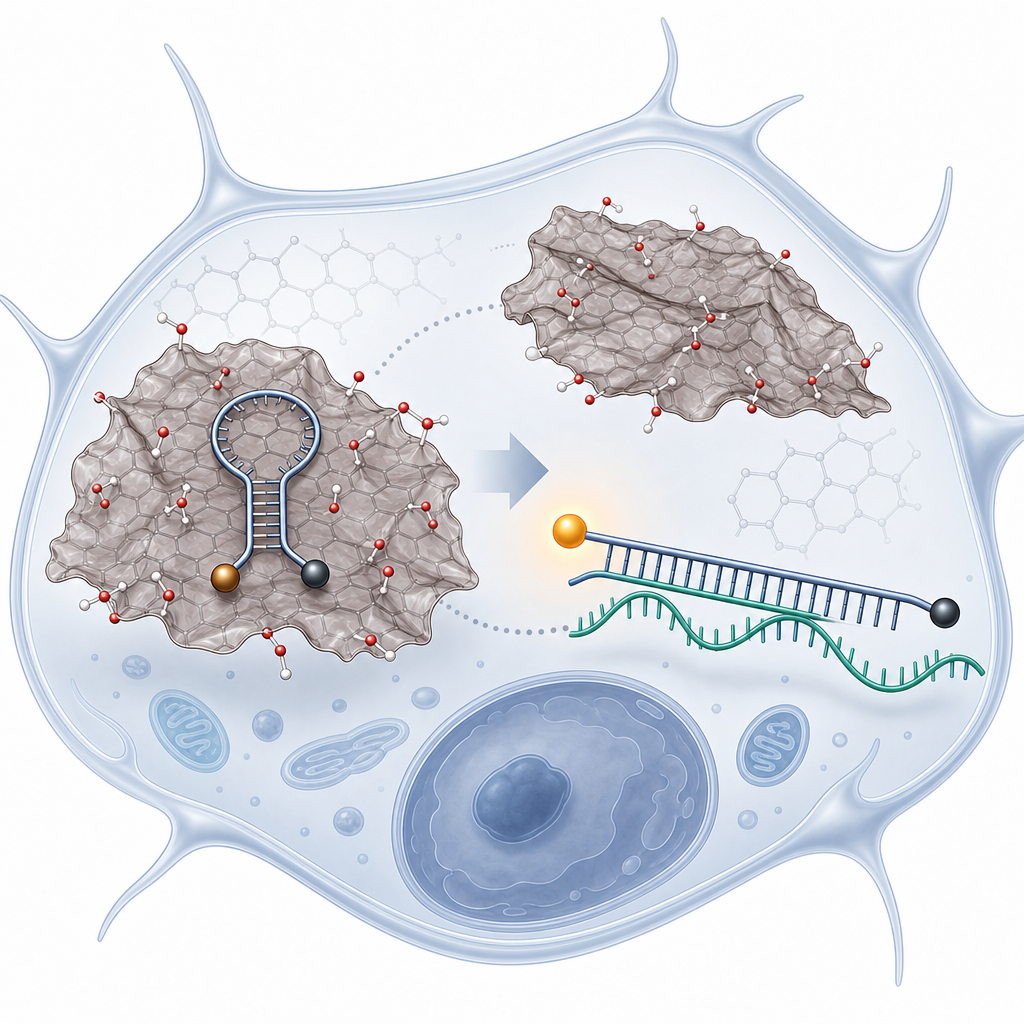
The quantitative results validate the platform. Adding GONS (0–10 μg/mL) quenched SurMB fluorescence by 45.4 %, giving a Stern–Volmer constant K_SV = 0.092 ± 0.01 mL/μg, which confirms strong π–π anchoring and low residual background. Upon injecting the complementary target, fluorescence rose from I_F ≈ 48 to I_F ≈ 344.5 at 100 nM tDNA, with a slope of 4.4 nM⁻¹ above 50 nM. A 3σ analysis gave a dynamic limit of detection LOD = 24 nM for the survivin target. Isothermal selectivity tests against perfect-match, single-mismatch (St-1), double-mismatch (St-2), and fully non-complementary (Sn) strands demonstrated single-nucleotide polymorphism resolution. Melting-curve analysis of GONS@SurMB yielded a midpoint t_m,f = 53.04 ± 0.12 °C with only ~1.2 °C hysteresis on cooling, indicating quasi-reversible thermodynamics. Resonance elastic light scattering (RELS) mapped GONS colloidal stability across 0–180 μg/mL and identified three regimes: linear Rayleigh scattering up to 17 μg/mL, inner-filter influence to 80 μg/mL, and assembly/sedimentation above 80 μg/mL. MTT viability assays showed GONS@SurMB at concentrations up to 133 μg/mL remained non-cytotoxic to U-87 MG astrocytes, while transfection experiments confirmed cellular uptake and intracellular SurMB release upon encountering survivin mRNA.
The demonstration is directly relevant to brain-cancer theranostics, intracellular mRNA imaging, and nucleic-acid-based gene therapy. Combined with emerging focused-ultrasound techniques for reversible BBB opening, GONS-supported molecular beacons could enable both diagnosis and therapeutic silencing of anti-apoptotic targets in glioblastoma. Beyond oncology, the approach generalises to any low-abundance mRNA biomarker where a turn-on fluorescent probe with SNP discrimination is desirable — including neurodegenerative-disease markers, viral RNA detection, and stem-cell differentiation monitoring. The authors specifically note that GONS-stimulated cancer stem cell differentiation, reported elsewhere, may further amplify the therapeutic value of this carrier chemistry.
For researchers building similar nanocarrier-based biosensors, the choice of high-quality single-layer graphene oxide is critical: monolayer character, controlled oxidation, and reproducible flake dimensions determine both the quenching efficiency and the colloidal stability window. ACS Material offers single-layer graphene oxide nanosheets and related GO products in the Graphene Series suitable for oligonucleotide loading, fluorescence biosensing, and cellular delivery studies of the type described here.How ACS Material products were used
- Single Layer Graphene Oxide Nanosheets (GONS) (Graphene Series) — “Single layer graphene oxide nanosheet nanocarriers (GONS) were purchased from ACS Materials, LLC (Medford, MA, USA).”
Product Performance in this StudyThe single-layer graphene oxide nanosheets served as the nanocarrier platform that adsorbed molecular beacons via π–π stacking and quenched their fluorescence (45.4% reduction; KSV = 0.092 mL/μg), enabling a turn-on response upon survivin mRNA binding with LOD = 24 nM and single-nucleotide polymorphism selectivity. GONS were also non-cytotoxic up to 133 μg/mL in U-87 MG cells.
Related product categories
Frequently asked questionsWhy use graphene oxide nanosheets as a carrier for molecular beacons in mRNA detection?
Graphene oxide nanosheets adsorb single-stranded oligonucleotides via π–π stacking and efficiently quench attached fluorophores, providing a very low background signal. When the beacon hybridises with its mRNA target inside a cell, it desorbs and switches on. This design also protects the beacon from nuclease degradation during delivery and helps it cross cell membranes, making GO carriers attractive for intracellular biomarker sensing.
What detection limit can a GONS molecular beacon achieve for survivin mRNA?
In the Stobiecka et al. 2016 study using ACS Material single-layer graphene oxide nanosheets, the GONS@SurMB probe reached a 3σ limit of detection of 24 nM for the complementary survivin target DNA at 37 °C. The probe also discriminated single- and double-nucleotide mismatches from the perfect complement, demonstrating single-nucleotide polymorphism sensitivity inside U-87 malignant glioma cells.
Is graphene oxide cytotoxic to astrocyte or glioma cells at biosensor concentrations?
MTT viability assays in this study showed that single-layer graphene oxide nanocarriers loaded with the survivin molecular beacon remained non-cytotoxic to U-87 MG astrocyte cells at concentrations up to 133 μg/mL. Bare GONS did not appreciably self-assemble below 80 μg/mL. Cell aggregation appeared only at higher carrier concentrations, so the useful biosensing window is well below the cytotoxic threshold.