-
Graphene Oxide Orthodontic Primer - University of Baghdad, 2024
Jul 10, 2026 | ACS MaterialHussein, A. H., & Yassir, Y. A. (2024). Development of a graphene oxide/hydroxyapatite-containing orthodontic primer: an in-vitro study. *Materials Chemistry and Physics*. https://doi.org/10.1016/j.matchemphys.2024.129857
Materials Chemistry and Physics · 2024
University of Baghdad researchers added ACS Material single-layer graphene oxide to an orthodontic primer, boosting antibacterial and remineralization performance in vitro.
About this research
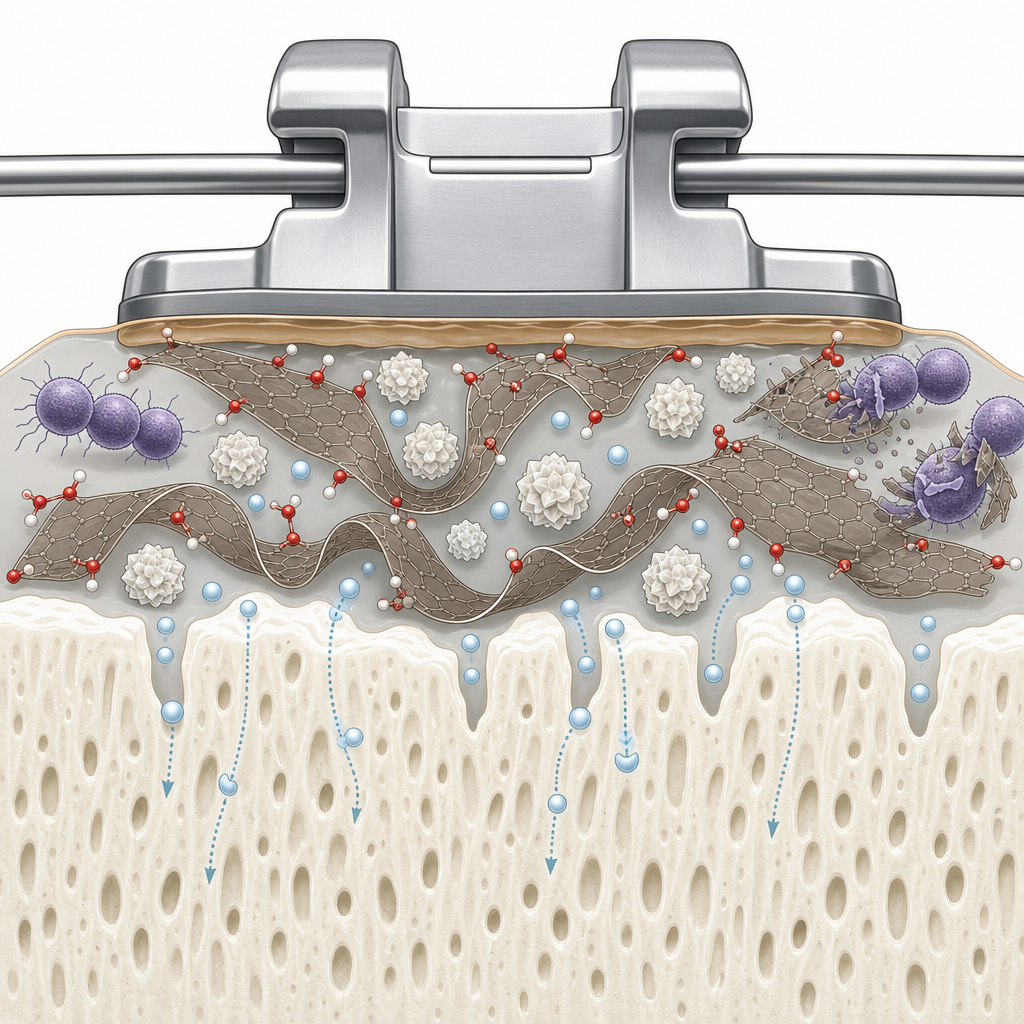
Researchers at the University of Baghdad developed a graphene oxide/hydroxyapatite orthodontic primer using single-layer graphene oxide (99% purity, 0.8–1.2 nm thickness) supplied by ACS Material, demonstrating that the GOHA 0.25–2 formulation delivered the best combination of antibacterial and remineralization performance while preserving bond strength. The team blended three concentrations of graphene oxide (0.1, 0.25, 0.5 wt%) and three concentrations of hydroxyapatite (2, 5, 7 wt%) into commercial Transbond XT primer to produce nine experimental groups, then compared them against unmodified primer for cell viability, shear bond strength, adhesive remnant index, enamel damage, antibacterial activity, and remineralization. The work targets prevention of white spot lesions (WSLs) that frequently form around fixed orthodontic brackets.Fixed orthodontic appliances act as plaque-retentive sites, raising the risk of enamel demineralization and disfiguring WSLs. Because management of established lesions is invasive, the field has shifted toward preventive bonding systems that combine antibacterial and remineralizing functions without relying on patient compliance. Graphene oxide is attractive here: unlike hydrophobic graphene materials it is hydrophilic, which improves cytocompatibility while retaining antibacterial action, and its oxygenated functional groups interact readily with ions. Hydroxyapatite is a bioactive mineral analog of tooth structure that releases Ca2+ and PO4 3- ions to remineralize enamel micropores. Combining the two as fillers in a low-viscosity primer—rather than the adhesive—lets the active material penetrate the etched enamel directly at the bracket margin, the highest-risk zone for lesion development.The ACS Material single-layer graphene oxide was first characterized to confirm the supplier specifications before formulation. FESEM showed a randomly distributed, partially transparent nanoscale layered structure, while XRD gave a sharp, intense peak at 2θ = 10.35 confirming the GO phase, with an estimated crystallite size near 15.5 nm by the Scherrer equation. EDX found the GO composed mainly of carbon (60.7 wt%) and oxygen (38.6 wt%). The graphene oxide was precisely weighed on a four-digit balance and mixed into Transbond XT primer by weight ratio, alongside 50 nm hydroxyapatite nanopowder. To avoid premature light polymerization, mixing was carried out in a black glass tube using a straight handpiece with a custom spatula for three minutes. Primer disks and thin coatings were then prepared for cytotoxicity, bonding, antibacterial, and pH-cycling remineralization testing, with the GO acting as the antibacterial component of the composite filler system.All nine GO/HA primers met the ISO cytocompatibility threshold, maintaining L929 fibroblast viability above 70% across 24, 48, and 72 h; the lowest values were 86.86% (GOHA 0.5–2, 24 h), 82.25% (GOHA 0.5–5, 48 h), and 82.03% (GOHA 0.1–7, 72 h). Shear bond strength rose above the control (12.43 MPa) in every group, reaching up to about 22 MPa, though differences were not statistically significant (Kruskal-Wallis p = 0.051). Adhesive remnant index values were statistically comparable to control, while enamel damage index was generally lower for the experimental groups, attributed to hydroxyapatite precipitation smoothing enamel defects. Antibacterial inhibition zones against Streptococcus mutans were significantly larger than control for GOHA 0.1–2, 0.1–5, 0.25–2, and 0.25–5, with 0.25 wt% GO outperforming 0.5 wt% GO. In pH-cycling remineralization tests, the selected groups showed greater reductions in DIAGNOdent laser fluorescence (ΔF) than control, and EDX confirmed significant increases in enamel calcium for all experimental groups and in phosphorus for GOHA 0.1–2 and 0.25–2, whereas the control lost mineral. The GOHA 0.25–2 primer delivered the best overall balance.This research supports a practical route to functional orthodontic bonding agents that resist demineralization at the bracket margin. By placing antibacterial graphene oxide and remineralizing hydroxyapatite into the primer layer that directly contacts etched enamel, the approach could reduce WSL formation during long fixed-appliance treatment without changing clinical handling or requiring patient cooperation. The authors note that the study is short-term and does not fully replicate the oral environment, and they call for larger-sample work, aging protocols for bond strength, and a randomized clinical trial of the GOHA 0.25–2 formulation in vivo. Adjacent applications include antibacterial dental adhesives, fissure sealants, and resin cements where controlled ion release and biofilm suppression matter.For researchers pursuing similar dental, biomaterial, or antibacterial composite work, the single-layer graphene oxide used here is available from ACS Material's graphene oxide product line, characterized for purity and thickness consistent with the supplier specifications cited in the paper. The study illustrates how a well-defined, high-purity graphene oxide can be incorporated at low weight fractions into a polymer matrix to add antibacterial functionality while maintaining biocompatibility and mechanical performance—useful context for groups evaluating GO as a filler in clinical-grade formulations.
How ACS Material products were used
- Single-Layer Graphene Oxide (Hummer's method, 99% purity, 0.8–1.2 nm thickness) (Graphene Series) — "Single-layer GO prepared by Hummer's method with 99 % purity and 0.8–1.2 nm thickness (ACS Material; Pasadena, CA, USA)"
Product Performance in this Study
The ACS Material single-layer graphene oxide functioned as the antibacterial nanofiller in the experimental orthodontic primer, contributing significantly higher antibacterial activity against Streptococcus mutans versus the control, with the 0.25 wt% loading performing best.
Related product categories
Frequently asked questions
How does graphene oxide improve an orthodontic primer's antibacterial performance?
In this study, single-layer graphene oxide added to the primer significantly increased inhibition zones against Streptococcus mutans compared with the unmodified control. Its hydrophilic, oxygen-rich surface supports antibacterial activity while keeping cytocompatibility. A 0.25 wt% graphene oxide loading outperformed 0.5 wt%, suggesting an optimal low concentration delivers the best biofilm suppression without compromising other properties.
What is graphene oxide combined with hydroxyapatite used for in dental materials?
The graphene oxide/hydroxyapatite combination is used as a functional filler in orthodontic primers to prevent white spot lesions around brackets. Graphene oxide contributes antibacterial action, while hydroxyapatite releases calcium and phosphate ions for enamel remineralization. The primer layer contacts etched enamel directly, sealing the high-risk bracket margin and strengthening the outer enamel against acid attack during fixed orthodontic treatment.
What grade of graphene oxide was used in the GO/HA orthodontic primer study?
The researchers used single-layer graphene oxide prepared by Hummer's method with 99% purity and 0.8–1.2 nm thickness, supplied by ACS Material. They confirmed these specifications by FESEM, XRD (sharp peak at 2θ = 10.35), and EDX, which showed the material was mainly carbon (60.7 wt%) and oxygen (38.6 wt%) with an estimated crystallite size near 15.5 nm.