-
Graphene Oxide Toxicity in Cyanobacteria - Arizona State University, 2023
Jul 10, 2026 | ACS MATERIAL LLCCruces, E. et al. (2023). Toxicity mechanisms of graphene oxide and cadmium in Microcystis aeruginosa: evaluation of photosynthetic and oxidative responses. *Aquatic Toxicology*. https://doi.org/10.1016/j.aquatox.2023.106703
Aquatic Toxicology · 2023
Arizona State University study uses ACS Material single-layer graphene oxide to probe combined GO and cadmium toxicity in Microcystis aeruginosa over 96 h.
About this research
Researchers at Arizona State University used a modified Hummer's single-layer graphene oxide obtained from ACS Material to investigate how graphene oxide (GO) and cadmium (Cd) jointly affect the photosynthetic and oxidative physiology of the freshwater cyanobacterium Microcystis aeruginosa, finding that GO concentrations at or above 5 µg/mL and Cd at or above 0.1 µg/mL reduced cell biomass and altered key photosynthetic parameters after 96 hours of exposure. The study combined adsorption isotherm measurements, photosynthetic fluorescence analysis, viability and oxidative-stress dyes, and transmission electron microscopy to dissect the mechanisms of single and combined contaminant toxicity. The most sensitive toxicity indicator was the maximum photosynthetic electron transport rate (ETRmax).
This research matters because graphene oxide is increasingly used in water-treatment adsorbents, membranes, and filters, raising the likelihood that GO will be released into aquatic ecosystems. Once in the environment, GO can interact with co-existing pollutants such as heavy metals, either amplifying or mitigating their toxicity depending on adsorption affinity and sheet chemistry. Cadmium is a particularly concerning aquatic contaminant because it is non-biodegradable, bioaccumulates, and inhibits photosynthesis. Despite many ecotoxicology studies, the mechanisms governing GO toxicity to photoautotrophic organisms remain poorly understood, especially in the presence of other toxicants. By using a well-characterized commercial GO and a model cyanobacterium, this work helps clarify how GO concentration, co-contaminant presence, and GO adsorption capacity together determine environmental risk, informing long-tail questions such as graphene oxide cadmium adsorption toxicity in algae.
The ACS Material product was a modified Hummer's powdered single-layer GO (CAS No. 7782-42-5), used as received. The authors characterized it thoroughly: scanning electron microscopy showed sheet-like material with a broad size distribution and sheets up to 5 µm long; Raman spectroscopy confirmed the graphitic structure via the G band (~1590 cm⁻¹) and D band (~1330 cm⁻¹); and FTIR identified C-O, C=O, and -OH oxygen functional groups. X-ray photoelectron spectroscopy measured a C/O ratio of 2.66 and greater than 99% purity. Zeta potential was -30.58 ± 4.07 mV in water, decreasing to -25.81 ± 1.71 mV in Bold's Basal Medium, giving the sheets only short-term stability that led to aggregation from 507 nm to over 5 µm during the 96-hour assays. The GO was deployed in two roles: as the adsorbent in batch Cd isotherm studies (10 mg/L adsorbent against 0-5 mg/L Cd), and as the test contaminant in 96-hour toxicity bioassays at nominal concentrations of 1, 5, 10, 25, 50, and 100 µg/mL, alone and combined with Cd in toxic-unit mixtures.
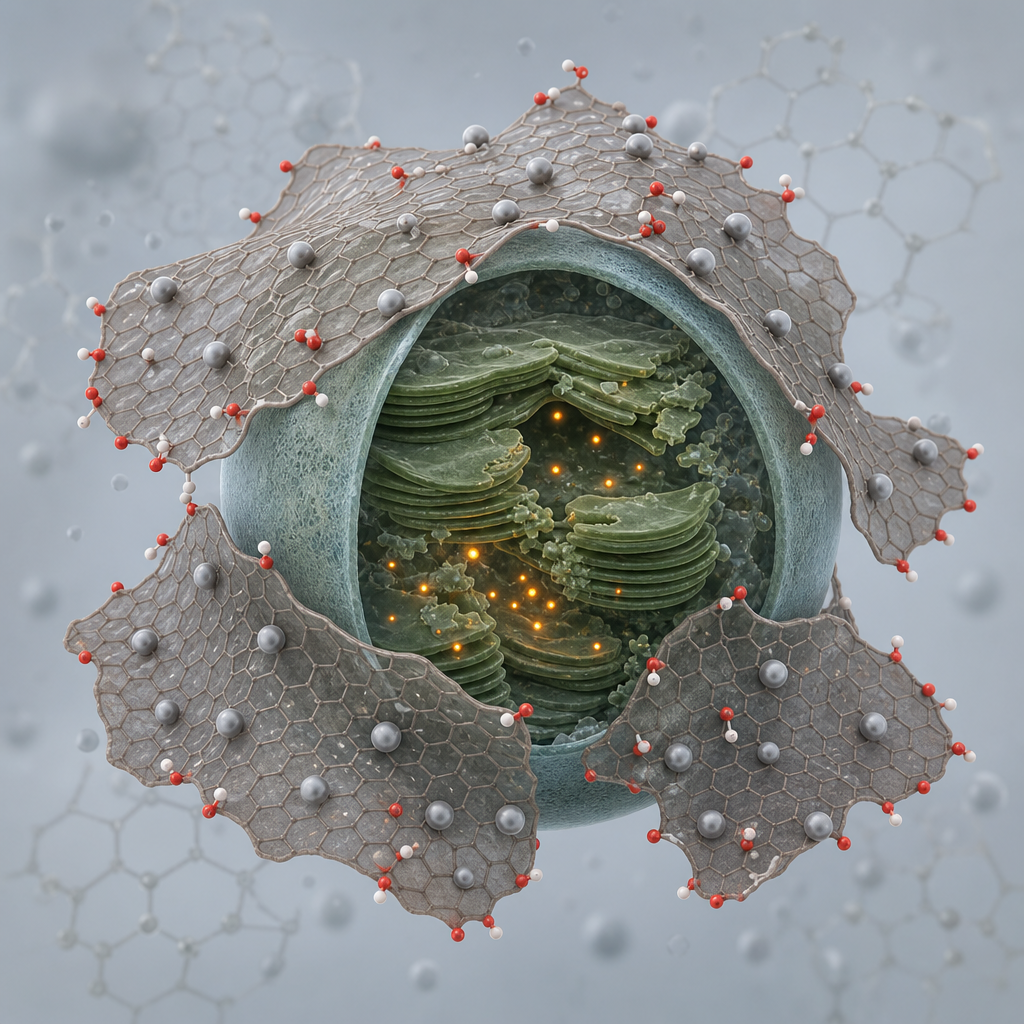
Key quantitative results emerged from the dose-response and combined-toxicity analyses. In MilliQ water, GO showed a maximum Cd adsorption capacity of 128.6 mg/g at 5 mg/L Cd, with the Langmuir model providing the best fit (high affinity constant KL = 9.728 L mg⁻¹), indicating monolayer adsorption on homogeneous sites. The most sensitive toxicity parameter, ETRmax, gave EC50 values of 18.2 ± 3.9 µg/mL for GO and 1.1 ± 0.3 µg/mL for Cd. Single concentrations of GO at or above 5 µg/mL and Cd at or above 0.1 µg/mL decreased cell biomass and altered photosynthetic parameters tied to primary productivity. In combined exposures expressed as toxic units, treatments with a higher GO proportion (the GO3/4 + Cd1/4 mixture, equivalent to GO at or above 9.1 µg/mL) produced the strongest photoinhibition and the largest decrease in photosynthetic parameters relative to single-factor controls. The high-GO mixtures increased BODIPY fluorescence (lipid peroxidation) and normalized H2DCFDA fluorescence (intracellular ROS) while decreasing FDA fluorescence (esterase activity, indicating membrane disruption or reduced metabolism). TEM imaging showed GO sheets surrounding cells, thicker and rougher cell envelopes, less ordered thylakoids, diffuse internal structures, and reduced cell size in combined treatments.
These findings support more accurate environmental-risk assessment of carbon nanomaterials in aquatic systems. The work shows that GO can act both as a direct membrane-disrupting agent and as a carrier or competitor for cadmium, so risk depends on the balance among GO concentration, Cd concentration, and GO adsorption capacity in a given water matrix. The results are relevant to water-treatment engineers using GO-based sorbents, ecotoxicologists modeling nanomaterial discharge, and regulators establishing safe-release thresholds. The authors point to the importance of considering co-contaminant adsorption equilibria and the aggregation behavior of GO in realistic media, since ionic strength strongly affected GO stability and therefore its interaction with cells. Future studies could extend the approach to other metal ions and to GO of differing oxidation degree and sheet size.
For researchers working on nanomaterial ecotoxicology, adsorption studies, or environmental fate of 2D materials, the well-defined single-layer graphene oxide used here is available from ACS Material's graphene series. The paper's detailed characterization—C/O ratio, purity, zeta potential, and Raman/FTIR signatures—provides a useful reference baseline for anyone selecting a comparable GO grade for aquatic-toxicity or heavy-metal adsorption experiments. Consistent, well-characterized starting material is essential when toxicity outcomes depend sensitively on surface chemistry and sheet size.How ACS Material products were used
- Single Layer Graphene Oxide (modified Hummer's method) (Graphene Series) — “A modified Hummer's powdered single layer GO was obtained from ACS Material (CAS No.: 7782-42-5) (Medford, MA, USA) and used as received.”
Product Performance in this Study
The ACS Material single-layer GO served as the central test material; characterization confirmed a sheet-like morphology (up to 5 µm), a C/O ratio of 2.66, >99% purity, and a high Cd adsorption affinity (KL = 9.728 L mg⁻¹), enabling the toxicity and co-contaminant study.
Related product categories
Frequently asked questions
How does graphene oxide affect cadmium toxicity in cyanobacteria?
Graphene oxide can both carry and compete with cadmium for binding sites. In this study, GO adsorbed Cd with a maximum capacity of 128.6 mg/g and high affinity (KL = 9.728 L/mg). At higher GO proportions (GO at or above 9.1 µg/mL), combined GO-Cd treatments caused stronger photoinhibition and oxidative stress in Microcystis aeruginosa than either contaminant alone.
What grade of graphene oxide was used to study aquatic toxicity?
The researchers used a modified Hummer's powdered single-layer graphene oxide from ACS Material. Characterization showed sheets up to 5 µm long, a carbon-to-oxygen ratio of 2.66, greater than 99% purity, and a zeta potential of -30.58 mV in water. This well-defined grade allowed reproducible measurement of photosynthetic and oxidative toxicity endpoints.
Why is ETRmax important for measuring graphene oxide toxicity?
ETRmax, the maximum photosynthetic electron transport rate, was the most sensitive toxicity indicator in this study. It directly reflects damage to the photosynthetic apparatus before broader physiological collapse. The EC50 values based on ETRmax were 18.2 µg/mL for graphene oxide and 1.1 µg/mL for cadmium, making it a reliable early endpoint for ecotoxicology assessment.