-
Graphene Oxide Transport in Limestone - Flinders University, 2020
Jun 16, 2026 | ACS MATERIAL LLCEsfahani, A. et al. (2020). Effect of bacteria and virus on transport and retention of graphene oxide nanoparticles in natural limestone sediments. *Chemosphere*.
Chemosphere · 2020
Flinders University researchers used ACS Material single-layer graphene oxide to study how bacteria and viruses affect nanoparticle transport in limestone aquifers.
About this research
Researchers at Flinders University used single-layer graphene oxide nanoparticles purchased from ACS Material (Medford, MA) to evaluate how co-present microorganisms influence the transport and retention of graphene oxide nanoparticles (GONPs) in natural limestone aquifer sediments. The headline finding is that at low ionic strength, the co-presence of the bacteriophage MS2 or Escherichia coli enhanced GONP recovery in column effluents from 44.96% to over 60%, because the microorganisms occupy reactive surface sites on limestone collectors and prevent nanoparticle attachment. The study addresses a realistic groundwater scenario relevant to managed aquifer recharge (MAR) operations.
Understanding how engineered nanoparticles move through real aquifer materials matters because graphene oxide is increasingly released into soils and water bodies from manufacturing, application, and disposal pathways, and GONPs can carry adsorbed heavy metals and organic pollutants deep into groundwater. Most prior column work has been performed in idealized clean sand or glass beads with only the nanoparticle of interest in suspension, which under-represents the colloidal complexity of real subsurface environments. Managed aquifer recharge sites, used in Australia, the United States, the Netherlands, and Israel to store treated water in carbonate aquifers, simultaneously inject microorganisms and may inject or mobilize engineered nanoparticles. Resolving how these two colloidal populations interact in carbonate sediments is critical for risk assessment of MAR-stored water.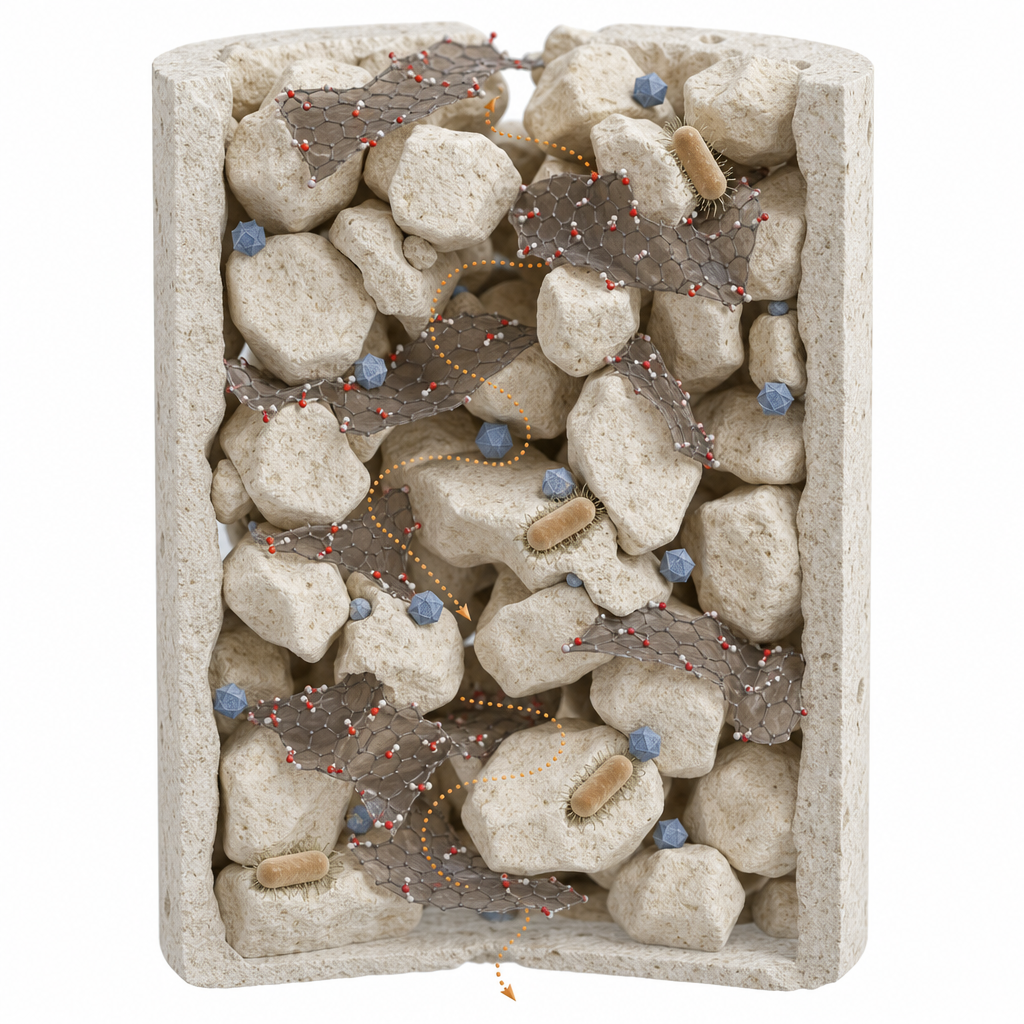
The ACS Material product was used as the central test nanoparticle. The supplier-reported thickness of 0.8–1.2 nm and Hummers-method preparation provided a well-defined single-layer GO starting material. Stock suspensions were prepared at 100 mg L⁻¹ in reverse-osmosis water adjusted to either 10 mM NaCl (low ionic strength) or 5 mM CaCl2 (high ionic strength), then bath-sonicated to disperse. Zeta potential and hydrodynamic diameter were measured on a Malvern Zetasizer Nano-ZS, and colloidal stability was tracked at 226 nm on a Shimadzu UV-1800. The GONPs were then injected (5 pore volumes) into 9 cm × 2.5 cm plexiglass columns wet-packed with 0.25–0.50 mm crushed limestone from Virginia, South Australia, either alone, with MS2 (ATCC 15597-B1), with E. coli (ATCC 700891), or into columns pre-saturated with each microorganism, and separately into biofilm-conditioned columns developed by feeding treated wastewater for 10 days.
Quantitatively, at 5 mM CaCl2 only 5.96% of injected GONPs eluted in the pristine control, 7.09% with MS2, and 6.63% with E. coli — statistically indistinguishable, because Ca²⁺ both compresses the electrostatic double layer and cross-links GO surface functional groups, driving the hydrodynamic diameter to 1826.66 ± 735 nm and triggering aggregation, ripening, and pore-throat straining (particle-to-collector ratio ≈ 0.005, above the 0.002 straining threshold). At 10 mM NaCl, individual GONP recovery was 44.96%, increasing to 60.08% with MS2 and 57.04% with E. coli. Pre-saturating columns with MS2 or E. coli before injecting GONPs alone gave recoveries of 60.40% and 56.16% respectively, confirming surface-site blocking as the dominant enhancement mechanism. Cmax/C0 values rose from 0.60 (pristine) to 0.77 (pre-MS2) and 0.71 (pre-E. coli). Zeta potentials of GONPs (−31.3 mV), MS2 (−32.7 mV), and E. coli (−34.3 mV) at low IS were all strongly negative, consistent with electrostatic repulsion from collectors (ζ = −17.2 mV). In biofilm-conditioned columns, only 19.44–23.47% of GONPs eluted regardless of microorganism co-presence, as the biofilm increased surface roughness and caused pore-throat straining at the inlet, acting as a bio-filter.
These results have direct implications for managed aquifer recharge operations in carbonate aquifers, where injection water typically carries both microbial loads and potential engineered-nanoparticle contaminants. The work suggests that under low-salinity recharge conditions, co-injected microorganisms may inadvertently facilitate deeper migration of GO and similar nanoparticles, raising groundwater contamination risk. Conversely, mature biofilm on aquifer grains substantially limits nanoparticle breakthrough, which could inform design of biological barriers or pretreatment strategies. The findings are also relevant for environmental fate modeling of 2D nanomaterials, stormwater reuse, and remediation scenarios involving colloid-facilitated contaminant transport, and they highlight the need for further studies on how colloid size, surface chemistry, and biofilm maturity jointly govern transport.
For researchers studying nanomaterial fate, environmental transport, or colloid-facilitated pollution, ACS Material's single-layer graphene oxide provides a reproducible, well-characterized starting material with defined sheet thickness for column-scale and batch experiments. The product is part of ACS Material's broader graphene oxide and graphene series and is suitable for environmental, electrochemical, and composite research where consistent monolayer GO chemistry is required.How ACS Material products were used
- Single Layer Graphene Oxide Flake (H Method) (Graphene Series) — “Single layer graphene oxide with thickness 0.8–1.2 nm prepared by Hummer's method (according to the manufacturer) were purchased from ACS Material, Medford, MA.”
Product Performance in this StudyThe ACS Material single-layer graphene oxide served as the model nanoparticle whose transport and retention behavior was characterized. Its colloidal stability was high at low ionic strength but aggregated strongly in 5 mM CaCl2, dictating size-selective straining behavior in limestone columns.
Related product categories
Frequently asked questionsHow do bacteria and viruses affect graphene oxide nanoparticle transport in groundwater?
Co-present bacteria like E. coli and viruses like MS2 bacteriophage can significantly enhance graphene oxide nanoparticle transport under low ionic strength conditions by occupying reactive surface sites on aquifer collectors, blocking attachment of nanoparticles. In limestone column experiments, microorganism co-presence increased GO nanoparticle recovery from about 45% to over 60%. At high ionic strength, however, microorganism effects diminish because aggregation dominates retention behavior.
Why does ionic strength matter for graphene oxide nanoparticle behavior in aquifers?
Ionic strength controls both colloidal stability and attachment thermodynamics of graphene oxide nanoparticles. At 10 mM NaCl, GO remains well-dispersed with strongly negative zeta potential (−31 mV) and travels readily through porous media. At 5 mM CaCl2, divalent calcium ions compress the electrostatic double layer and cross-link GO surface functional groups, causing aggregation to over 1800 nm hydrodynamic diameter and triggering pore-throat straining that retains over 90% of nanoparticles.
What role do biofilms play in nanoparticle retention in aquifer sediments?
Natural biofilms developed on limestone collectors act as effective bio-filters against nanoparticle migration. In biofilm-conditioned columns fed treated wastewater for 10 days, only about 19–23% of graphene oxide nanoparticles eluted regardless of co-present microorganisms. Biofilms increase surface roughness, neutralize collector zeta potential, and clog pore throats near the column inlet, causing physical straining that traps nanoparticles even under electrostatically unfavorable attachment conditions.