-
Graphene Oxide Transport in Porous Media — Hohai University, 2017
Jun 01, 2026 | ACS MATERIAL LLCWang, M. et al. (2017). Effects of temperature on graphene oxide deposition and transport in saturated porous media. *Journal of Hazardous Materials*. https://doi.org/10.1016/j.jhazmat.2017.02.014
Journal of Hazardous Materials · 2017
Hohai University researchers used ACS Material single-layer graphene oxide to quantify how temperature and ionic strength govern GO retention and transport in saturated sand.
About this research
Researchers at Hohai University, working with collaborators at the University of Florida, used single-layer graphene oxide (GO) nanosheets supplied by ACS Material (Medford, MA) to determine how temperature influences the deposition and transport of GO in saturated porous media. Published in the Journal of Hazardous Materials (2017), the study systematically combined stability tests, batch sorption experiments, sand-column breakthrough measurements, and Hydrus-1D modeling at two temperatures (6 °C and 24 °C) and two ionic strengths (1 mM and 10 mM KCl). The headline result is that temperature exerts a strong, ionic-strength-dependent control on GO mobility: at 10 mM IS, lowering temperature increased GO transport in every sand/grain-size combination tested.
Understanding how engineered carbon nanomaterials behave in subsurface environments is critical because GO is increasingly used in biosensors, electronic devices, drug delivery vehicles, energy storage, and composite materials, and inevitably enters soil and groundwater through manufacturing, use, and disposal. Prior literature has examined the roles of ionic strength, pH, surfactants, organic matter, flow velocity, grain size, and moisture content, but the influence of temperature — which varies seasonally and with depth in the subsurface (e.g., 4–14 °C in shallow Canadian groundwater) — had not been systematically addressed for GO. Because nanoparticle-bound contaminants can pose persistent risks to ecosystems and human health, closing this knowledge gap is directly relevant to environmental risk assessment and groundwater protection.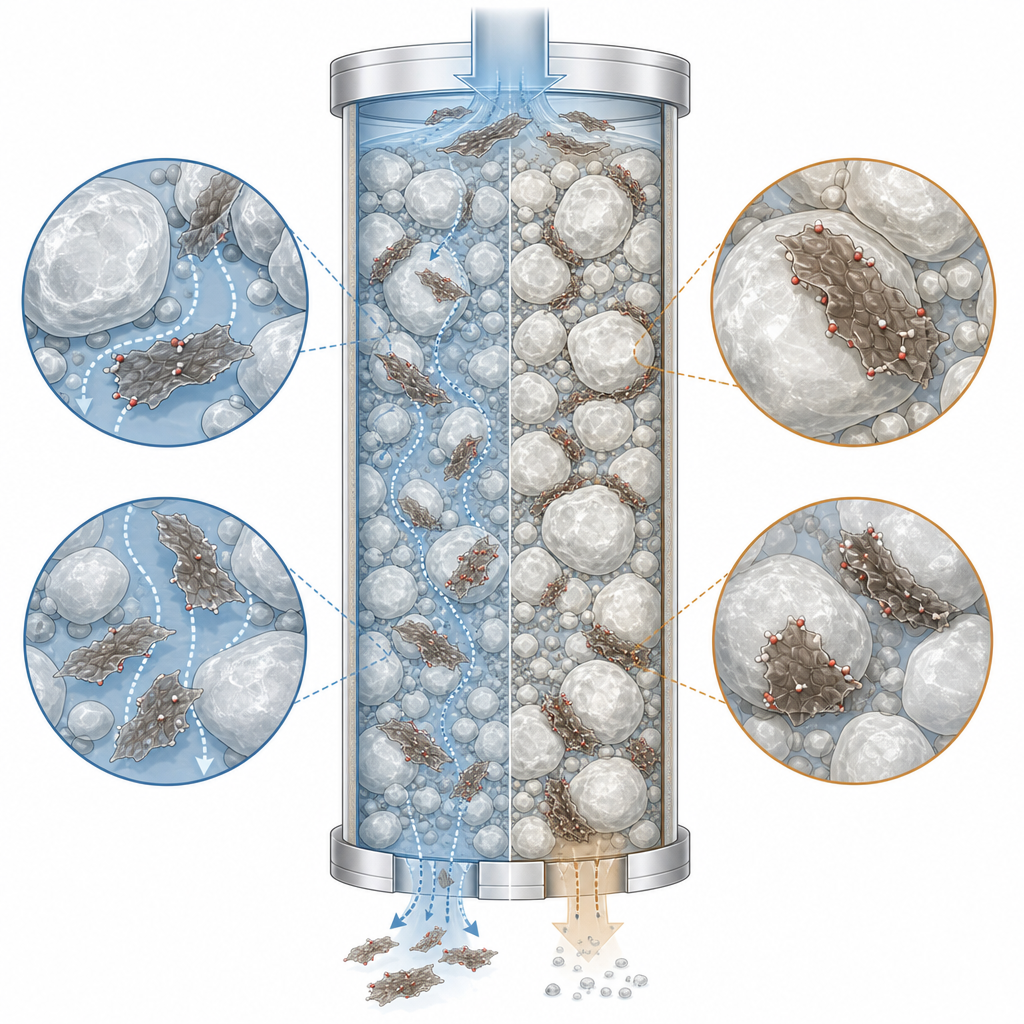 The ACS Material single-layer GO was produced via a modified Hummers method, with a flake diameter of 1–5 µm and thickness of 0.8–1.2 nm. To prepare working suspensions, 100 mg of the as-received GO was ultrasonicated in 1000 mL deionized water for 2 hours, then diluted with KCl electrolyte solutions to a working concentration of 20 mg/L at the targeted ionic strength. The GO suspensions were characterized by UV-Vis absorbance at 230 nm, with hydrodynamic diameter measured on a Malvern ZetaSizer and zeta potential on a Brookhaven ZetaPlus. The same GO suspension was used for parallel stability monitoring (7 h), batch sorption onto natural and acid-cleaned quartz sand (fine 0.3–0.4 mm; coarse 0.9–1.0 mm), and column transport experiments in a 2.5 × 12.5 cm acrylic column packed at a Darcy velocity of 0.2 cm/min. Breakthrough curves were collected over 2 pore volumes of GO injection followed by 3 pore volumes of background flushing, with effluent fractions analyzed by UV-Vis.
The GO suspensions were exceptionally stable across the tested matrix, with the largest temporal change in relative concentration only 0.025 C/C₀ over 7 hours (10 mM KCl, 24 °C). XDLVO calculations confirmed strong energy barriers above 10.6 mJ/m² between GO sheets, making aggregation in the primary minimum essentially impossible for 1–5 µm flakes; energy barriers were 16.6 and 16.5 mJ/m² at 1 mM and 11.1 and 10.6 mJ/m² at 10 mM (6 °C and 24 °C, respectively). At 1 mM IS, GO was highly mobile in all sand columns, with mass recovery between 77.3% and 92.4%, and temperature had negligible influence on transport. At 10 mM IS, however, temperature mattered strongly: higher temperature consistently reduced GO mobility for every sand type and grain size, and the amount of GO sorbed onto sand at 24 °C was more than double that at 6 °C. Zeta-potential measurements indicated that both GO and sand surfaces remained negatively charged but became less negative at higher temperature, weakening electrostatic repulsion. Hydrus-1D simulations using an advection–dispersion-reaction model with a maximum retention capacity Sₘₐₓ and first-order attachment coefficient k reproduced the breakthrough curves and confirmed temperature-driven changes in deposition parameters.
These findings have direct implications for environmental risk assessment of GO and other carbon nanomaterials in groundwater systems, seasonal contaminant transport modeling, and the design of permeable reactive barriers. Because subsurface temperature varies between roughly 4 °C and 14 °C in temperate shallow aquifers, the demonstrated temperature sensitivity at moderate ionic strengths means that summer/winter cycles could meaningfully shift GO mobility and the co-transport of bound heavy metals and organic contaminants. The work also points to the need to incorporate temperature-dependent attachment parameters into colloid filtration models and to extend the analysis to other engineered nanomaterials such as carbon nanotubes and reduced graphene oxide.
For researchers studying nanoparticle fate, transport, or environmental toxicology, reproducible starting materials are essential — and the single-layer graphene oxide used here is available from ACS Material in the Graphene Series catalog. Using a well-characterized commercial GO with specified flake size and thickness allowed the authors to cleanly attribute observed transport behavior to temperature and electrolyte effects rather than to batch-to-batch variability, supporting the broader goal of building a quantitative framework for nanomaterial behavior in porous media.How ACS Material products were used
- Single Layer Graphene Oxide Flake (H Method) (Graphene Series) — “The single layer GO nanosheets (ACS Material, Medford, MA) used in this study were produced using modified Hummers method [27]. Based on the information provided by the manufacture, the GO particles are in the diameter range of 1-5 um and the thickness range of 0.8-1.2 nm.”
Product Performance in this StudyThe ACS Material single-layer graphene oxide nanosheets (1–5 µm diameter, 0.8–1.2 nm thick) served as the model nanoparticle for the entire study. The GO was highly stable across tested temperatures and ionic strengths, with mass recovery in sand columns ranging from 77.3% to 92.4%, enabling robust quantification of temperature-dependent retention and transport.
Related product categories
Frequently asked questionsHow does temperature affect graphene oxide transport in saturated sand columns?
At low ionic strength (1 mM KCl), temperature has negligible effect on graphene oxide transport and the GO remains highly mobile with mass recovery between 77.3% and 92.4%. At higher ionic strength (10 mM KCl), however, increasing temperature consistently reduces GO mobility across all sand types and grain sizes, because warmer temperatures roughly double the amount of GO sorbed onto sand and reduce the magnitude of the negative zeta potential.
What grade of graphene oxide is used for nanoparticle fate and transport studies?
Single-layer graphene oxide produced by a modified Hummers method is the standard for fate and transport research. In this study the GO was supplied by ACS Material with flakes 1–5 µm in lateral diameter and 0.8–1.2 nm thick, giving a well-defined monolayer. Single-layer GO disperses readily in water by ultrasonication, allowing reproducible stability tests, batch sorption, and column breakthrough experiments at controlled concentrations such as 20 mg/L.
Why is XDLVO theory used to interpret graphene oxide deposition in porous media?
Extended DLVO (XDLVO) theory accounts for van der Waals attraction, electric double-layer repulsion, and Lewis acid-base interactions, which together govern colloidal stability and deposition of GO. In this work XDLVO predicted strong energy barriers above 10.6 mJ/m² between GO sheets, confirming the experimentally observed stability. The theory also explained why higher ionic strength introduces secondary energy minima that promote attachment to sand surfaces.