-
Graphene Oxide | ACS Material
Nov 21, 2017 | ACS MATERIAL LLCGraphene oxide is the workhorse of the graphene world: a single sheet of carbon studded with oxygen, cheap to make by the ton, soluble in water, and endlessly tunable. It is how most of the world actually gets its hands on graphene-like material — not by peeling crystals, but by oxidizing graphite, dispersing it, and reducing it back. This guide covers what graphene oxide really is, the 160-year synthesis story from Brodie to Hummers, its contested structure, how reduction turns an insulator back into a conductor, and the applications — membranes, energy, electronics, biomedicine — that make it matter, with interactive simulators and the primary literature behind every claim.
Quick answer: Graphene oxide (GO) is a single-layer sheet of carbon decorated with oxygen-containing groups — hydroxyls and epoxides across the basal plane, carboxyls at the edges. Those groups make it an electrical insulator but also render it dispersible in water, mechanically processable, and chemically tunable. GO is produced by oxidizing graphite (most often by the Hummers method) and exfoliating it; removing the oxygen — "reduction" — gives reduced graphene oxide (rGO), which recovers much of graphene's conductivity. This oxidize-disperse-reduce route is the most scalable, lowest-cost path to graphene-based materials, which is why GO underpins applications from water-filtration membranes to supercapacitors to drug delivery.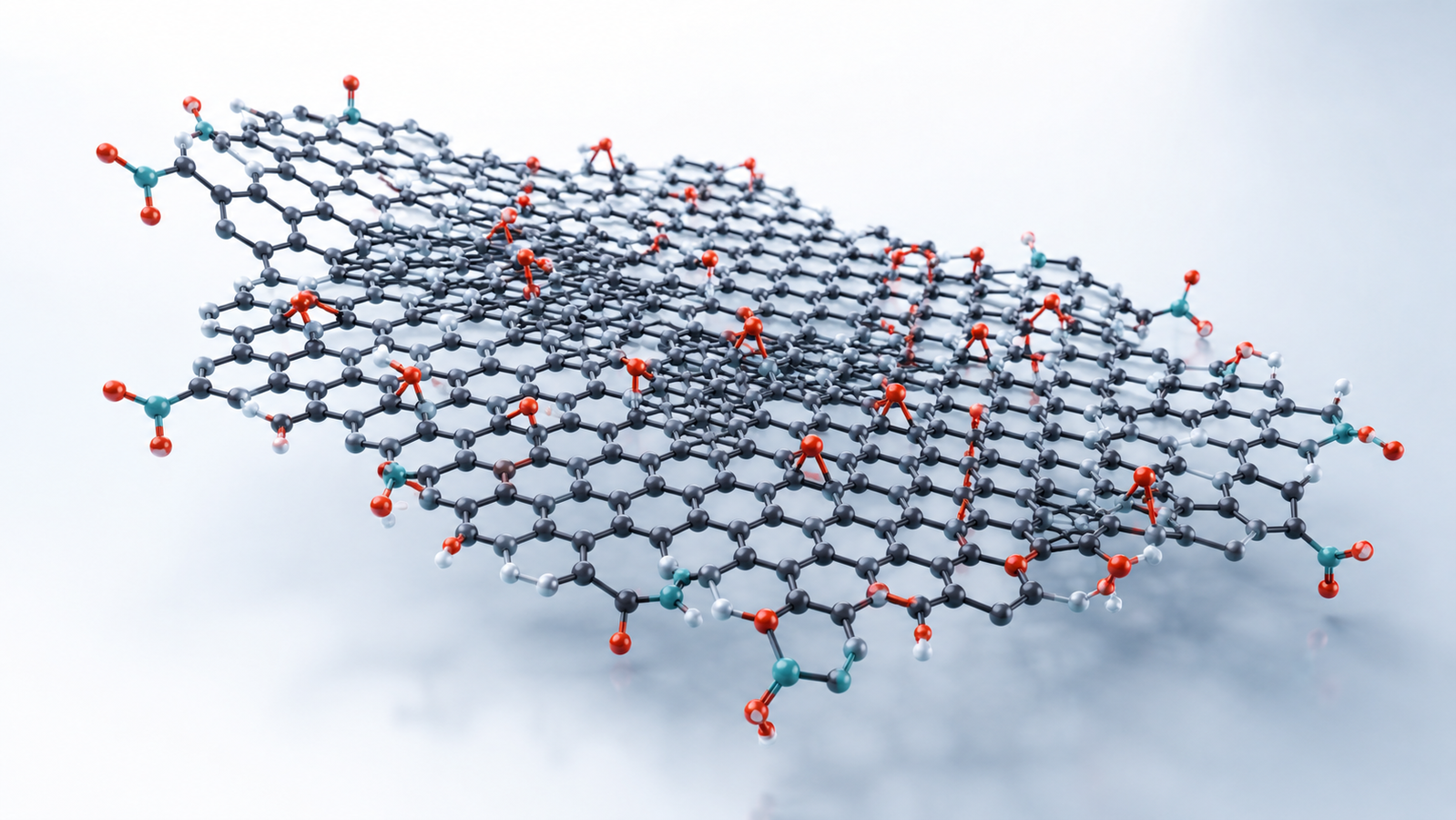
A single graphene oxide sheet: islands of intact, conductive sp² carbon interrupted by hydroxyl and epoxide groups across the plane, with carboxylic acids decorating the torn edges. What Graphene Oxide Actually Is
Graphene is a single layer of carbon atoms locked in a honeycomb lattice — every atom sp²-hybridized, every bond part of a continuous conjugated network that conducts electricity and heat superbly. Graphene oxide is what you get when you chemically assault that lattice with oxygen. The attack converts a large fraction of the flat, conductive sp² carbon into puckered sp³ carbon bearing oxygen groups: hydroxyls (–OH) and epoxides (–O–) scattered across the basal plane, and carboxylic acids (–COOH) clinging to the sheet edges. The result is a single sheet of carbon, hydrogen, and oxygen that looks like graphene under a microscope but behaves nothing like it electrically.
That trade-off is the whole point. Breaking the conjugation costs GO its conductivity — pristine GO is an electrical insulator, not a conductor, a fact worth stating plainly because it is frequently muddled. But in exchange, the oxygen groups make GO hydrophilic: it disperses spontaneously in water to form stable, honey-colored colloids without any surfactant, something graphene itself stubbornly refuses to do. Those same groups are chemical handles for functionalization, and they prop the carbon sheets apart so they can be exfoliated down to single layers. GO is, in short, graphene made processable — you give up electrons to gain a material you can pour, coat, print, and chemically modify.
The relationship runs in a cycle that defines the field. Graphite is oxidized to graphite oxide, exfoliated into single-layer graphene oxide, and then — when conductivity is needed back — chemically or thermally reduced to reduced graphene oxide (rGO), a graphene-like material that recovers much of the lost sp² network. Oxidize, disperse, reduce: it is the most scalable and lowest-cost route to bulk graphene-based material that exists, and it is why a 19th-century chemistry experiment became a 21st-century industry.
A 160-Year Story: Brodie to Hummers
Graphene oxide is far older than graphene. In 1859, the Oxford chemist Benjamin Brodie, trying to pin down the atomic weight of graphite, treated it with potassium chlorate and fuming nitric acid and produced what he described as thin, paper-like foils — the first graphite oxide, made 145 years before graphene itself was isolated.1 In 1898 Ludwig Staudenmaier refined the recipe, adding the chlorate in portions over the course of a week and incorporating sulfuric acid to reach a higher, more uniform degree of oxidation in a single vessel.2 Both routes worked, and both were slow, hazardous, and prone to releasing explosive or toxic gases.
The turning point came in 1958, when William Hummers and Richard Offeman at the National Lead Company published a faster, safer alternative: oxidize graphite with potassium permanganate (KMnO₄) and sodium nitrate (NaNO₃) in concentrated sulfuric acid, completing in hours what had taken days.3 The Hummers method — note the spelling, named for Hummers, no apostrophe-s — became and remains the dominant synthesis worldwide. It is not without flaws: the nitrate generates toxic NOₓ gases, and residual manganese and oxidation byproducts must be washed out. So the recipe keeps being improved. The most influential modernization, from James Tour's group at Rice University in 2010, drops the nitrate entirely, increases the permanganate, and runs the reaction in a 9:1 mixture of sulfuric and phosphoric acids, yielding more highly and regularly oxidized GO with no toxic gas evolution.4 Greener variants — eliminating the nitrate, lowering temperatures, recycling acids — continue to appear.5
The Contested Structure of GO
For a material this important, GO's exact atomic structure was argued over for the better part of a century — and in the strictest sense still is. The difficulty is intrinsic: GO is non-stoichiometric (its carbon-to-oxygen ratio varies with how it was made), amorphous, and hygroscopic, so no two batches are identical and no single crystal structure exists to solve. Early models built up the picture piece by piece. Hofmann proposed only epoxide groups; Ruess added hydroxyls and recognized the carbon sheet must pucker; Scholz and Boehm revised the layout; Szabó incorporated ketones. The modern understanding of GO's chemistry — how these groups form, react, and define the material — has been synthesized in an influential critical review.6
The model most chemists reach for today is the Lerf-Klinowski model, derived from solid-state NMR in 1998, which abandoned the search for a regular lattice and described GO as a largely random arrangement of hydroxyl and epoxide groups on the basal plane with carboxylic acids at the edges — intrinsically non-periodic.7 More recent work by Dimiev and Tour added a dynamic dimension, showing that GO is not even a static structure: in water it slowly reacts and releases acidity, evolving over time rather than sitting still.8 The practical lesson for anyone buying or using GO is that "graphene oxide" names a family of related materials, not a single compound, and oxidation degree, flake size, and synthesis route all matter.
The simulator below lets you explore a single GO sheet — toggle the functional groups on and off, and see how stripping the oxygen restores the conductive sp² network of rGO.
How GO Is Made Today
Modern GO production follows the same three-act logic regardless of the exact recipe: intercalate, oxidize, exfoliate. First, concentrated acid and an oxidizer force their way between graphite's stacked layers, prying them apart and inserting reactive species — this diffusion of oxidant into the galleries is the slow, rate-determining step.8 Second, the oxidizer attacks the carbon planes, decorating them with the oxygen groups and swelling the interlayer spacing from graphite's tight 3.35 å to roughly twice that, as water and functional groups wedge the sheets apart. Third, mild agitation or sonication completes the job: the now-weakly-bound, oxygen-studded layers float apart into single- and few-layer graphene oxide, dispersible directly in water.
The animation below walks through these three stages — pristine graphite, oxidized and expanded graphite oxide, and finally exfoliated single-layer GO.
Quality is where suppliers separate. The degree of oxidation, lateral flake size, single-layer yield, and — critically — the thoroughness of purification all vary. Incompletely washed GO retains residual salts and acids that compromise both performance and safety (more on that below). Producing large single sheets with an intact carbon framework and minimal impurities requires pure reactants, controlled conditions, and repeated purification — the difference between research-grade material and a flammable mess.
From GO to rGO: Reduction
Insulating GO becomes conductive again through reduction — stripping away the oxygen to rebuild the sp² network. The product, reduced graphene oxide, is graphene's affordable, scalable cousin: it recovers a large share of the electrical conductivity, but never perfectly, because reduction leaves behind residual oxygen and permanent lattice defects (holes and vacancies created when the oxygen groups departed). rGO is therefore a distinct material, not true graphene — the distinction matters for anyone specifying it.
There are many routes to remove the oxygen, each trading off conductivity, scalability, and cleanliness. Chemical reduction with hydrazine was the classic demonstration, converting GO into graphene-like nanosheets in suspension.9 Thermal reduction simply heats GO to high temperature, blasting off oxygen as CO and CO₂ (this is how the supercapacitor materials below are made). Electrochemical and, increasingly, laser reduction allow patterned, localized conversion — writing conductive rGO circuits directly into an insulating GO film. The full menu of reduction methods, and how each affects the final properties, has been reviewed comprehensively.10 A useful consequence: because reduction can be tuned continuously, the same starting sheet can be dialed anywhere from insulator to semiconductor to near-metallic conductor.
Use the slider below to watch GO's conductivity climb — and its oxygen content fall — as the degree of reduction increases.
Properties That Make GO Useful
GO's value comes from a bundle of properties that graphene itself cannot match in practice. Water dispersibility is the headline: stable aqueous colloids mean GO can be processed with the cheap, scalable, environmentally benign solution methods of ordinary chemistry — spin-coating, spraying, vacuum filtration, inkjet printing — rather than the vacuum systems graphene demands. Mechanical strength survives the oxidation surprisingly well: atomic-force measurements put the effective Young's modulus of monolayer GO at roughly 208 GPa, lower than pristine graphene's terapascal stiffness but still far stronger than most engineering materials, and enough to make GO a potent reinforcement filler.13 Tunable optics and electronics follow from reduction: as oxygen is removed, GO shifts from a transparent insulator toward a conductor, so thin films can be tuned across orders of magnitude in conductivity and made into transparent, flexible electrodes — a candidate to replace brittle indium tin oxide.11 GO is also optically active, with composition-dependent fluorescence that makes it a chemically tunable platform for photonics and sensing.12
Crucially, GO is a building block. Its sheets can be assembled into macroscopic forms that retain nanoscale order: free-standing GO "paper" made by simple vacuum filtration interlocks the platelets into a film stiffer and stronger than many conventional papers,14 and that paper can be toughened further by cross-linking the sheets with divalent ions such as Ca²⁺ and Mg²⁺.15 GO, rGO, and graphene thus form a versatile trio of carbon feedstocks for papers, coatings, composites, foams, and fibers — the conceptual basis for treating GO as a general-purpose raw material rather than a niche chemical.16
Membranes and Molecular Sieving: GO's Standout Application
If GO has a killer application, it is the separation membrane — and the story is one of the most elegant in nanomaterials. Stack GO sheets into a laminate and you build a maze: water and small species thread the two-dimensional channels between sheets, while anything too large is blocked. The foundational discovery, from Andre Geim's group at Manchester in 2012, was startling: micron-thick GO laminates are so tightly sealed they are vacuum-tight to helium in the dry state, yet they let water vapor pass through essentially unimpeded, as if the membrane were not there.17 Water moves through GO's nanocapillaries with almost no friction; nearly everything else stops.
The follow-up work turned that curiosity into a sieve. Immersed in water, the same laminates block all dissolved species with a hydrated radius larger than about 4.5 å, while smaller ions slip through at rates thousands of times faster than ordinary diffusion would allow.18 The remaining obstacle for desalination was that GO swells in water, widening its channels to ~13.5 å — too large to stop common salt ions. The 2017 breakthrough was learning to physically confine the laminate and tune the interlayer spacing down a controlled ladder, from ~9.8 å to 6.4 å, finally squeezing the channels below the size of hydrated salt ions and reaching around 97% rejection of NaCl while barely slowing the water.19 GO membranes also separate gases selectively, with ultrathin films sieving hydrogen from larger molecules.20 The simulator below shows the mechanism — adjust the interlayer spacing and watch which species make it through.
The appeal for industry is that GO membranes are made by depositing a water dispersion onto a support — mechanically robust, easy to fabricate, and with no fundamental barrier to large-scale production, exactly the kind of solution-processed manufacturing GO enables. Water purification, desalination, solvent recovery, and even nuclear-waste separations are all active targets.
Energy Storage and Electronics
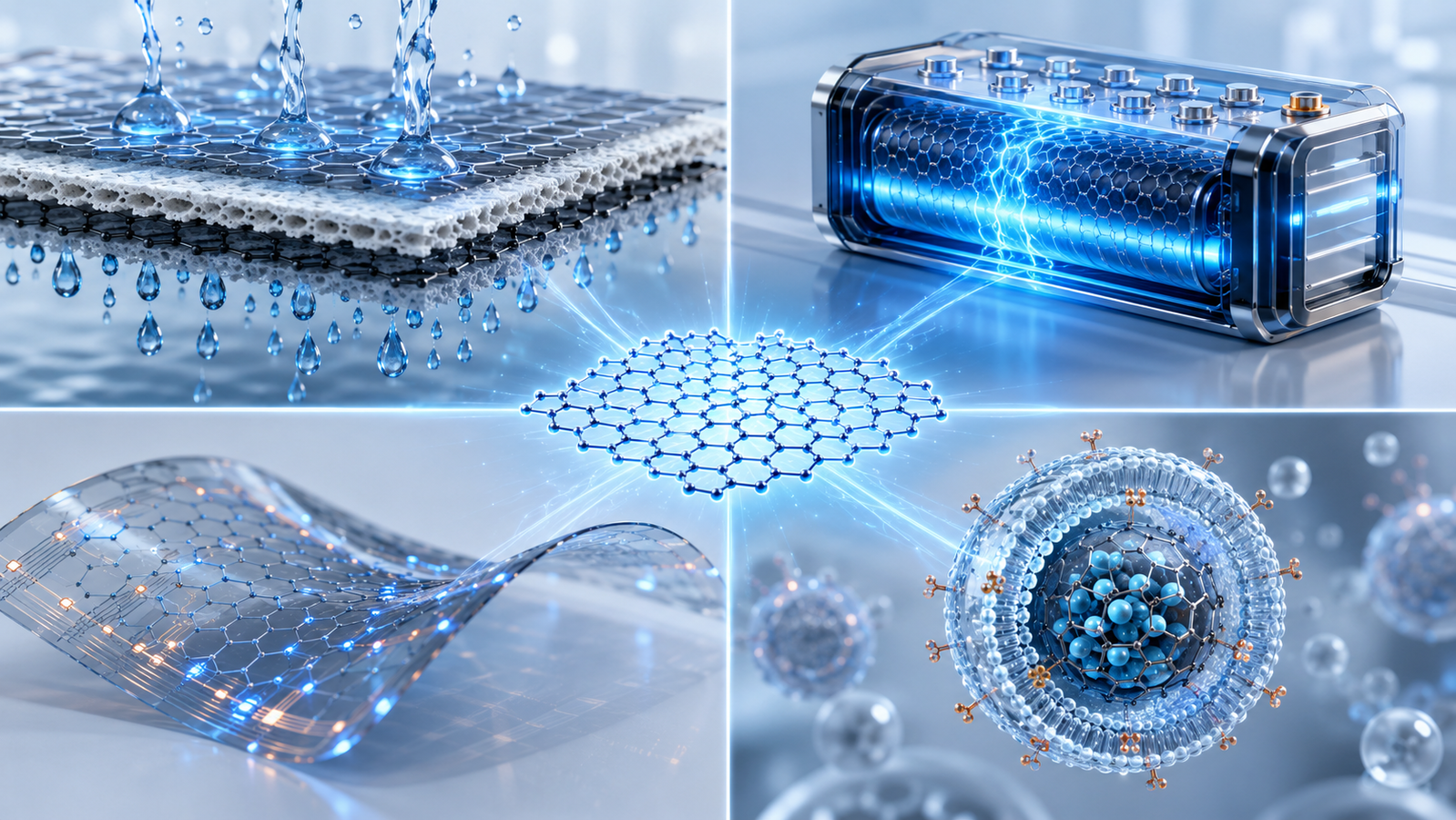
One feedstock, many devices: the oxidize-disperse-reduce route lets graphene oxide flow into membranes, energy electrodes, flexible conductors, and biomedical carriers alike. GO is a precursor to some of the best carbon electrodes ever measured. Chemically activating thermally exfoliated graphite oxide with potassium hydroxide produces a porous, sp²-rich carbon with a Brunauer-Emmett-Teller surface area reaching about 3,100 m²/g — a continuous three-dimensional network of atom-thick, curved walls riddled with sub-5-nanometer pores — that delivers high capacitance and conductivity as a supercapacitor electrode.21 Because GO disperses in water and reduces on demand, it slots naturally into batteries, capacitors, conductive inks, and printed electronics; the broad synthesis-properties-applications landscape for GO and its reduced form in energy devices has been surveyed in depth.22 And because reduced GO can be deposited as a large-area, tunable, semi-transparent film with ambipolar transistor behavior in its thinnest form, it is a serious candidate for flexible displays, touch panels, and transparent conductors where conventional materials are too brittle.11
Biomedicine and Antibacterial Uses
The same water dispersibility and vast functionalizable surface that help GO in membranes make it attractive in biology, though always with the caveat that biocompatibility depends sharply on dose, size, and surface chemistry. As a drug carrier, PEGylated nanoscale GO can load water-insoluble aromatic anticancer drugs onto its surface by π-stacking and ferry them into cells — an early and influential demonstration of GO-based delivery.23 Functionalized nano-GO doubles as a fluorescent label for cellular imaging while carrying its cargo,24 and engineered GO surfaces can capture rare circulating tumor cells from blood.
GO is also intrinsically antibacterial. Free-standing GO and rGO paper inhibit the growth of E. coli with minimal cytotoxicity to mammalian cells, a result that launched interest in GO coatings for clinical and environmental use.25 The mechanism is twofold — physical membrane damage from sharp sheet edges plus oxidative stress — and it operates across graphite, graphite oxide, GO, and rGO to differing degrees.26 Molecular studies show graphene sheets entering cells through spontaneous membrane penetration at edge asperities and corner sites, the physical basis for both the antibacterial action and the toxicology that must be managed in any biomedical use.27
Handling and Safety
One safety issue deserves explicit attention because it is widely underappreciated: graphite oxide can be flammable, even explosively so, when it is not properly purified. The hazard was documented as far back as 1965, when Boehm and Scholz characterized the "deflagration point" of graphite oxide — a temperature above which the oxygen-rich material can self-propagate a rapid decomposition.28 The danger is strongly tied to residual contaminants: potassium salts and other oxidizing byproducts left over from synthesis can render the material energetic and prone to ignition.29 The deflagration temperature even depends on synthesis route, differing by up to 100 °C between Brodie- and Hummers-made material. This is not a reason to avoid GO — it is a reason to insist on thoroughly purified material. Well-washed GO with residual salts removed handles safely, which is precisely why purification quality is a core specification, not an afterthought. Beyond flammability, normal nanomaterial precautions apply: avoid inhaling dry powder, use appropriate ventilation and personal protective equipment, and handle dispersions, which are inherently lower-risk, where possible.
GO Products from ACS Material
ACS Material manufactures graphene oxide across the formats research and pilot-scale work require, all made by a modified Hummers method and purified repeatedly to remove the potassium-salt residues that compromise safety and performance. The Single-Layer Graphene Oxide (H Method) is supplied as a high-single-layer-yield material suitable for reduction to graphene and for composite work. For solution processing without the dispersion step, Single-Layer Graphene Oxide Dispersion in water (and an ethanol version) ships ready to use at concentrations up to 10 mg/mL, with a pH of about 3–5, and stays stable for over a year without any surfactant. For microscopy and membrane research, Graphene Oxide Film provides TEM support films in single-layer (0.6–1 nm) and double-layer (1–1.5 nm) thicknesses. The same catalog carries Reduced Graphene Oxide, Single-Layer Graphene, and graphene nanoplatelets for teams working across the full oxidize-disperse-reduce cycle. Every lot ships with characterization data, and the applications team can advise on grade selection, oxidation degree, and dispersion handling.
FAQ
Is graphene oxide conductive?
No — pristine graphene oxide is an electrical insulator. The oxygen groups disrupt the sp² carbon network that carries current in graphene. Conductivity is recovered by reducing GO to reduced graphene oxide (rGO), which rebuilds much of that network, though rGO never quite matches pristine graphene because residual oxygen and lattice defects remain.
What is the difference between graphene oxide and reduced graphene oxide?
GO is the oxidized, oxygen-rich, water-dispersible insulator that comes straight out of the Hummers process. rGO is GO after most of that oxygen has been removed by chemical, thermal, electrochemical, or laser reduction — it is conductive and graphene-like, but contains residual oxygen and permanent defects, so it is a distinct material from both GO and true graphene.
What is graphene oxide used for?
The biggest opportunities are separation membranes (water purification, desalination, gas and solvent separation), energy storage (supercapacitor and battery electrodes, conductive inks), transparent flexible electronics via rGO, mechanical reinforcement of composites, and biomedicine (drug delivery, imaging, antibacterial coatings). GO is also the most common precursor for producing graphene-like material at scale.
What is the Hummers method?
It is the dominant way to make graphene oxide, published by Hummers and Offeman in 1958: graphite is oxidized with potassium permanganate and sodium nitrate in concentrated sulfuric acid. It is faster and safer than the older Brodie and Staudenmaier routes. Modern "improved" versions — notably Tour's 2010 method using a sulfuric/phosphoric acid mix without nitrate — raise the oxidation quality and eliminate toxic gas evolution.
Is graphene oxide magnetic?
Pure graphene oxide is not magnetic in any useful sense. It can be made magnetically responsive by decorating it with magnetic nanoparticles (for example iron oxide), which is done deliberately for applications like magnetically separable adsorbents and targeted drug carriers — but that is a composite, not GO itself.
Is graphene oxide safe to handle?
Properly purified GO — with residual salts washed out — handles safely with standard nanomaterial precautions. The main specific hazard is that poorly purified graphite oxide containing residual potassium salts can be flammable or even deflagrate when heated. Avoid inhaling dry powder, work with adequate ventilation and PPE, and favor dispersions where possible. Biocompatibility in biomedical contexts depends on dose, flake size, and surface chemistry.
References
1Brodie, B. C. On the Atomic Weight of Graphite. Philosophical Transactions of the Royal Society of London 149, 249–259 (1859). DOI: 10.1098/rstl.1859.00132Staudenmaier, L. Verfahren zur Darstellung der Graphitsäure. Berichte der Deutschen Chemischen Gesellschaft 31, 1481–1487 (1898). DOI: 10.1002/cber.189803102373Hummers, W. S.; Offeman, R. E. Preparation of Graphitic Oxide. Journal of the American Chemical Society 80, 1339 (1958). DOI: 10.1021/ja01539a0174Marcano, D. C.; Kosynkin, D. V.; Berlin, J. M.; Sinitskii, A.; Sun, Z.; Slesarev, A.; Alemany, L. B.; Lu, W.; Tour, J. M. Improved Synthesis of Graphene Oxide. ACS Nano 4, 4806–4814 (2010). DOI: 10.1021/nn10063685Chen, J.; Yao, B.; Li, C.; Shi, G. An Improved Hummers Method for Eco-Friendly Synthesis of Graphene Oxide. Carbon 64, 225–229 (2013). DOI: 10.1016/j.carbon.2013.07.0556Dreyer, D. R.; Park, S.; Bielawski, C. W.; Ruoff, R. S. The Chemistry of Graphene Oxide. Chemical Society Reviews 39, 228–240 (2010). DOI: 10.1039/B917103G7Lerf, A.; He, H.; Forster, M.; Klinowski, J. Structure of Graphite Oxide Revisited. The Journal of Physical Chemistry B 102, 4477–4482 (1998). DOI: 10.1021/jp97318218Dimiev, A. M.; Tour, J. M. Mechanism of Graphene Oxide Formation. ACS Nano 8, 3060–3068 (2014). DOI: 10.1021/nn500606a9Stankovich, S.; Dikin, D. A.; Piner, R. D.; Kohlhaas, K. A.; Kleinhammes, A.; Jia, Y.; Wu, Y.; Nguyen, S. T.; Ruoff, R. S. Synthesis of Graphene-Based Nanosheets via Chemical Reduction of Exfoliated Graphite Oxide. Carbon 45, 1558–1565 (2007). DOI: 10.1016/j.carbon.2007.02.03410Pei, S.; Cheng, H.-M. The Reduction of Graphene Oxide. Carbon 50, 3210–3228 (2012). DOI: 10.1016/j.carbon.2011.11.01011Suk, J. W.; Piner, R. D.; An, J.; Ruoff, R. S. Mechanical Properties of Monolayer Graphene Oxide. ACS Nano 4, 6557–6564 (2010). DOI: 10.1021/nn101781v12Eda, G.; Fanchini, G.; Chhowalla, M. Large-Area Ultrathin Films of Reduced Graphene Oxide as a Transparent and Flexible Electronic Material. Nature Nanotechnology 3, 270–274 (2008). DOI: 10.1038/nnano.2008.8313Loh, K. P.; Bao, Q.; Eda, G.; Chhowalla, M. Graphene Oxide as a Chemically Tunable Platform for Optical Applications. Nature Chemistry 2, 1015–1024 (2010). DOI: 10.1038/nchem.90714Dikin, D. A.; Stankovich, S.; Zimney, E. J.; Piner, R. D.; Dommett, G. H. B.; Evmenenko, G.; Nguyen, S. T.; Ruoff, R. S. Preparation and Characterization of Graphene Oxide Paper. Nature 448, 457–460 (2007). DOI: 10.1038/nature0601615Park, S.; Lee, K.-S.; Bozoklu, G.; Cai, W.; Nguyen, S. T.; Ruoff, R. S. Graphene Oxide Papers Modified by Divalent Ions — Enhancing Mechanical Properties via Chemical Cross-Linking. ACS Nano 2, 572–578 (2008). DOI: 10.1021/nn700349a16Compton, O. C.; Nguyen, S. T. Graphene Oxide, Highly Reduced Graphene Oxide, and Graphene: Versatile Building Blocks for Carbon-Based Materials. Small 6, 711–723 (2010). DOI: 10.1002/smll.20090193417Nair, R. R.; Wu, H. A.; Jayaram, P. N.; Grigorieva, I. V.; Geim, A. K. Unimpeded Permeation of Water through Helium-Leak-Tight Graphene-Based Membranes. Science 335, 442–444 (2012). DOI: 10.1126/science.121169418Joshi, R. K.; Carbone, P.; Wang, F. C.; Kravets, V. G.; Su, Y.; Grigorieva, I. V.; Wu, H. A.; Geim, A. K.; Nair, R. R. Precise and Ultrafast Molecular Sieving through Graphene Oxide Membranes. Science 343, 752–754 (2014). DOI: 10.1126/science.124571119Abraham, J.; Vasu, K. S.; Williams, C. D.; Gopinadhan, K.; Su, Y.; Cherian, C. T.; Dix, J.; Prestat, E.; Haigh, S. J.; Grigorieva, I. V.; Carbone, P.; Geim, A. K.; Nair, R. R. Tunable Sieving of Ions Using Graphene Oxide Membranes. Nature Nanotechnology 12, 546–550 (2017). DOI: 10.1038/nnano.2017.2120Kim, H. W.; Yoon, H. W.; Yang, S.-M.; Yoo, S.-M.; Suh, B. M.; Park, H. B.; et al. Selective Gas Transport through Few-Layered Graphene and Graphene Oxide Membranes. Science 342, 91–95 (2013). DOI: 10.1126/science.123609821Zhu, Y.; Murali, S.; Stoller, M. D.; Ganesh, K. J.; Cai, W.; Ferreira, P. J.; Pirkle, A.; Wallace, R. M.; Cychosz, K. A.; Thommes, M.; Su, D.; Stach, E. A.; Ruoff, R. S. Carbon-Based Supercapacitors Produced by Activation of Graphene. Science 332, 1537–1541 (2011). DOI: 10.1126/science.120077022Zhu, Y.; Murali, S.; Cai, W.; Li, X.; Suk, J. W.; Potts, J. R.; Ruoff, R. S. Graphene and Graphene Oxide: Synthesis, Properties, and Applications. Advanced Materials 22, 3906–3924 (2010). DOI: 10.1002/adma.20100106823Liu, Z.; Robinson, J. T.; Sun, X.; Dai, H. PEGylated Nanographene Oxide for Delivery of Water-Insoluble Cancer Drugs. Journal of the American Chemical Society 130, 10876–10877 (2008). DOI: 10.1021/ja803688x24Sun, X.; Liu, Z.; Welsher, K.; Robinson, J. T.; Goodwin, A.; Zaric, S.; Dai, H. Nano-Graphene Oxide for Cellular Imaging and Drug Delivery. Nano Research 1, 203–212 (2008). DOI: 10.1007/s12274-008-8021-825Hu, W.; Peng, C.; Luo, W.; Lv, M.; Li, X.; Li, D.; Huang, Q.; Fan, C. Graphene-Based Antibacterial Paper. ACS Nano 4, 4317–4323 (2010). DOI: 10.1021/nn101097v26Liu, S.; Zeng, T. H.; Hofmann, M.; Burcombe, E.; Wei, J.; Jiang, R.; Kong, J.; Chen, Y. Antibacterial Activity of Graphite, Graphite Oxide, Graphene Oxide, and Reduced Graphene Oxide: Membrane and Oxidative Stress. ACS Nano 5, 6971–6980 (2011). DOI: 10.1021/nn202451x27Li, Y.; Yuan, H.; von dem Bussche, A.; Creighton, M.; Hurt, R. H.; Kane, A. B.; Gao, H. Graphene Microsheets Enter Cells through Spontaneous Membrane Penetration at Edge Asperities and Corner Sites. Proceedings of the National Academy of Sciences 110, 12295–12300 (2013). DOI: 10.1073/pnas.122227611028Boehm, H. P.; Scholz, W. Der "Verpuffungspunkt" des Graphitoxids. Zeitschrift für Anorganische und Allgemeine Chemie 335, 74–79 (1965). DOI: 10.1002/zaac.1965335011029Krishnan, D.; Kim, F.; Luo, J.; Cruz-Silva, R.; Cote, L. J.; Jang, H. D.; Huang, J. Energetic Graphene Oxide: Challenges and Opportunities. Nano Today 7, 137–152 (2012). DOI: 10.1016/j.nantod.2012.02.003