-
Graphene Quantum Dot Organic Synapses - Hanyang University, 2017
Jun 05, 2026 | ACS MATERIAL LLCChoi, H. Y. et al. (2017). Organic electronic synapses with pinched hystereses based on graphene quantum-Dot nanocomposites. *NPG Asia Materials*. https://doi.org/10.1038/am.2017.133
NPG Asia Materials · 2017
Hanyang University researchers built PEDOT:PSS/GQD organic electronic synapses with pinched hysteresis using ACS Material graphene quantum dots.
About this research
Researchers at Hanyang University demonstrated organic electronic synapses based on PEDOT:PSS/graphene quantum dot (GQD) nanocomposites using a GQD aqueous suspension supplied by ACS Material, and showed that the devices exhibit clear pinched-hysteresis current–voltage (I–V) loops that are the electrical fingerprint of a synaptic device. The Al/PEDOT:PSS:GQDs/ITO/glass stack was fabricated entirely by solution processing. Under successive positive voltage sweeps the conductance gradually increased, and under successive negative sweeps it decreased, mimicking the potentiation and depression of a biological synapse. The 1:0.4 PEDOT:PSS-to-GQD volume ratio gave the best synaptic response.
Neuromorphic hardware aims to replicate the massive parallelism, plasticity and energy efficiency of biological synapses, which is impossible to reach with conventional CMOS logic alone. Resistive-switching devices are the most attractive synaptic primitive because of their simple two-terminal structure and CMOS compatibility. Within that family, organic and carbon-based nanocomposites stand out for low cost, solution processability, mechanical flexibility and environmental friendliness. Graphene quantum dots are especially interesting as the active charge-trapping element: their discrete electronic states, tunable energy levels and well-defined trapping/detrapping kinetics give designers a direct handle on conductance modulation. The paper addresses an open question in this space, namely how to combine a conducting polymer (PEDOT:PSS) with GQDs into an active layer whose conductance can be programmed continuously rather than abruptly switched, enabling analog synaptic weight updates.
The GQD suspension in deionized water was obtained from ACS Material (Pasadena, CA, USA) and mixed directly with Clevios PH1000 PEDOT:PSS. Six formulations were prepared by combining 1 mL of PEDOT:PSS with 0, 0.2, 0.4, 0.6, 1 or 1.2 mL of the GQD suspension, labeled E-S-0 through E-S-1.2. Each mixture was ultrasonicated for 30 min, then spin-coated onto cleaned ITO/glass substrates at 3000 rpm for 30 s followed by 300 rpm for 10 s, and baked at 100 °C for 10 min. Top aluminum electrodes (1 mm diameter, 200 nm thick) were thermally evaporated to complete the Al/PEDOT:PSS:GQDs/ITO/glass capacitor. The GQDs from ACS Material gave bright blue photoluminescence under 365 nm UV excitation, confirmed by PL and UV–vis spectra, and acted as the charge-trapping centers responsible for the analog conductance response of the active layer.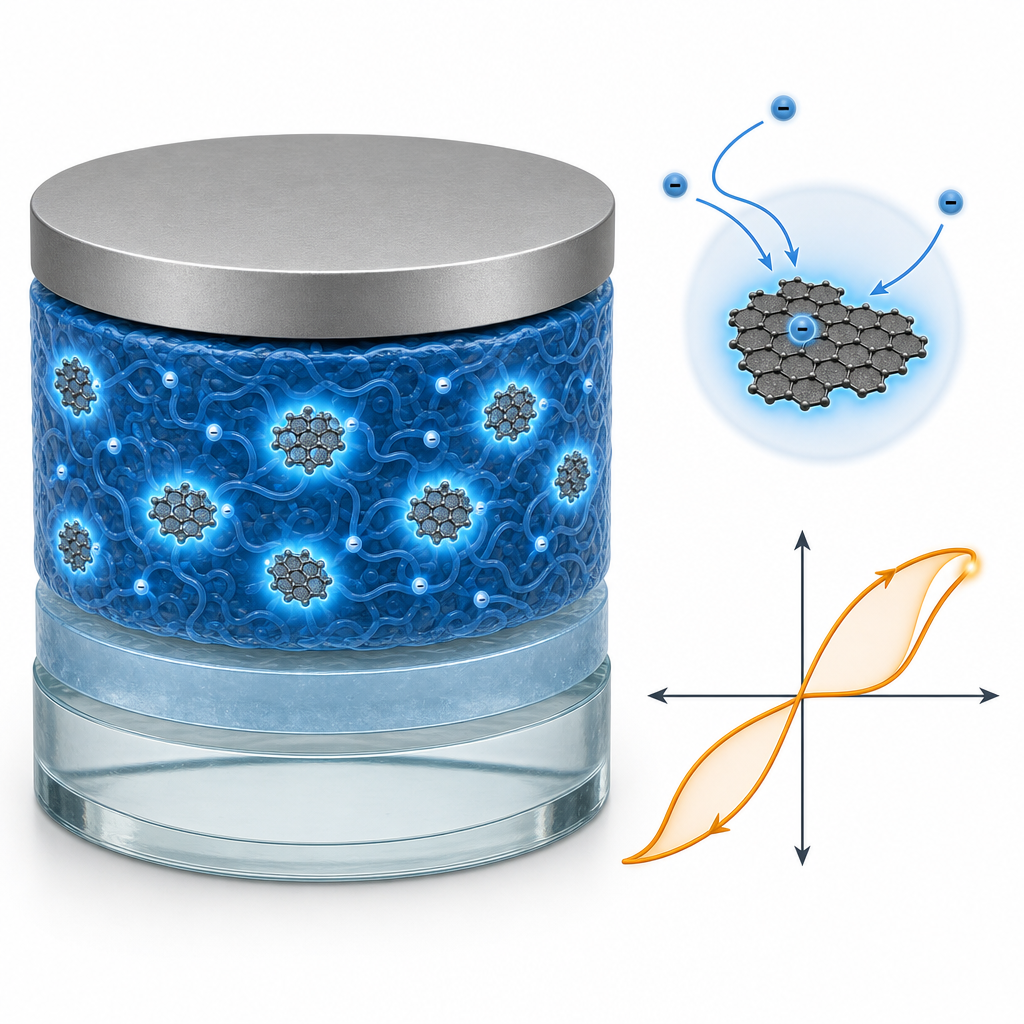
The pristine PEDOT:PSS device (E-S-0) showed no hysteresis, confirming that the synaptic behavior originates entirely from the embedded GQDs. As GQDs were introduced, pinched-hysteresis loops appeared and the steady-state current decreased monotonically with increasing GQD loading, consistent with electron trapping at the GQDs reducing the effective hole conduction in the p-type PEDOT:PSS matrix. The E-S-0.4 device, corresponding to a 1:0.4 PEDOT:PSS:GQD ratio, was identified as the optimum: it combined the most clearly defined pinched hysteresis with the strongest voltage-driven conductance modulation. Under dual positive bias sweeps, conductance increased step-by-step with successive sweeps, reproducing long-term potentiation; under dual negative sweeps, conductance decreased step-by-step, reproducing long-term depression. The authors interpret these analog updates as progressive filling of GQD trap states under positive bias and progressive emptying under negative bias, with the energy-band diagram constructed from ultraviolet photoelectron spectroscopy and UV–vis data supporting the picture. Cross-sectional SEM verified a uniform PEDOT:PSS/GQD layer between ITO and Al, and all electrical measurements were performed at room temperature in air on a Keithley 2400 sourcemeter.
The demonstration is directly relevant to neuromorphic computing, where analog, non-volatile synaptic weights are needed for in-memory machine-learning accelerators, edge AI and brain-inspired sensors. Because the entire stack is solution-processed at low temperature on ITO/glass, it is compatible with flexible and large-area substrates, opening a path to wearable artificial neural networks and bio-interfaced electronics. The authors point to further optimization of GQD size, surface chemistry and polymer matrix to extend retention, increase the number of distinguishable conductance states and improve endurance. The same PEDOT:PSS/GQD platform could also be useful for memristive logic, reservoir computing and adaptive photodetectors.
For researchers working on organic memristors, synaptic transistors, or carbon-based bio-inspired electronics, the result confirms that commercially available graphene quantum dots can serve as effective charge-trapping elements in conducting-polymer matrices without elaborate in-house synthesis. The blue-luminescent aqueous GQD suspensions used here are available from ACS Material, alongside related carboxylated, aminated and hydroxylated graphene quantum dot products that allow tuning of dispersibility and energy-level alignment for adjacent neuromorphic, sensing and optoelectronic applications.How ACS Material products were used
- Blue Luminescent Graphene Quantum Dots (aqueous suspension) (Quantum Dots & Upconverting Nanoparticles) — “a GQD suspension in deionized water (ACS Material, Pasadena, CA, USA)”
Product Performance in this StudyThe graphene quantum dots from ACS Material were embedded in PEDOT:PSS to form the active layer of the organic electronic synapse. Their charge-trapping states produced the pinched-hysteresis I–V response that defines synaptic behavior, with the 1:0.4 PEDOT:PSS:GQD ratio giving the best performance.
Related product categories
Frequently asked questionsHow do graphene quantum dots enable synaptic behavior in PEDOT:PSS devices?
Graphene quantum dots embedded in PEDOT:PSS act as discrete charge-trapping centers. Under positive bias, electrons are progressively trapped on the GQDs, while negative bias releases them. This gradual filling and emptying of trap states produces analog conductance changes and pinched-hysteresis I–V loops that mimic long-term potentiation and depression in biological synapses, instead of an abrupt resistive switch.
What PEDOT:PSS-to-graphene quantum dot ratio works best for organic synapses?
In this study, six formulations from 1:0 to 1:1.2 by volume were compared. The 1:0.4 ratio (1 mL PEDOT:PSS to 0.4 mL GQD aqueous suspension) gave the most well-defined pinched hysteresis and the strongest analog conductance modulation under successive bias sweeps. Higher GQD loadings reduced overall current too strongly, while lower loadings did not produce clear synaptic hysteresis.
Why are aqueous graphene quantum dot suspensions useful for neuromorphic device fabrication?
Aqueous GQD suspensions are directly compatible with water-based conducting polymers like PEDOT:PSS, so they can be mixed, ultrasonicated and spin-coated without solvent exchange. This enables fully solution-processed, low-temperature fabrication of synaptic stacks on ITO/glass or flexible substrates, supporting large-area neuromorphic circuits, wearable artificial neural networks and bio-interfaced electronics.