-
Graphene Quantum Dots for Biosynaptic Devices - Hanyang University, 2020
Jul 02, 2026 | ACS MATERIAL LLCSung, S. et al. (2020). Biosynaptic devices based on chicken egg albumen:graphene quantum dot nanocomposites. *Scientific Reports*. https://doi.org/10.1038/s41598-020-57966-z
Scientific Reports · 2020
Researchers at Hanyang University built chicken egg albumen:graphene quantum dot biosynaptic memristors with retention times above 10,000 seconds.
About this research
Researchers at Hanyang University used graphene quantum dots supplied by ACS Material, blended into chicken egg albumen (CEA), to build two-terminal biosynaptic devices that emulate biological synapses with retention times above 10^4 seconds. The Al/CEA:GQD/ITO architecture displayed clockwise pinched current-voltage hysteresis under consecutive negative and positive voltage sweeps - the hallmark fingerprint of a memristive synapse. By varying the GQD volume fraction in the albumen matrix from 0 to 20%, the team systematically mapped how quantum-dot loading governs synaptic performance, and they proposed a carrier-transport model fitted to the slopes of the I-V curves. The work positions naturally derived proteins combined with carbon nanomaterials as a viable, human-friendly platform for next-generation neuromorphic hardware.
Neuromorphic computing has emerged as a leading route around the von Neumann bottleneck, where data shuttling between memory and processor limits both throughput and energy efficiency. Two-terminal memristors that mimic synaptic plasticity at low power are central to this effort, but conventional oxide-based resistive switches can be costly to integrate and difficult to flex. Organic and bio-organic memristors based on hybrid nanocomposites offer simpler solution processing, mechanical flexibility, and the prospect of biocompatible electronics for wearable and implantable sensing. Chicken egg albumen has attracted growing attention in this space because its proteins denature upon heating, modifying oxygen diffusion paths and supporting the formation and rupture of conductive filaments. Pairing this protein matrix with charge-storing nanofillers such as graphene quantum dots is a logical strategy to combine sustainable matrix chemistry with the well-defined electronic structure of a 2D carbon allotrope.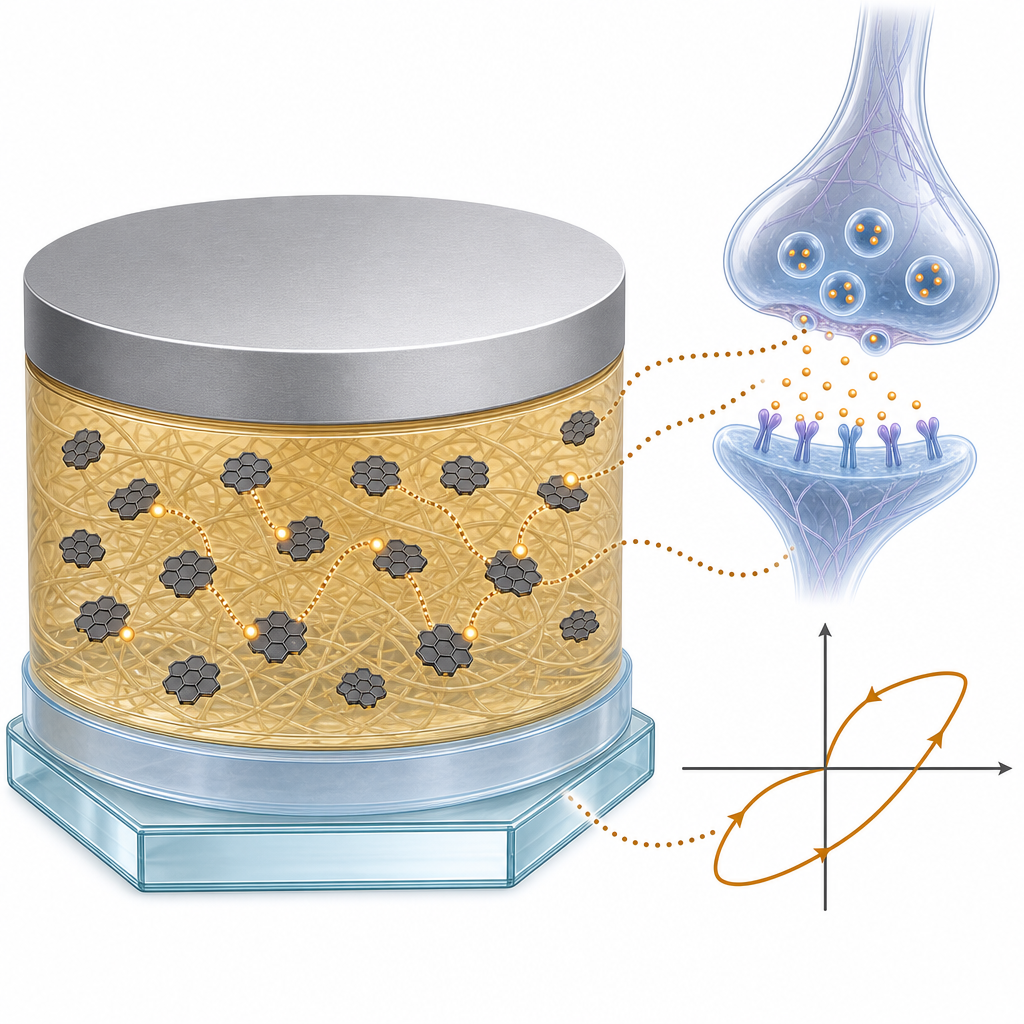
Graphene quantum dots from ACS Material were used as the charge-storage component embedded in the albumen active layer. The fabrication began by separating egg white from yolk with a steel-mesh spoon, then mixing the CEA liquid with the GQD solution at volume ratios of 0%, 5%, 10%, 15%, and 20%, followed by 15 minutes of ultrasonication at room temperature to disperse the dots uniformly. ITO-coated glass substrates were ultrasonically cleaned in acetone, methanol, and de-ionized water, then dried under high-purity N2. The CEA:GQD blends were spin-coated through a multi-step program (500 rpm/3 s, 1500 rpm/5 s, 4000 rpm/30 s, 1500 rpm/5 s, 500 rpm/3 s) to yield uniform films. Devices were annealed at 120 °C for 20 minutes to drive controlled protein denaturation, and 200-nm-thick, 1-mm-diameter aluminum top electrodes were thermally evaporated through a shadow mask at 1 × 10^-6 Torr. The GQDs sit at the heart of this stack: they provide the localized charge-storage sites whose filling and emptying under applied bias produces the analog conductance modulation needed for synaptic behavior.
The Al/CEA:GQD/ITO devices showed clockwise pinched hysteresis loops in I-V curves measured with a Keithley 2400 system at 300 K, with the loop area and current levels modulated by GQD concentration. The hysteresis confirms memristive switching consistent with biological synaptic responses. Retention measurements remained stable for more than 10^4 seconds under ambient conditions, indicating robust non-volatile storage of the conductance state - a critical metric for synaptic weight stability. The team analyzed the carrier transport mechanisms by fitting the slopes of different I-V regions, attributing conduction at low bias to ohmic behavior and at higher bias to trap-assisted and space-charge-limited transport associated with charge trapping in the GQDs. Structural characterization by scanning electron microscopy (Verios G4 UC) confirmed the morphology of the CEA:GQD composite films. Together, the data establish that incorporating graphene quantum dots into a denatured protein matrix produces a reliable artificial synapse with tunable plasticity, low fabrication cost, and stable operation over relevant timescales.
The demonstration is relevant to several research streams. Biocompatible memristors are attractive for wearable neuromorphic sensors, implantable electronics, and transient/green electronics that minimize environmental impact at end-of-life. The use of GQDs - synthesizable at scale and compatible with solution processing - opens routes to large-area, flexible synaptic arrays on plastic substrates. The authors note that further work on pulse-driven measurements, on emulating short- and long-term plasticity, and on scaling crossbar arrays would extend this platform toward functional neuromorphic blocks. Adjacent applications include photo-synaptic devices using the optical absorption of GQDs, multi-state memory for in-memory computing, and bio-integrated logic circuits where protein-based matrices may interface naturally with biological tissue.
For researchers developing similar synaptic, memristive, or charge-storage devices, the graphene quantum dot products available from ACS Material provide the dispersible, electronically well-defined nanocarbon used in this study. Reproducible GQD chemistry is critical for hysteresis tuning, retention stability, and device-to-device uniformity. The paper underscores how a single nanomaterial component, properly dispersed in a low-cost biopolymer host, can deliver synapse-like behavior without exotic deposition equipment - a practical entry point for laboratories building toward neuromorphic computing demonstrators.How ACS Material products were used
- Graphene Quantum Dots (GQD solution) (Quantum Dots & Upconverting Nanoparticles) — “The separated CEA liquid was mixed with a GQD solution (ACS MATERIAL) in volume ratios of 0, 5, 10, 15 and 20%”
Product Performance in this StudyThe ACS Material graphene quantum dots, embedded in chicken egg albumen at controlled volume ratios, provided the charge-storage centers that enabled stable clockwise pinched I-V hysteresis and synaptic plasticity in the fabricated biosynaptic devices, with retention times exceeding 10^4 s.
Related product categories
Frequently asked questionsHow do graphene quantum dots enable synaptic behavior in egg albumen memristors?
Graphene quantum dots embedded in the chicken egg albumen layer act as discrete charge-storage and trapping centers. Under applied voltage sweeps, electrons are captured and released by these dots, modulating the conductance of the film and producing the clockwise pinched I-V hysteresis that defines memristive synaptic behavior. Tuning the GQD volume fraction (0-20%) controls the hysteresis area and retention, enabling analog synaptic weight programming for neuromorphic devices.
Why is chicken egg albumen used as the matrix in biosynaptic devices?
Chicken egg albumen is a low-cost, biocompatible protein matrix whose dielectric constant is low and whose proteins denature on annealing. Denaturation alters oxygen diffusion paths and supports the formation and rupture of conductive filaments under bias, generating resistive switching. Combined with the human-friendly, biodegradable nature of albumen, this makes CEA an attractive host for sustainable, flexible synaptic devices targeting wearable and implantable neuromorphic systems.
What retention time did the CEA:GQD biosynaptic devices achieve?
The Al/CEA:GQD/ITO biosynaptic devices retained their conductance state for more than 10,000 seconds (10^4 s) under ambient conditions, with relatively constant performance. This long retention demonstrates non-volatile storage of synaptic weights, a key requirement for memristive artificial synapses used in neuromorphic computing where stable analog states must be maintained between programming events.