-
Graphene Super Strength: How a One-Atom Sheet Outperforms Steel
Jan 08, 2020 | ACS MATERIAL LLCGraphene is the strongest material ever measured: a single atomic layer of carbon that is roughly 200 times stronger than structural steel by weight, yet so thin a square meter weighs less than a milligram. That headline hides a more interesting story — what "strength" actually means for a one-atom sheet, how a famous 2008 experiment pushed an AFM tip into a graphene drumhead to measure it, why a perfect flake reaches 130 GPa but a real-world film usually does not, and how engineers are putting a fraction of that strength to work in composites, coatings, sports gear, and aerospace today. This guide covers all of it, with interactive physics simulators and the primary literature behind every number.
Quick answer: Graphene's strength comes from its lattice of sp² carbon–carbon bonds — among the strongest chemical bonds in nature — arranged in a flawless two-dimensional honeycomb. A defect-free monolayer has a Young's modulus (stiffness) near 1 TPa and an intrinsic (breaking) strength of about 130 GPa, measured directly by nanoindentation in 2008. That makes it the strongest material ever tested and, normalized for its tiny weight, roughly 200× stronger than high-strength steel. The catch: that figure is for a perfect, pristine flake. Real graphene contains defects and grain boundaries that lower its strength, and the way to exploit it in practice is as a reinforcing additive in composites and coatings rather than as a bulk structural solid.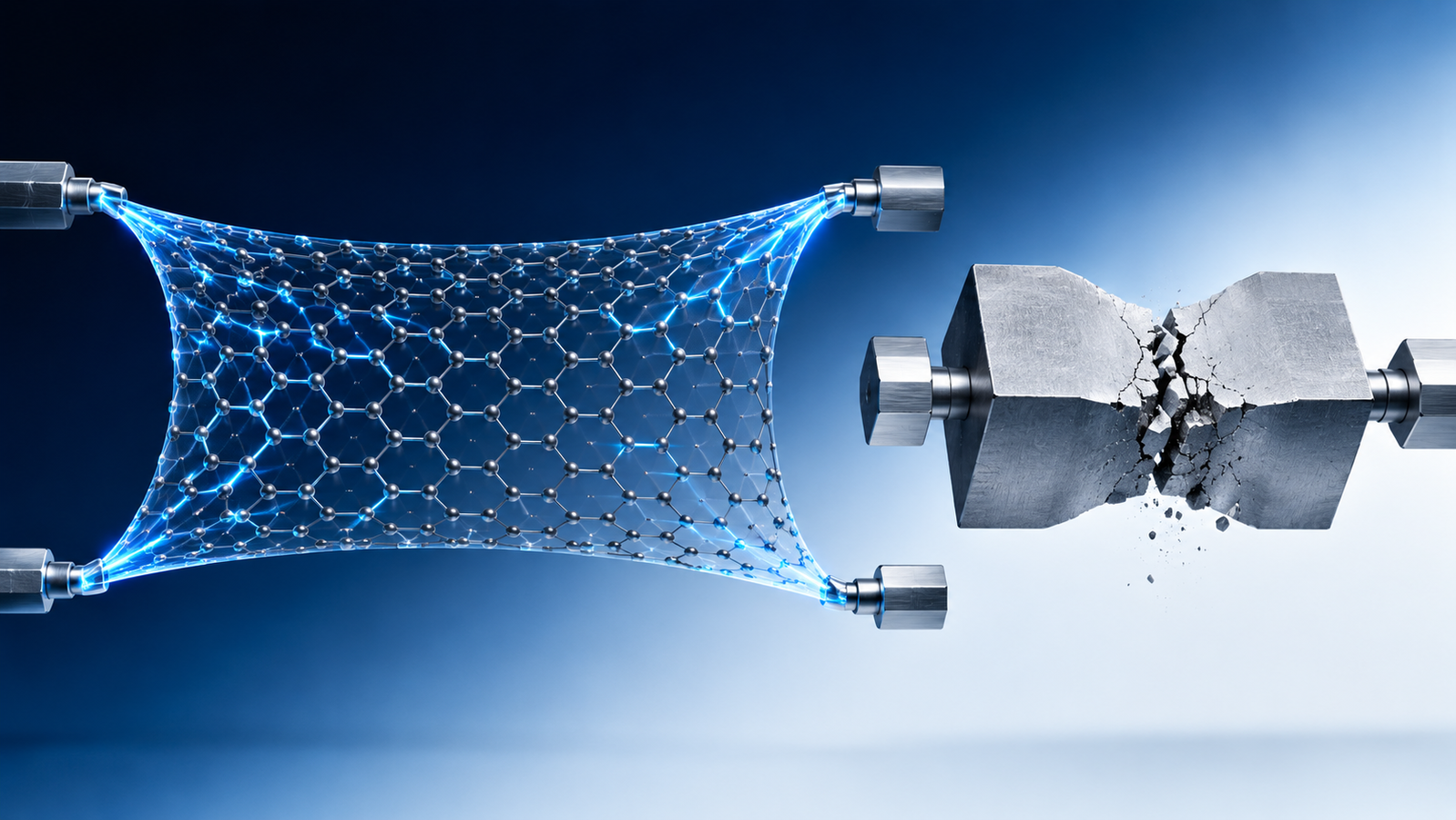
Graphene's strength is the strength of its carbon–carbon bond network: pull on a flawless sheet and every bond shares the load, so it stretches elastically to a stress no bulk metal can survive. What Makes Graphene So Strong
Graphene is a single layer of carbon atoms locked into a hexagonal, honeycomb lattice. Each atom is covalently bonded to three neighbors through sp² hybridization, and those carbon–carbon bonds are the source of everything that follows. The C–C bond is one of the strongest and shortest bonds in organic chemistry, and in graphene every atom in the plane participates in three of them at 120° angles, distributing any applied load across a continuous, seamless network with no weak links to initiate failure.1
Two features make this arrangement exceptional. First, it is genuinely two-dimensional: there is no third dimension into which the structure can buckle or shear under in-plane tension, so a pulling force is carried directly by bond stretching rather than by the bending, sliding, or dislocation motion that limits metals. Second, a pristine sheet is essentially a single, perfect crystal — there are no grain boundaries, voids, or impurity inclusions where a crack could nucleate. When graphene was first isolated and characterized in 2004, this combination of a perfect 2D crystal and the intrinsic strength of the C–C bond immediately marked it as a candidate for the strongest material in existence.12 For a broader tour of how this same structure produces graphene's electrical, thermal, and optical properties, see our companion overview of graphene facts and fundamentals.
Two Numbers: Stiffness and Strength
Two distinct quantities describe a material's mechanical performance, and they are easy to confuse. Young's modulus measures stiffness — how much stress is needed to produce a given amount of elastic stretch. Intrinsic strength measures how much stress the material can bear before it fractures. A material can be very stiff but weak, or compliant but strong; graphene happens to be both extremely stiff and extremely strong.
For a defect-free monolayer, Young's modulus is approximately 1 TPa (1,000 GPa) and the intrinsic strength is approximately 130 GPa.3 First-principles calculations of the ideal strength — the stress at which the lattice itself becomes mechanically unstable — agree closely with this value, confirming that the measured number really does approach the theoretical limit of the bond network rather than being set by some flaw.4 Because graphene is one atom thick, mechanicians often quote these as two-dimensional quantities normalized to the sheet rather than to a bulk cross-section: a 2D elastic modulus of about 340 N/m and a 2D breaking strength of about 42 N/m, which convert to the TPa and GPa figures using graphene's effective thickness of 0.335 nm.35
What makes these numbers headline-worthy is graphene's combination of strength and lightness. Carbon is a light element, so on a strength-to-weight (specific strength) basis graphene leaves structural metals far behind — the often-quoted figure is that it is on the order of 100–200 times stronger than steel for the same weight. The frequently repeated image is that a hypothetical sheet of graphene as thin as household cling film could, in principle, support the weight of an elephant balanced on a pencil before it punctured.
How We Know: The Nanoindentation Test
You cannot clamp a one-atom sheet in a tensile machine and pull. The breakthrough measurement, reported by Lee, Wei, Kysar, and Hone in 2008, instead suspended monolayer graphene over an array of micron-sized circular holes to make tiny free-standing drumheads, then pushed down on the center of each drumhead with the diamond tip of an atomic force microscope while recording force versus depth.3 The shape of that force–deflection curve encodes the elastic modulus, and the force at which the membrane finally bursts — combined with the known geometry of the tip — gives the breaking stress directly under the tip, which is the intrinsic strength.
The simulator below reproduces this experiment with the actual membrane mechanics. Drag the indentation and watch the force climb non-linearly (the stiffening is the sheet stretching, not bending), then break when the stress under the tip reaches graphene's intrinsic limit.
The elegance of the method is that it isolates the intrinsic strength: by loading a small, suspended region with a sharp tip, the experiment probes a patch of lattice small enough to be effectively defect-free, so the number it returns reflects the bonds themselves. This is why 130 GPa is described as an intrinsic strength — a ceiling set by chemistry, which larger or imperfect samples approach but rarely reach.
Stretching to the Breaking Point
Graphene fails in a way that is fundamentally different from a metal. A ductile metal yields: past a certain stress its atoms begin to slip along dislocations, it deforms permanently, and it absorbs energy before finally tearing. Graphene does none of this. It has no yield point and no plastic regime — it stretches elastically, storing energy like a spring, all the way up to fracture, at which point it fails suddenly and completely. It is, in materials terms, a nearly ideal brittle solid that happens to be enormously strong.6
Its elasticity is also non-linear. Rather than following a straight Hooke's-law line, the stress–strain relation softens at large strain and is well described by σ = Eε + Dε², where E ≈ 1.0 TPa and the second-order elastic modulus D ≈ −2.0 TPa.3 The peak of that curve — the intrinsic strength — falls at a remarkable strain of roughly 25%, meaning a pristine sheet can be reversibly stretched by about a quarter of its length before breaking. The second simulator lets you pull a sheet and trace this curve to fracture, with high-strength steel drawn for scale.
That ~25% elastic strain limit is itself a useful property: it is why graphene is being explored for flexible and stretchable electronics, where a conductor must survive repeated bending and stretching without cracking.7 Recent experiments on free-standing monolayers have confirmed that graphene can sustain large, fully reversible elastic strains, opening the door to "straintronics," where mechanical strain is used deliberately to tune the material's electronic behavior.6
Graphene vs. Steel, Kevlar, and Carbon Nanotubes
Ranking materials by strength requires care, because the fair comparison depends on whether you weight by cross-section or by mass. By intrinsic strength, graphene (~130 GPa) sits at the top, comparable to a single-walled carbon nanotube — which is, after all, a rolled-up tube of the same graphene lattice — and far above engineering materials. Kevlar, the benchmark for high-performance fibers, has a tensile strength around 3.7 GPa; high-strength structural steels reach roughly 1–2 GPa. On a per-weight basis the gap widens further, because graphene is several times less dense than steel.
The honest caveat is that these are not interchangeable comparisons. Steel's value as a structural material lies partly in its ductility and toughness — its ability to bend, absorb impact, and fail gracefully — not only in its peak strength. Graphene wins decisively on intrinsic strength and stiffness-to-weight, but as a brittle 2D crystal it is not a drop-in replacement for a load-bearing steel beam. Its strength is best understood as a resource to be transferred into other materials, which is the subject of the next two sections.
The Real-World Catch: Defects and Grain Boundaries
The 130 GPa figure describes a perfect flake. The graphene that can be manufactured at scale — most importantly the large-area films grown by chemical vapor deposition (CVD) — is polycrystalline: it is stitched together from many small single-crystal grains that meet at grain boundaries, lines of non-hexagonal (often pentagon–heptagon) carbon rings.8 A crack finds it far easier to start and propagate along these boundaries and at point defects, so the practical strength of a real sheet can fall well below the intrinsic ceiling.
How much it falls depends sensitively on the structure of the boundaries. Atomistic studies showed the counterintuitive result that, under the right conditions, certain high-angle tilt boundaries can be nearly as strong as pristine graphene, because the way the defect rings are arranged matters more than how many there are.9 Building on this, a 2013 study demonstrated that CVD graphene with well-connected grains can recover a large fraction of intrinsic strength — the earlier disappointing measurements were traced to damage introduced during the polymer transfer process, not to the grain boundaries themselves.10 Graphene's fracture toughness — its resistance to a propagating crack — has also been measured directly, giving engineers the data needed to design around its brittleness rather than be surprised by it.11 The practical lesson is that sheet quality, grain size, and clean handling determine how much of graphene's theoretical strength actually shows up in a part.
Putting Strength to Work: Composites and Coatings
Because bulk graphene is impractical as a standalone structural solid, the dominant route to using its strength is as a nanoscale reinforcement dispersed into a host material — a polymer, epoxy, metal, or cement. Even a small loading of graphene or graphene nanoplatelets can raise a composite's stiffness, strength, and toughness, while also adding electrical and thermal conductivity and improved barrier properties.1213
The key physics is load transfer: the host matrix must grip the graphene tightly enough that, when the composite is stressed, the load is actually transmitted into the strong filler rather than slipping past it. Spectroscopic measurements of a single graphene monolayer embedded in a polymer have mapped exactly how stress builds up from the edges of a flake toward its center, quantifying the interfacial shear that governs reinforcement efficiency.14 Getting the most out of graphene therefore depends on good dispersion (so flakes do not clump), high aspect ratio (large, thin platelets transfer load better), and strong interfacial bonding — which is why surface-functionalized grades and well-exfoliated nanoplatelets are formulated specifically for composite work.12
Strength in the 21st Century
Graphene's mechanical properties are already moving from the lab into products, almost always in the composite-additive form described above. In sporting goods, graphene-reinforced resins appear in tennis rackets, bicycle frames and tires, skis, and helmets, where a few percent of added stiffness and toughness at negligible weight is commercially valuable. In aerospace and automotive applications, graphene-reinforced composites are being explored for lightweight panels, coatings, and multifunctional components, where even modest improvements in stiffness, toughness, conductivity, or barrier performance can be valuable.15
In construction, adding small amounts of graphene or reduced graphene oxide to cement and concrete has been shown to increase compressive and flexural strength and reduce permeability, potentially allowing less material to do the same job. In protective coatings, graphene's combination of strength, impermeability, and chemical inertness makes it attractive for hard, anti-wear, and anti-corrosion surface layers. And in flexible electronics and wearables, it is precisely graphene's ability to be stretched and bent elastically — that ~25% strain headroom — that lets it serve as a durable transparent conductor on surfaces that must flex without failing.716 Across all of these, the engineering goal is the same: capture a useful fraction of graphene's extraordinary intrinsic strength inside a material you can actually manufacture and shape.
Graphene Products from ACS Material
ACS Material supplies graphene in the formats used for both mechanical research and composite development, each with characterization data and applications support for grade selection.
- Single-Layer Graphene — high-surface-area monolayer graphene in powder and dispersion forms, the starting point for reduction, coatings, and reinforcement work.
- Trivial Transfer® Graphene (TTG) — continuous single- or multilayer CVD graphene films that transfer onto any substrate with only tweezers and water, ideal for suspended-membrane and mechanical experiments.
- CVD Graphene — large-area, high-quality films on copper, Si/SiO₂, PET, quartz, and other substrates for studies where continuous, low-defect sheets matter.
- Graphene Nanoplatelets — few-layer platelets in a range of thicknesses and diameters, formulated to disperse into polymers, rubbers, adhesives, and thermoset composites to improve mechanical strength and conductivity.
- Full Graphene Series — the complete catalog, including graphene oxide, reduced graphene oxide, and functionalized grades for composite and coating formulations.
For background on the most widely used solution-processable grade and its mechanical role in composites, see our detailed guide to graphene oxide structure, synthesis, and applications, and for budgeting research quantities, our overview of how much graphene costs.
FAQ
Is graphene really 200 times stronger than steel?On a strength-to-weight basis, roughly yes — a defect-free graphene monolayer has an intrinsic strength near 130 GPa, and because carbon is light, that corresponds to on the order of 100–200 times the specific strength of structural steel. The comparison is for a pristine flake, not for bulk material, and it weighs strength per unit mass rather than overall toughness, where ductile steel still has advantages.Why isn't everything made of graphene if it's so strong?The 130 GPa figure applies to a perfect, microscopic flake. Manufacturable large-area graphene contains grain boundaries and defects that lower its strength, and as a brittle 2D crystal it cannot simply replace a structural beam. The realistic way to use its strength is as a reinforcing additive in composites and coatings, which is exactly how it is being commercialized.How was graphene's strength measured if you can't pull on one atom?By nanoindentation. Graphene is suspended over micron-sized holes to form free-standing drumheads, and an AFM tip pushes on the center while recording force versus depth. The force–deflection curve gives the elastic modulus, and the bursting force combined with the tip geometry gives the intrinsic breaking strength (Lee et al., Science 2008).Does graphene oxide have the same strength as graphene?No. Graphene oxide (GO) is graphene decorated with oxygen groups that disrupt the perfect sp² lattice, so individual GO sheets are weaker and less stiff than pristine graphene. GO and reduced GO are valued for being inexpensive, water-dispersible, and easy to process into composites and papers — useful mechanically in bulk form, but not a substitute for the intrinsic strength of a flawless monolayer.How much can graphene stretch before it breaks?A pristine monolayer can be stretched elastically by roughly 25% before fracture, with no permanent (plastic) deformation along the way. That large reversible strain is part of why graphene is attractive for flexible and stretchable electronics.References
1Novoselov, K. S.; Geim, A. K.; Morozov, S. V.; et al. Electric Field Effect in Atomically Thin Carbon Films. Science 306, 666–669 (2004). DOI: 10.1126/science.11028962Geim, A. K.; Novoselov, K. S. The Rise of Graphene. Nature Materials 6, 183–191 (2007). DOI: 10.1038/nmat18493Lee, C.; Wei, X.; Kysar, J. W.; Hone, J. Measurement of the Elastic Properties and Intrinsic Strength of Monolayer Graphene. Science 321, 385–388 (2008). DOI: 10.1126/science.11579964Liu, F.; Ming, P.; Li, J. Ab Initio Calculation of Ideal Strength and Phonon Instability of Graphene under Tension. Physical Review B 76, 064120 (2007). DOI: 10.1103/PhysRevB.76.0641205Akinwande, D.; Brennan, C. J.; Bunch, J. S.; et al. A Review on Mechanics and Mechanical Properties of 2D Materials — Graphene and Beyond. Extreme Mechanics Letters 13, 42–77 (2017). DOI: 10.1016/j.eml.2017.01.0086Cao, K.; Feng, S.; Han, Y.; et al. Elastic Straining of Free-Standing Monolayer Graphene. Nature Communications 11, 284 (2020). DOI: 10.1038/s41467-019-14130-07Kim, K. S.; Zhao, Y.; Jang, H.; et al. Large-Scale Pattern Growth of Graphene Films for Stretchable Transparent Electrodes. Nature 457, 706–710 (2009). DOI: 10.1038/nature077198Wei, Y.; Wu, J.; Yin, H.; et al. The Nature of Strength Enhancement and Weakening by Pentagon–Heptagon Defects in Graphene. Nature Materials 11, 759–763 (2012). DOI: 10.1038/nmat33709Grantab, R.; Shenoy, V. B.; Ruoff, R. S. Anomalous Strength Characteristics of Tilt Grain Boundaries in Graphene. Science 330, 946–948 (2010). DOI: 10.1126/science.119689310Lee, G.-H.; Cooper, R. C.; An, S. J.; et al. High-Strength Chemical-Vapor-Deposited Graphene and Grain Boundaries. Science 340, 1073–1076 (2013). DOI: 10.1126/science.123512611Zhang, P.; Ma, L.; Fan, F.; et al. Fracture Toughness of Graphene. Nature Communications 5, 3782 (2014). DOI: 10.1038/ncomms478212Papageorgiou, D. G.; Kinloch, I. A.; Young, R. J. Mechanical Properties of Graphene and Graphene-Based Nanocomposites. Progress in Materials Science 90, 75–127 (2017). DOI: 10.1016/j.pmatsci.2017.07.00413Stankovich, S.; Dikin, D. A.; Dommett, G. H. B.; et al. Graphene-Based Composite Materials. Nature 442, 282–286 (2006). DOI: 10.1038/nature0496914Gong, L.; Kinloch, I. A.; Young, R. J.; et al. Interfacial Stress Transfer in a Graphene Monolayer Nanocomposite. Advanced Materials 22, 2694–2697 (2010). DOI: 10.1002/adma.20090426415Kinloch, I. A.; Suhr, J.; Lou, J.; Young, R. J.; Ajayan, P. M. Composites with Carbon Nanotubes and Graphene: An Outlook. Science 362, 547–553 (2018). DOI: 10.1126/science.aat743916Galiotis, C.; Frank, O.; Koukaras, E. N.; Sfyris, D. Graphene Mechanics: Current Status and Perspectives. Annual Review of Chemical and Biomolecular Engineering 6, 121–140 (2015). DOI: 10.1146/annurev-chembioeng-061114-123216Further reading: New to graphene? Start with our pillar guide — Graphene Facts: properties, structure, and applications — for the complete picture of what graphene is and how its record strength fits alongside its electrical, thermal, and optical properties.This article is provided for educational purposes by ACS Material LLC and concerns the mechanical properties of graphene. The idealized property values cited (for example, ~1 TPa Young's modulus and ~130 GPa intrinsic strength) are benchmarks for defect-free monolayer material under specific test conditions; the properties of any commercial product depend on grade, number of layers, defect density, and handling. Consult the relevant product datasheets and SDS before purchase or use. The interactive simulators are schematic teaching tools built on simplified physical models, not predictive engineering software.