-
Graphene-Supported Co-Fe3O4 for Antibiotic Sensing — Sustainable Environment Research Center, 2021
Jun 24, 2026 | ACS MATERIAL LLCNehru, R., Dong, C., & Chen, C. (2021). Cobalt-Doped Fe3O4 Nanospheres Deposited on Graphene Oxide as Electrode Materials for Electrochemical Sensing of the Antibiotic Drug. *ACS Applied Nano Materials*. https://doi.org/10.1021/acsanm.1c00826
Sustainable Environment Research Center · ACS Applied Nano Materials · 2021
Researchers built a Co-doped Fe3O4/graphene oxide electrode using ACS Material graphene, achieving 1.04 nM detection of chloramphenicol in milk.
About this research
Researchers at the Sustainable Environment Research Center (National Kaohsiung University of Science and Technology) used layered graphene supplied by ACS Material to fabricate a cobalt-doped Fe3O4 nanosphere/graphene oxide (Co–Fe3O4 NS/GO) composite that detects the antibiotic chloramphenicol (CAP) at a limit of 1.04 nM. Published in ACS Applied Nano Materials in 2021, the study reports a voltammetric sensor capable of monitoring CAP residues in commercial milk with strong selectivity, cycle stability, and reproducibility. The work demonstrates how pairing a doped transition-metal oxide with a graphene support yields an inexpensive electrode material for routine antibiotic-residue screening in food.
Chloramphenicol is a broad-spectrum antibiotic whose residues in animal-derived foods are associated with adverse health outcomes including aplastic anaemia, leading many regulators to ban or severely restrict its use. Conventional detection relies on HPLC, GC-MS, LC-MS/MS, capillary electrophoresis, chemiluminescence, ELISA, or antibody-based assays — all of which are accurate but expensive, slow, and instrument-intensive. Electrochemical sensors offer a faster, lower-cost alternative, but bare carbon electrodes suffer from surface fouling, poor reproducibility, and limited sensitivity. The field has therefore moved toward composite electrodes that combine carbon supports with transition-metal oxides, where the metal oxide supplies catalytic redox activity and the carbon framework supplies conductivity, surface area, and π–π interactions with aromatic analytes such as CAP.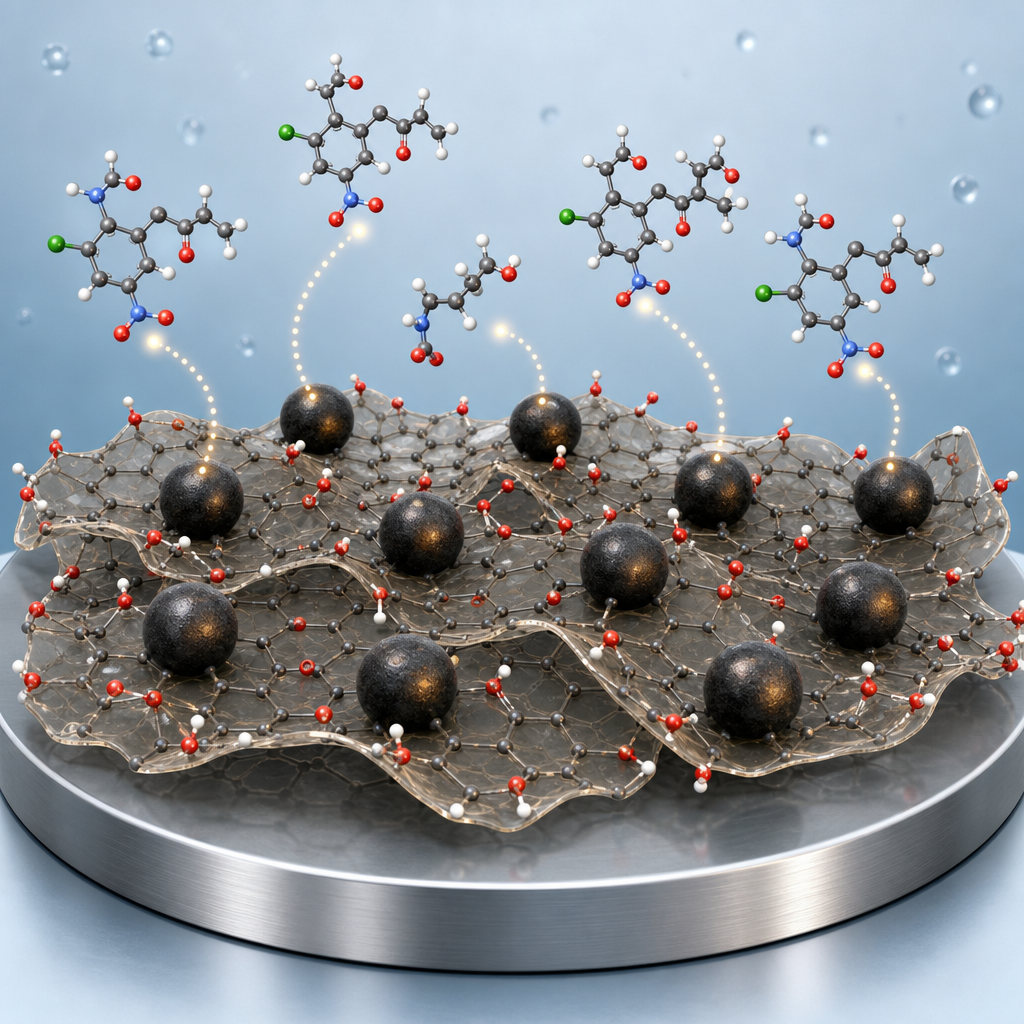
The ACS Material graphene was used as received, without further purification, and incorporated directly into the hydrothermal synthesis. In a typical preparation, 1.92 mmol of CoCl2·6H2O and 9.6 mmol of FeCl3·6H2O were dissolved in 150 mL of ethylene glycol; 45 mg of the ACS Material graphene was dispersed in the same solvent and added to the metal salt mixture. Urea (0.46 M) and sodium citrate (0.96 g) were introduced, and the mixture was sealed in a Teflon-lined autoclave at 200 °C for 11 hours. The graphene sheets acted as a two-dimensional scaffold that anchored the nucleating Co–Fe3O4 nanospheres, suppressing the agglomeration that typically degrades pristine Fe3O4 electrodes and providing the conductive pathway needed for fast electron-hopping between Fe2+/Fe3+ and Co2+ sites. After washing and drying, the Co–Fe3O4 NS/GO powder was drop-cast (6 μL of a 1 mg mL⁻¹ aqueous suspension) onto a polished glassy carbon electrode to complete the sensor.
The modified electrode delivered a limit of detection of 1.04 nM for chloramphenicol and a sensitivity of 5.0788 μA·μM⁻¹·cm⁻², measured by differential pulse voltammetry between 0.3 and –0.8 V in 0.05 M phosphate-buffered saline. Electrochemical impedance spectroscopy in 5.0 mM [Fe(CN)6]3−/4− with 0.1 M KCl showed lower charge-transfer resistance for Co–Fe3O4 NS/GO than for undoped Fe3O4 or bare GCE, confirming that Co doping plus the graphene wrap enhances electron-transfer kinetics. Structural characterization (XRD with Cu-Kα radiation, FTIR, SEM, TEM with EDX, and XPS) confirmed incorporation of Co2+ into the inverse-spinel Fe3O4 lattice and uniform decoration of the graphene sheets with nanospheres. The sensor maintained activity across repeated cycles, rejected common interfering metal ions and antibiotics, and recovered chloramphenicol spiked into centrifuged commercial milk samples (HA1, Kaohsiung) with satisfactory accuracy, validating its practical use on real food matrices rather than only buffered standards.
The combination of nanomolar detection limits, real-sample compatibility, and a low-cost preparation route positions Co–Fe3O4 NS/GO as a candidate for portable, point-of-need testing of antibiotic residues in dairy and other animal-derived products. The same composite chemistry — a doped magnetite supported on graphene oxide — is relevant beyond CAP detection: similar electrodes have been explored for hydrogen evolution, supercapacitors, lithium-ion battery anodes, and electrochemical detection of pesticides, hormones, and other small-molecule contaminants. Future work pointed to by the authors includes extending the platform to multiplexed antibiotic screening and integrating the electrode into disposable screen-printed formats suitable for on-site food quality monitoring.
For researchers building graphene-supported electrocatalysts or electrochemical sensors, layered graphene and graphene oxide products from ACS Material's graphene series provide a consistent starting feedstock for hydrothermal compositing with transition-metal oxides. The paper shows that even unmodified, as-received graphene can serve as the electronic backbone for a high-performance composite sensor without additional purification — a useful workflow datapoint for groups optimizing cost and reproducibility in sensor development.How ACS Material products were used
- Layered graphene (graphene oxide/graphene flakes) (Graphene Series) — “The layered graphene obtained from ACS materials was later used without any further purification.”
Product Performance in this StudyThe ACS Material layered graphene served as the carbon support onto which cobalt-doped Fe3O4 nanospheres were hydrothermally deposited, enabling π–π interactions, fast electron-transfer kinetics, and a low detection limit of 1.04 nM for chloramphenicol sensing.
Related product categories
Frequently asked questionsWhat is graphene oxide used for in electrochemical antibiotic sensors?
Graphene oxide serves as a conductive two-dimensional support that anchors catalytic metal-oxide nanoparticles and provides π–π interactions with aromatic antibiotic molecules such as chloramphenicol. The high surface area and fast electron-transfer kinetics of graphene oxide reduce charge-transfer resistance at the electrode surface, lowering detection limits into the nanomolar range and improving reproducibility compared with bare glassy carbon electrodes.
Why is cobalt doping used to improve Fe3O4 electrocatalysts?
Cobalt doping introduces Co2+ ions into the inverse-spinel Fe3O4 lattice, modifying the surface electronic state and creating additional mixed-valence redox couples. This accelerates electron hopping between Fe2+, Fe3+, and Co2+ sites, enriching electrochemical activity and improving cycle stability. In chloramphenicol sensing, the doped magnetite supported on graphene oxide achieved a 1.04 nM detection limit and 5.0788 μA·μM⁻¹·cm⁻² sensitivity, outperforming undoped Fe3O4 controls.
How is chloramphenicol detected in milk using a modified glassy carbon electrode?
Milk powder is reconstituted with phosphate-buffered saline and centrifuged at 10,000 rpm to remove fat and proteins. The clarified supernatant is analyzed by differential pulse voltammetry on a glassy carbon electrode modified with Co–Fe3O4 NS/GO, scanning from 0.3 to –0.8 V. Chloramphenicol gives a reduction peak whose current scales linearly with concentration, enabling quantitative detection at nanomolar levels with recovery suitable for food-safety screening.