-
Graphene/BNi-2 Brazing of Inconel 718 - Da-Yeh University, 2020
Jul 02, 2026 | ACS MATERIAL LLCLee, I., Sheu, H., & Hsu, H. (2020). The effects of graphene content on the mechanical properties and thermal conductivity of Inconel 718 superalloy brazed using BNi-2/graphene composite …. *Results in Physics*.
Results in Physics · 2020
Researchers at Da-Yeh University used ACS Material graphene in BNi-2 filler to braze Inconel 718, raising shear strength to 390.8 MPa and conductivity 142%.
About this research
Researchers led by I.-Kon Lee at Da-Yeh University (Taiwan), in collaboration with Chung Cheng Institute of Technology, used graphene supplied by ACS Material to fabricate a graphene/BNi-2 (G-BNi-2) composite brazing filler for joining Inconel 718 nickel-based superalloy. By dispersing 0.03–0.07 wt% graphene into the conventional BNi-2 nickel filler, the team raised joint shear strength to 390.8 MPa and increased through-thickness thermal conductivity by 142% relative to a graphene-free baseline. The study, published in Results in Physics (2020), establishes graphene-modified filler metals as a practical route to simultaneously strengthen and de-bottleneck heat flow across superalloy brazed joints used in turbine engines and other high-temperature aerospace components.
Inconel 718 dominates turbine blade, rocket motor, and nuclear reactor applications because of its high-temperature strength and oxidation resistance, but conventional fusion welding promotes niobium segregation, Laves phase formation, and liquation cracking. Brazing avoids melting the base metal and therefore preserves the parent microstructure, but standard BNi-2 brazing produces brittle Ni-Cr-Nb-Mo intermetallic compounds (Ni3Nb, Ni3Si, MC carbides) at the joint center, creating both mechanical stress concentrators and a thermal barrier (Ni3Nb conductivity ≈ 1.15 W/m·K). The challenge is to redistribute these intermetallics and improve heat dissipation across the joint without sacrificing bonding integrity — a problem of direct relevance to turbine efficiency and component life.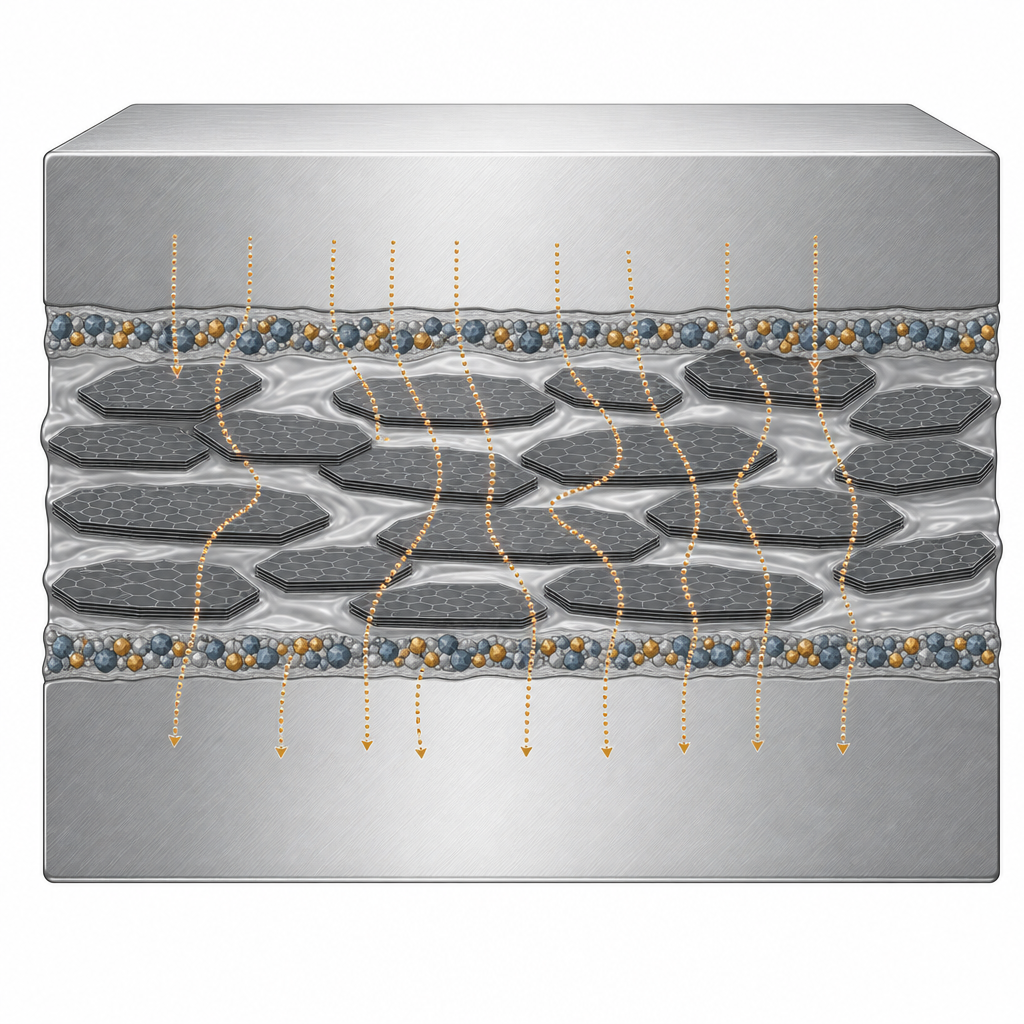
The ACS Material graphene used here consisted of thin-layer graphene sheets with a lateral size of approximately 5 μm, a BET specific surface area of 600–800 m²/g, a thickness of 6–15 nm, and a density of 2.26 g/cm³. These specifications correspond to industrial thin-layer graphene nanoplatelets from ACS Material's graphene series. The authors mixed graphene with BNi-2 powder using a planetary ball mill (Retsch PM 100, 300 rpm, 10:1 ball-to-powder ratio, 1 h) at three loadings: 0.03, 0.05, and 0.07 wt%. SEM imaging confirmed that the graphene sheets adhered to the surface of BNi-2 particles after milling. The composite filler was painted onto polished Inconel 718 coupons, clamped with 5 N·m of force, and brazed in a vacuum furnace at 1050 °C for 50 min under 1 × 10⁻³ Pa. Wettability was characterized via contact angle on Inconel 718 substrates, and the joints were sectioned for OM, SEM-EDS, XRD, and TEM analysis.
All G-BNi-2 fillers wetted Inconel 718 well, with contact angles below 80°. Microstructural analysis showed that without graphene, the brazing center contained continuous Ni(Cr,Fe) intermetallic compounds and a hard δ phase, with a microhardness peak of 761 Hv. Adding graphene eliminated these continuous intermetallic colonies at the joint center, dropping the center hardness to ~320–330 Hv while increasing hardness within the diffusion layer where Mo and Nb became confined. EDS mapping and TEM SAED (showing the hexagonal graphene diffraction pattern) confirmed that graphene preferentially accumulated at diffusion-layer boundaries, where it impeded inward diffusion of Nb and Mo. Mechanically, the baseline BNi-2 joint reached 378.9 MPa in shear; adding 0.03 wt% graphene raised this to a peak of 390.8 MPa, but higher loadings degraded performance to 344 MPa (0.05 wt%) and 315.5 MPa (0.07 wt%) due to graphene agglomeration at crack-initiation sites. Thermally, the trend reversed: brazed thermal conductivity climbed monotonically from 9.36 W/m·K (no graphene) to 22.7 W/m·K (0.07 wt%), a 142% improvement, attributable to in-plane heat conduction across well-dispersed graphene sheets bridging the joint.
The results provide a practical lever for aerospace and power-generation manufacturers building Inconel 718 components subjected to thermal-barrier issues at brazed interfaces. A graphene loading near 0.03 wt% maximizes mechanical strength, while higher loadings up to 0.07 wt% can be selected when heat dissipation is the priority — for example, at turbine blade roots, combustor liners, or heat-exchanger joints. The same composite-filler approach extends naturally to other nickel superalloys (Inconel 625, Hastelloy) and to graphene/Cu or graphene/Ag systems for electronics packaging. Future work could optimize ball-milling parameters to suppress graphene re-agglomeration and explore functionalized graphene to further tune the carbon–chromium interfacial reaction that produces the observed MC carbide network.
For researchers working on metal-matrix brazing fillers, nickel superalloy joining, or thermal interface materials, the ACS Material graphene nanoplatelet series used in this study is available in industrial-scale quantities with the specifications matching those reported (5 μm lateral size, 6–15 nm thickness, 600–800 m²/g BET). The same product line supports investigations into graphene-reinforced solders, conductive composites, and high-temperature joint materials where dispersion quality and consistent flake geometry determine performance.How ACS Material products were used
- Graphene Nanoplatelets (thin-layer graphene sheets) (Graphene Series) — “The graphene was purchased from ACS Material Company. The morphology of graphene sheets is shown in Fig. 1: the lateral size is approximately 5 µm, with an average Brunauer–Emmett–Teller (BET) specific surface area of 600–800 m2/g, a thickness of 6–15 nm and a density of 2.26 g/cm3.”
Product Performance in this StudyThe graphene sheets, added at 0.03–0.07 wt% into BNi-2 filler, suppressed deleterious intermetallic phases at the brazing center, raised the joint shear strength to a peak of 390.8 MPa at 0.03 wt%, and increased thermal conductivity by 142% (to 22.7 W/m·K) at 0.07 wt%.
Related product categories
Frequently asked questionsHow does graphene improve the shear strength of Inconel 718 brazed joints?
Graphene added to BNi-2 filler at 0.03 wt% disrupts the continuous Ni-Cr-Nb-Mo intermetallic compounds that normally form at the joint center during vacuum brazing. By accumulating at diffusion-layer boundaries, the graphene impedes inward Nb and Mo diffusion and redistributes hard phases away from the load-bearing center. This raised shear strength from 378.9 MPa (BNi-2 only) to a peak of 390.8 MPa.
What graphene loading gives the highest thermal conductivity in brazed Inconel 718?
A loading of 0.07 wt% graphene in the BNi-2 filler produced the highest joint thermal conductivity of 22.7 W/m·K, which is 142% higher than the 9.36 W/m·K measured for the graphene-free baseline. The improvement is attributed to in-plane heat conduction through dispersed graphene sheets bridging the brazing zone. However, this loading sacrifices some mechanical strength compared with 0.03 wt%.
What grade of graphene is best for nickel superalloy brazing fillers?
Thin-layer graphene nanoplatelets with lateral sizes around 5 μm, thicknesses of 6–15 nm, and BET surface areas of 600–800 m²/g performed well in this study. These specifications correspond to industrial thin-layer graphene nanoplatelets from ACS Material. Larger lateral size promotes in-plane thermal conduction, while moderate thickness allows uniform dispersion by planetary ball milling without excessive agglomeration.