-
Graphene/Hydrogen Titanate Li-ion Anodes — Louisiana State University, 2014
Jun 23, 2026 | ACS MATERIAL LLCLuan, X., & Wang, Y. (2014). Thermal annealing and graphene modification of exfoliated hydrogen titanate nanosheets for enhanced lithium-ion intercalation properties. *Journal of Materials Science & Technology*.
Journal of Materials Science & Technology · 2014
LSU researchers used ACS Material graphene nanosheets to hybridize exfoliated H2Ti3O7 nanosheets, raising Li-ion anode capacity by up to 187%.
About this research
Researchers at Louisiana State University used graphene nanosheets supplied by ACS Material, LLC to hybridize exfoliated hydrogen titanate (H2Ti3O7) nanosheets, boosting the initial lithium-ion charge capacity of the anode from 124.6 to 233.9 mA h g⁻¹ — an enhancement of roughly 187% for material annealed at 450 °C. The study, published in the Journal of Materials Science & Technology in 2014, systematically maps how thermal annealing temperature and graphene modification interact to control the crystallinity, morphology, and electrochemical behavior of layered titanate anode materials.
Layered titanates are attractive lithium-ion battery anodes because their [TiO6] octahedral framework provides short, direct pathways for Li⁺ transport and accommodates volume change during insertion/extraction. However, freshly exfoliated hydrogen titanate nanosheets often suffer from poor crystallinity and rapid capacity fade, while higher-temperature annealing converts them into less active sodium titanates. There is also a long-standing electronic-conductivity bottleneck: titanate anodes are insulating, limiting rate capability. Adding a 2D conductive scaffold such as graphene is one of the most direct ways to address both the conductivity gap and the tendency of titanate nanosheets to restack. This work targets exactly that intersection — combining layered titanate chemistry with 2D carbon to extract more usable capacity from a sustainable, abundant Ti-based anode chemistry.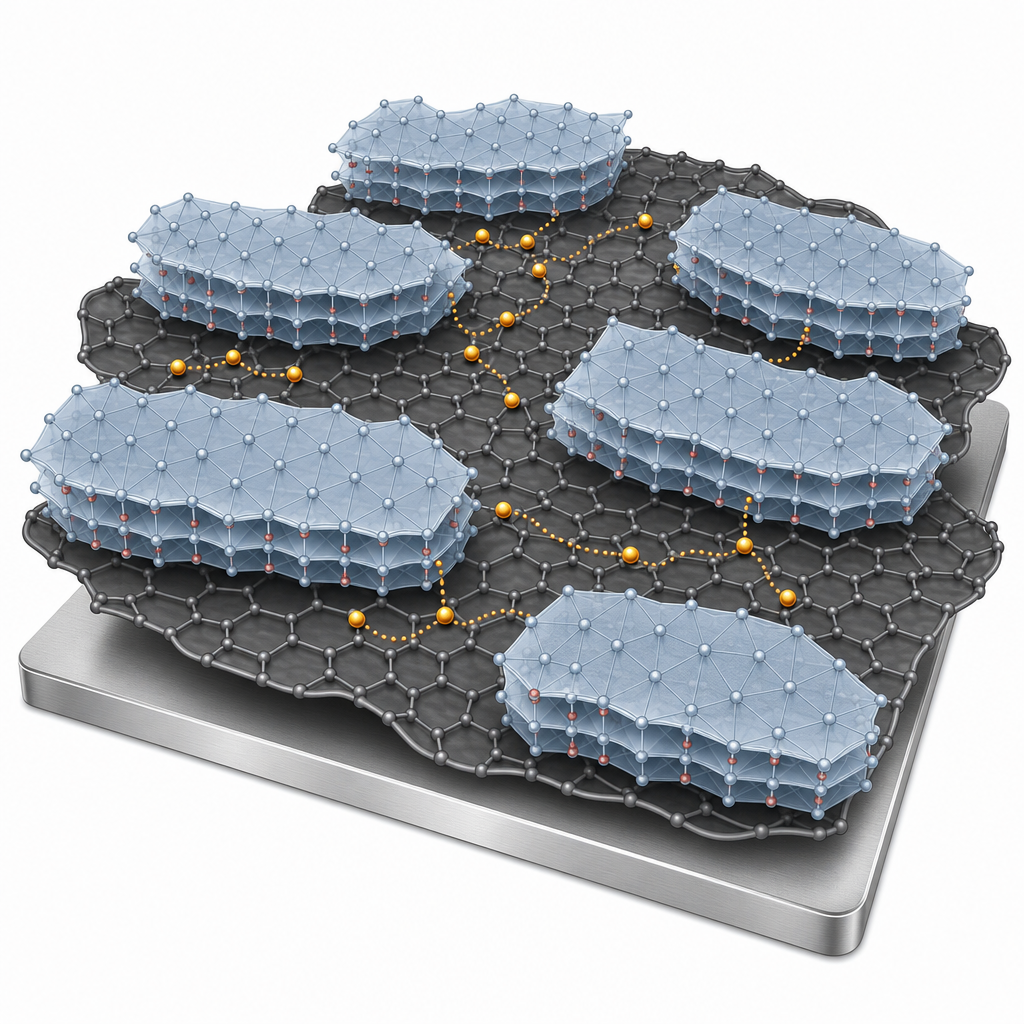
The titanate component was prepared by calcining Cs2CO3 with anatase TiO2 to form lepidocrocite-type Cs0.7Ti1.825O4, followed by acid leaching to a protonated HxTi2−x/4O4·H2O phase, intercalation with tetrabutylammonium hydroxide (TBAOH), Na⁺ ion exchange in NaOH, and water washing to produce well-dispersed H2Ti3O7 nanosheets with lateral sizes up to several micrometers and an interlayer spacing of 0.8 nm. Hybrid electrodes were then prepared by mixing these titanate nanosheets with graphene nanosheets from ACS Material at a 1:100 graphene:titanate weight ratio in N-methyl-2-pyrrolidone with acetylene black and PVDF (70:20:10 active:AB:PVDF), coating onto Cu foil with an automatic film applicator at 500 µm, drying, pressing, and assembling into CR2032 coin cells against Li foil with 1 M LiPF6 in EC/DMC/DEC electrolyte. SEM imaging showed the titanate nanosheets adhering as "stickers" across the wrinkled graphene sheets, confirming that the 2D-on-2D geometry produced uniform contact between the conductive carbon and the active titanate.
Electrochemical cycling was performed between 0.01 and 2.5 V vs. Li⁺/Li at 170 mA g⁻¹ for 100 cycles. Without graphene, the unannealed H2Ti3O7 delivered the highest initial discharge capacity of 130.5 mA h g⁻¹, but faded to 72.1 mA h g⁻¹ (only 55.2% retention) due to imperfect crystallinity and residual TBA⁺. Annealing at 450 °C produced well-crystallized H2Ti3O7 with trace TiO2 that retained 115.2 mA h g⁻¹ — a 92.5% retention — while annealing at 650 and 850 °C converted the material into mixed sodium titanates (Na2Ti6O13/Na0.8Ti4O8 and Na2Ti6O13/Na2Ti3O7) with lower initial capacities of 101.3 and 63.8 mA h g⁻¹, respectively. Adding ACS Material graphene at 1 wt% transformed the picture: the unannealed graphene/H2Ti3O7 hybrid delivered 170.7 mA h g⁻¹ initially and retained 101.0 mA h g⁻¹ after 100 cycles, a 40% improvement in retained capacity. The 450 °C-annealed graphene hybrid hit 233.9 mA h g⁻¹ initially and 119.7 mA h g⁻¹ after 100 cycles. The authors attribute the gains to the markedly higher electronic conductivity supplied by graphene, reduced charge-transfer resistance, and the uniform 2D–2D contact that suppresses titanate restacking.
These results matter for the broader effort to push beyond graphite anodes using Ti-based oxides, which are intrinsically safer (no lithium plating at low voltages) and use earth-abundant elements. The work also reinforces a general design principle for layered oxide anodes: pair the 2D active material with a 2D conductive carbon at low loading to unlock capacity that is otherwise locked behind poor electron transport. Adjacent applications include sodium-ion batteries (where sodium titanates are themselves of interest), hybrid supercapacitors, and photocatalytic electrodes where the same H2Ti3O7/graphene morphology has been exploited. The authors note follow-up work on optimizing graphene loading and exploring other 2D conductive additives.
For researchers working on titanate, niobate, or vanadate layered anodes, graphene nanosheets from ACS Material offer a drop-in conductive scaffold at the loading levels (about 1 wt%) used in this study. ACS Material's graphene series, including single-layer graphene, graphene nanoplatelets, and graphene dispersions in NMP, is available to support similar hybrid electrode development for lithium- and sodium-ion battery research.How ACS Material products were used
- Graphene Nanosheets (Graphene Series) — “Hybrid graphene/hydrogen titanate nanosheets were fabricated by mixing graphene nanosheets (ACS Material, LLC) with hydrogen titanates in a weight ratio of 1:100.”
Product Performance in this StudyGraphene nanosheets from ACS Material were hybridized with H2Ti3O7 at 1:100 weight ratio, raising the initial charge capacity from 124.6 to 233.9 mA h g⁻¹ (a 187% increase) for the 450 °C-annealed sample and from ~130 to 170.7 mA h g⁻¹ for the unannealed sample, owing to improved electronic conductivity and reduced charge-transfer resistance.
Related product categories
Frequently asked questionsHow does graphene modification improve hydrogen titanate lithium-ion battery anodes?
Graphene boosts both initial capacity and electronic conductivity of layered hydrogen titanate (H2Ti3O7) anodes. In this study, adding only 1 wt% graphene nanosheets raised the initial charge capacity of 450 °C-annealed H2Ti3O7 from 124.6 to 233.9 mA h g⁻¹, a 187% increase. The 2D-on-2D contact between graphene and titanate also reduces charge-transfer resistance and suppresses restacking of the active nanosheets during cycling.
What annealing temperature gives the best cycling stability for exfoliated H2Ti3O7 anodes?
Annealing at 450 °C produced the most stable cycling performance. The sample retained a charge capacity of 115.2 mA h g⁻¹ after 100 cycles at 170 mA g⁻¹, corresponding to 92.5% capacity retention. In contrast, the unannealed material retained only 55.2%, and samples annealed at 650 and 850 °C converted into less-active sodium titanates (Na2Ti6O13, Na0.8Ti4O8, Na2Ti3O7) with lower capacities.
Why are layered titanate nanosheets considered as anodes for lithium-ion batteries?
Layered titanates such as H2Ti3O7 consist of [TiO6] octahedra sharing edges and corners with alkali ions or protons in the interlayer spaces. This architecture provides short, direct pathways for Li⁺ transport, accommodates the volume changes from Li insertion and extraction, and operates at safe voltages without lithium plating. They are also based on earth-abundant Ti and O, making them attractive sustainable alternatives to graphite anodes.