-
Graphene/Ionic Liquid Heavy-Metal Sensor - Graz, 2016
Jun 23, 2026 | ACS MATERIAL LLCChaiyo, S. et al. (2016). Electrochemical sensors for the simultaneous determination of zinc, cadmium and lead using a Nafion/ionic liquid/graphene composite modified screen-printed …. *Analytica Chimica Acta*.
Analytica Chimica Acta · 2016
A Nafion/ionic liquid/graphene composite on a screen-printed carbon electrode enables simultaneous trace detection of Zn, Cd and Pb in drinking water.
About this research
Researchers at the University of Graz, working with collaborators from Chulalongkorn University, Srinakharinwirot University and the Jožef Stefan Institute, used industrial-quality graphene from ACS Material, LLC (Medford, USA) to build a Nafion/ionic liquid/graphene (N/IL/G) composite-modified screen-printed carbon electrode capable of simultaneously detecting trace zinc, cadmium and lead in drinking water. By drop-casting the composite onto a screen-printed carbon electrode (SPCE) and electrodepositing a bismuth film in situ, the team produced a disposable, mercury-free sensor that achieves nanogram-per-milliliter sensitivity using square-wave anodic stripping voltammetry (SWASV). The work was published in Analytica Chimica Acta in 2016.
Heavy-metal contamination of drinking water remains a major public-health concern, and regulatory limits for Zn, Cd and Pb are tightening worldwide. Classical analytical techniques such as ICP-MS and atomic absorption spectroscopy deliver excellent sensitivity but require bulky instruments, high running costs and trained operators, which limits their use for on-site monitoring. Electrochemical stripping methods on screen-printed electrodes provide a portable, low-cost alternative, but require electrode modifiers that combine high electroactive surface area, strong cation pre-concentration and good antifouling behavior. Combining a 2D carbon material with an ionic liquid and a cation-exchange polymer is an attractive route to such a multifunctional interface, particularly when paired with a non-toxic bismuth film that replaces mercury in the stripping step.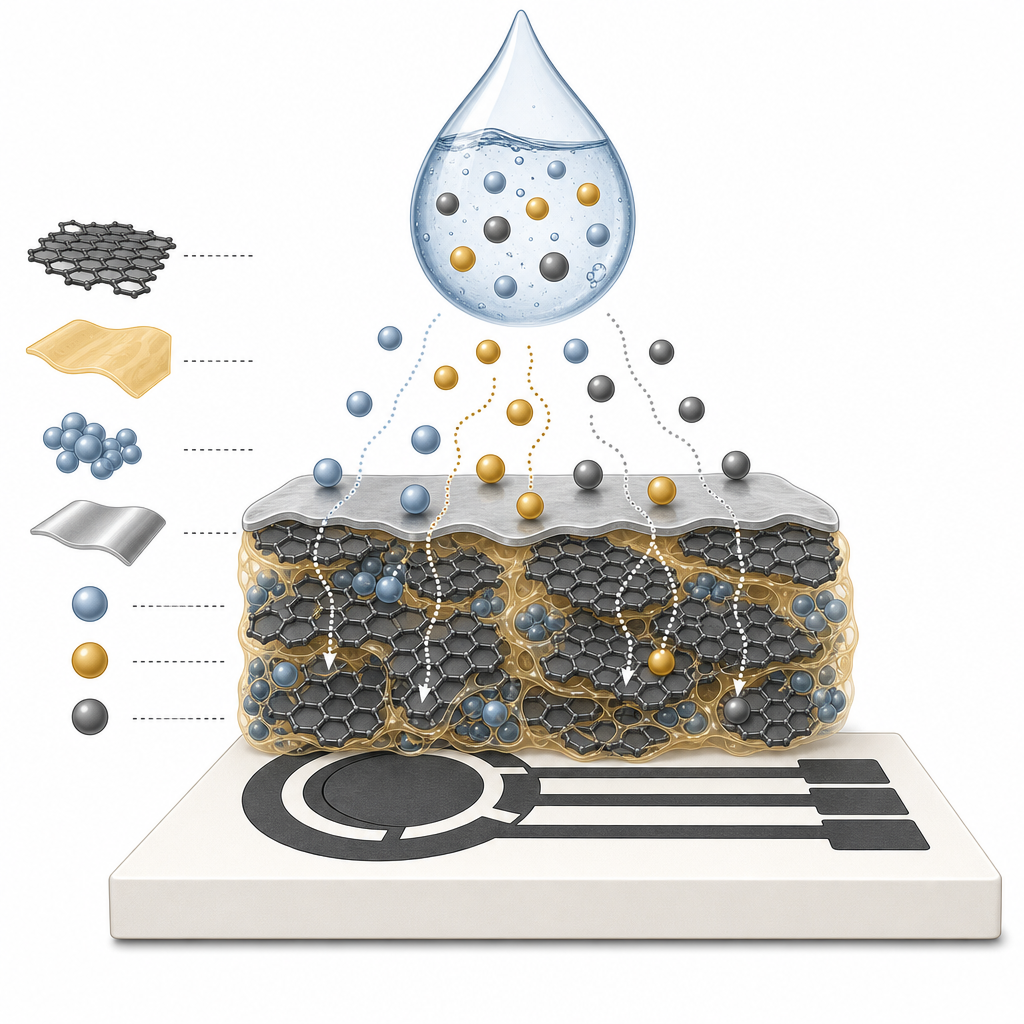
In this study, the ACS Material graphene plays the central role of the conductive 2D scaffold inside the composite ink. The Methods section states that "Industrial-quality graphene was obtained from ACS Material, LLC (Medford, USA)." To prepare the casting solution, 1.0 mg of this graphene was dispersed in 1.0 mL of N,N-dimethylformamide by ultrasonic agitation for about 2 h, then mixed with 0.5% (m:v) 1-butyl-2,3-dimethylimidazolium tetrafluoroborate ionic liquid and 0.1% (v:v) Nafion and sonicated for a further 30 min. A 1.0 µL droplet of this N/IL/G ink was drop-cast onto the 0.196 cm² working area of a carbon-ink SPCE printed on a ceramic substrate and allowed to dry at room temperature. During each measurement, Bi(III) (200 ng mL⁻¹) was added to a pH 4.5 acetate buffer so that a bismuth film co-deposited in situ with the analyte metals at −1.4 V for 120 s, forming the active stripping interface on top of the graphene composite.
The N/IL/G/Bi-modified SPCE delivered well-resolved stripping peaks for Zn(II), Cd(II) and Pb(II) in a single voltammetric sweep using SWASV. Compared with bare SPCE and with composites lacking either the ionic liquid or Nafion, the full three-component composite produced markedly higher stripping currents, confirming a synergistic effect between graphene's large electroactive surface, the ionic liquid's high ionic conductivity and the cation-exchange pre-concentration provided by Nafion. The sensor exhibited linear responses over wide concentration ranges for all three metals, with limits of detection reported in the low ng mL⁻¹ regime, suitable for screening drinking water against WHO and EPA guideline values. Reproducibility was characterized by low relative standard deviations across repeated measurements, and the disposable nature of screen-printed electrodes eliminated cross-contamination between samples. Interference studies with common ions including Cl⁻, SO₄²⁻, PO₄³⁻, F⁻, Ca(II), K(I), Mg(II), Fe(III), As(III), Hg(II), Cu(II), Co(II), Ni(II) and Mn(II) showed acceptable selectivity, and recoveries in spiked drinking water samples were close to 100%, validating the sensor for real-sample analysis.
The combination of low cost, simple fabrication and field-deployable instrumentation makes this platform attractive for environmental monitoring, point-of-need water quality screening, food safety analysis and occupational-exposure testing. Because the modifier is a printable ink, the same chemistry can be transferred to other electrode geometries such as flexible substrates and lab-on-chip devices. The authors also note that the synergistic N/IL/G concept can be extended to other heavy metals and to organic analytes by tuning the ionic liquid or by replacing the bismuth film with antimony or tin films. Future work pointed to in the paper includes integration with portable potentiostats for in-field measurement and exploration of additional ionic liquids to further optimize the dispersion and electrochemical window of the graphene composite.
For researchers developing electrochemical sensors, coatings or 2D-material inks, this study illustrates how an industrial-grade graphene from ACS Material can be combined with common laboratory chemicals to produce a high-performing analytical interface without specialized equipment. ACS Material supplies a range of graphene products, including industrial-grade graphene oxide, single-layer graphene and graphene dispersions in NMP and water, that are suitable for similar composite-electrode and sensor-development workflows.How ACS Material products were used
- Industrial-Grade Graphene Oxide (Graphene Series) — “Industrial-quality graphene was obtained from ACS Material, LLC (Medford, USA).”
Product Performance in this StudyThe industrial-quality graphene from ACS Material served as the conductive nanocarbon component of the N/IL/G composite film on the screen-printed carbon electrode, contributing high surface area and electron transfer that enabled sensitive, simultaneous square-wave anodic stripping voltammetric detection of Zn(II), Cd(II) and Pb(II).
Related product categories
Frequently asked questionsHow does graphene improve heavy-metal detection on screen-printed electrodes?
Graphene provides a large electroactive surface area, high charge-carrier mobility and good chemical stability, all of which enhance electron transfer at the electrode-solution interface. When combined with an ionic liquid and Nafion on a screen-printed carbon electrode, the graphene composite increases the stripping current and lowers the detection limit for Zn(II), Cd(II) and Pb(II) compared with unmodified or single-component electrodes.
Why use a bismuth film instead of mercury for stripping voltammetry?
Bismuth forms intermetallic alloys with Zn, Cd and Pb that give sharp, well-resolved stripping peaks similar to those obtained on mercury, but bismuth is far less toxic and environmentally hazardous. Bismuth-film electrodes also tolerate dissolved oxygen better than mercury, allow in-situ deposition during the pre-concentration step, and are compatible with disposable screen-printed sensors used for field water analysis.
What is the role of Nafion and the ionic liquid in the N/IL/G composite?
Nafion is a perfluorinated cation-exchange polymer that pre-concentrates positively charged metal ions at the electrode surface while resisting fouling. The 1-butyl-2,3-dimethylimidazolium tetrafluoroborate ionic liquid provides high ionic conductivity, a wide electrochemical window and good wetting of graphene. Together, they create a synergistic interface with graphene that boosts sensitivity, selectivity and stability for stripping voltammetry of heavy metals.