-
Graphene/TCNQ Cu(II) Sensor - AGH University, 2017
Jun 23, 2026 | ACS MATERIAL LLCPięk, M. et al. (2017). High selective potentiometric sensor for determination of nanomolar con-centration of Cu (II) using a polymeric electrode modified by a graphene/7, 7, 8, 8 …. *Talanta*.
Talanta · 2017
AGH University researchers built an all-solid-state Cu(II)-selective electrode using ACS Material single-layer graphene with TCNQ, reaching nanomolar detection.
About this research
Researchers at AGH University of Science and Technology (Faculty of Materials Science and Ceramics, Cracow, Poland) used Single Layer Graphene purchased from ACS Material, LLC to construct an all-solid-state Cu(II)-selective electrode that detects copper at nanomolar concentrations. Reported in Talanta in 2017, the work by Pięk, Fendrych, Smajdor, Piech and Paczosa-Bator combines graphene with 7,7,8,8-tetracyanoquinodimethane (TCNQ) and its copper salt to form a solid-contact transducer layer beneath a PVC-based ion-selective membrane. The graphene/TCNQ-modified electrode showed a Nernstian slope of 30.55 mV/decade, a linear range spanning 10^-9 to 10^-2 M Cu2+, a detection limit of 10^-9.2 M, and excellent long-term stability over more than a month of testing.
Copper monitoring matters in environmental, food and biomedical contexts. Copper is essential as a micronutrient yet toxic in excess, with links to Wilson's disease, Alzheimer's disease and damage to kidney and liver function. Industrial effluents from metal processing, electroplating and mining release copper into water systems, demanding sensitive on-site monitoring. Existing approaches such as stripping voltammetry, ICP-MS, atomic absorption spectrometry and chromatography offer good sensitivity but are slow, expensive and laboratory-bound. Ion-selective electrodes are attractive because they enable fast, low-cost, portable measurement. The central challenge for all-solid-state ion-selective electrodes (ASS-ISEs) is the intermediate layer that converts the ionic signal at the membrane into an electronic signal at the substrate: it must be conductive, hydrophobic and chemically stable to deliver a reproducible standard potential and low detection limit.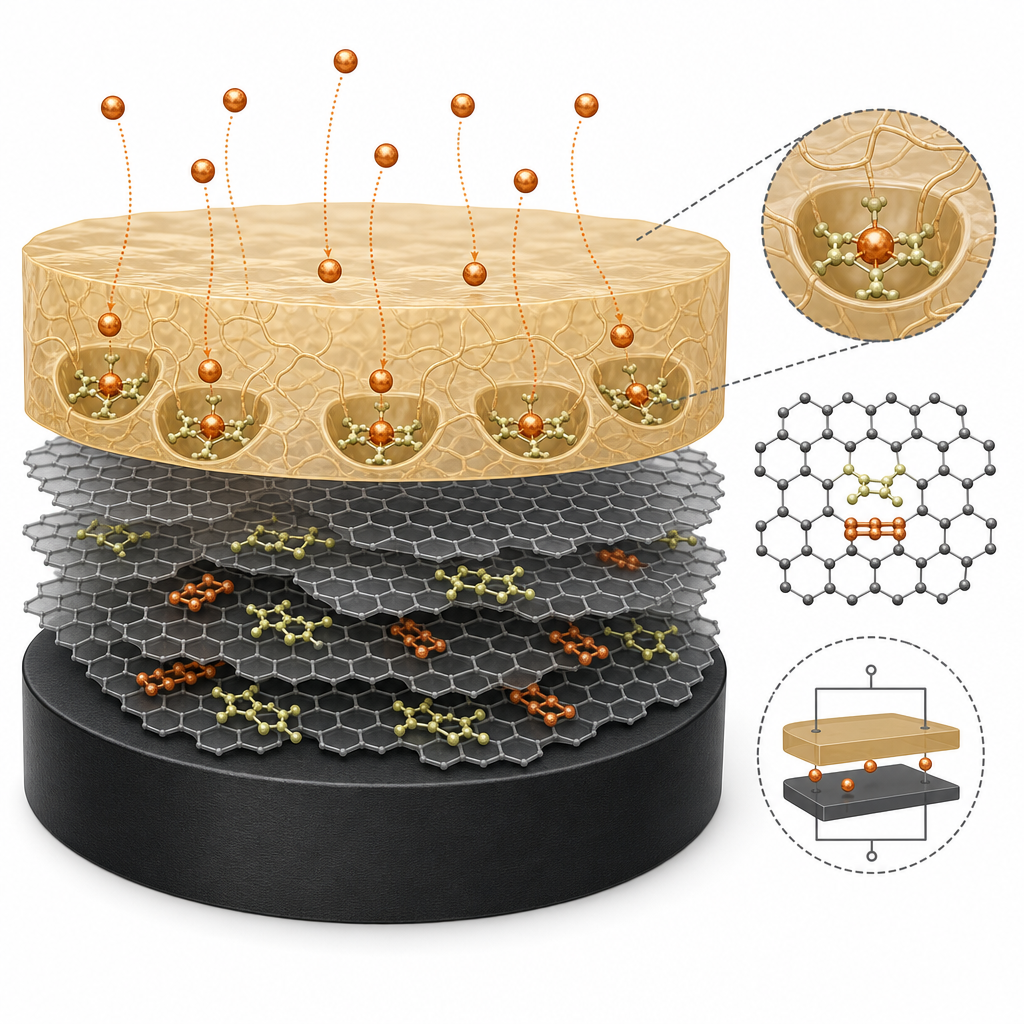
The ACS Material Single Layer Graphene served as the high-capacitance component of the solid-contact transducer layer. Glassy carbon disc electrodes were polished with alumina, then drop-cast with 15 µL of an acetone mixture containing graphene with TCNQ (1:2 weight ratio), graphene with TCNQ-Cu, or graphene with both TCNQ and TCNQ-Cu (1:1:1). After 24 h of solvent evaporation at room temperature, a Cu(II)-selective PVC membrane (0.5% copper(II) ionophore IV, 0.46% sodium tetrakis[3,5-bis(trifluoromethyl)phenyl]borate, 35.5% PVC, 63.54% o-NPOE) was cast over the layer from a THF solution. Electrodes were conditioned for 48 h in 10^-6 M Cu(NO3)2. In this architecture graphene provides a high electrical double-layer capacitance at the membrane interface, while TCNQ and its copper radical salt act as a redox transducer. The authors compared this construction with graphene oxide, Cu-TCNQ, rGO-Cu-TCNQ, plain TCNQ and a bare coated-disc reference electrode.
The graphene/TCNQ electrode produced the lowest standard deviation of E0 across five replicate electrodes, only 0.9 mV, indicating that the sensor can be deployed without frequent recalibration. Its Nernstian slope of 30.55 mV/decade, linear range from 10^-9 to 10^-2 M Cu2+, and detection limit of 10^-9.2 M outperformed each of the other constructions tested and most previously reported Cu(II) ISEs. The graphene-containing layers also reduced total electrode resistance dramatically, from 1251 kΩ for the coated disc to 232 kΩ for graphene/TCNQ and 131 kΩ for graphene/TCNQ-Cu, while raising solid-contact capacitance to 284 µF and 495 µF respectively. Chronopotentiometric drift was just 21.7 ± 2.9 µV/h for the graphene/TCNQ electrode and 16.2 ± 1.4 µV/h for graphene/TCNQ/TCNQ-Cu, versus 32.9 ± 6.4 mV/h for the bare design. Selectivity coefficients against K+, Na+, Mg2+, Ca2+, Zn2+, Pb2+ and Ni2+ improved across all interfering ions, with log K^pot values reaching -6.84 against Mg2+. Direct potentiometric measurements of Cu(II) in tap water, mineral water, river water, chocolate foil and canned beer, peanuts and tuna agreed with anodic stripping voltammetry to within 96-101% recovery.
The sensors enable rapid, low-cost copper monitoring in drinking water, environmental samples and food safety testing where nanomolar sensitivity is required. The graphene/TCNQ construction is particularly attractive for portable and miniaturized analyzers because it eliminates the internal filling solution of conventional ISEs, tolerates a wide pH window (4-6) covering free Cu2+ speciation, and remains stable over weeks of operation. The same solid-contact strategy is transferable to other ion-selective platforms; the authors note prior work applying nanostructured TCNQ to K+ and Na+ electrodes. Future extensions could target multi-ion arrays for environmental monitoring, point-of-care biomedical assays, and on-line industrial process control where stable reference potentials matter as much as raw sensitivity.
For researchers developing electrochemical sensors, solid-contact ion-selective electrodes or graphene-based transducer interfaces, Single Layer Graphene from ACS Material provided the high-surface-area, conductive component that anchored the sensor's stability and detection limit in this study. The relevant graphene products and dispersions are available in the ACS Material Graphene Series catalog for groups working on similar potentiometric and electrochemical applications.How ACS Material products were used
- Single Layer Graphene (Graphene Series) — “Single Layer Graphene was purchased from ACS Material, LLC, USA.”
Product Performance in this StudySingle layer graphene from ACS Material was combined with TCNQ to form the solid-contact transducer layer of the Cu(II)-selective electrode. It contributed a high electrical double-layer capacitance, lowered total electrode resistance, and produced the best potential reproducibility (SD of E0 = 0.9 mV) and a sub-nanomolar detection limit (10^-9.2 M Cu2+).
Related product categories
Frequently asked questionsWhy is graphene used as a solid-contact layer in ion-selective electrodes?
Graphene provides a large specific surface area that establishes a high electrical double-layer capacitance at the interface between the substrate and the ion-selective membrane. This high capacitance buffers small currents and stabilizes the electrode potential. In the Cu(II) sensor reported here, adding single layer graphene lowered total electrode resistance from 1251 kΩ to 232 kΩ and reduced potential drift to 21.7 µV/h, enabling reliable nanomolar detection.
How does the graphene/TCNQ nanocomposite improve copper ion detection?
The composite combines two transducer mechanisms in one layer. Graphene delivers a high double-layer capacitance, while TCNQ and its copper radical salt provide a fast redox couple that converts ionic potential at the membrane into electronic potential at the glassy carbon substrate. Together they extend the linear range to 10^-9 to 10^-2 M Cu2+, push the detection limit to 10^-9.2 M, and keep the standard deviation of E0 to just 0.9 mV across replicate electrodes.
What detection limit can a graphene-modified Cu(II)-selective electrode achieve?
The graphene/TCNQ-modified all-solid-state Cu(II)-selective electrode reported by the AGH University team reached a detection limit of 10^-9.2 M Cu2+, with a near-Nernstian slope of 30.55 mV/decade. The electrode operated successfully in tap water, mineral water, river water and digested food samples, returning recoveries of 96 to 101 percent compared with anodic stripping voltammetry, demonstrating viability for trace copper analysis in real matrices.