-
Graphene/TiO2 Hypoxanthine Biosensor for Meat Freshness — Purdue University, 2017
Jun 05, 2026 | ACS MATERIAL LLCAlbelda, J. A. et al. (2017). Graphene-titanium dioxide nanocomposite based hypoxanthine sensor for assessment of meat freshness. *Biosensors and Bioelectronics*. https://doi.org/10.1016/j.bios.2016.03.041
Biosensors and Bioelectronics · 2017
Purdue University researchers used ACS Material graphene to build a TiO2-graphene amperometric hypoxanthine sensor that tracks pork freshness over 7 days.
About this research
Researchers at Purdue University's School of Materials Engineering, working with collaborators at De La Salle University in Manila, used graphene supplied by ACS Material as the carbon backbone of a TiO2-graphene (TiO2-G) nanocomposite that functions as the transducer in an amperometric hypoxanthine biosensor for meat freshness assessment. The Nafion/XOD/TiO2-G/glassy carbon electrode delivered a linear response from 20 to 512 μM hypoxanthine, a 9.5 μM detection limit, and a sensitivity of 4.1 nA/μM, and it tracked spoilage in pork tenderloins stored at room temperature for seven days with strong agreement (r = 0.9795) versus a commercial enzymatic colorimetric assay.
Reliable, low-cost monitoring of meat freshness remains an open challenge for the food industry. Sensory panels are fast but subjective, while chromatographic and spectrophotometric assays for ATP-degradation markers like hypoxanthine (Hx) and xanthine (Xn) are accurate but slow and labor-intensive. Because Hx accumulates almost immediately after slaughter and is associated with the bitter off-flavor of aging meat, electrochemical biosensors that can quantify Hx in minutes are an attractive replacement. The challenge has been finding an electrode material that simultaneously provides high surface area for xanthine oxidase (XOD) immobilization, supports direct electron transfer to the enzyme's redox-active centers, resists interference from uric acid, ascorbic acid and glucose, and remains conductive enough for amperometric operation. Graphene-metal-oxide composites are a leading candidate, but few studies have paired TiO2 directly with graphene for Hx detection.
In the methodology, graphene (98% carbon) obtained from ACS Material was used as received as the carbon platform for hydrothermal TiO2 growth. Twenty milligrams of the graphene was sonicated in a water/ethanol/SDS mixture, followed by addition of 0.1 mL titanium isopropoxide and a further hour of sonication. The suspension was then transferred to a Teflon-sealed autoclave and held at 130 °C for 12 h, after which the product was filtered, washed and dried. TEM confirmed that 10–20 nm anatase TiO2 spheres and globules were anchored directly on the basal plane of the graphene sheets, with only mild wrinkling and buckling of the graphene preserved. FTIR showed shifts of the aromatic C-C and C-O bands of graphene (to 1554 and 1116 cm⁻¹), and XPS revealed a new Ti-C peak at 283.7 eV and a Ti-O-C component in the O 1s spectrum, both indicating covalent linkage between TiO2 and graphene oxygenated edge groups. The nanocomposite (1 mg/mL in DMF, 16 μL drop) was cast onto a polished glassy carbon electrode, then loaded with 20 μL of XOD solution and overcoated with 4 μL of 5% Nafion to form the working electrode.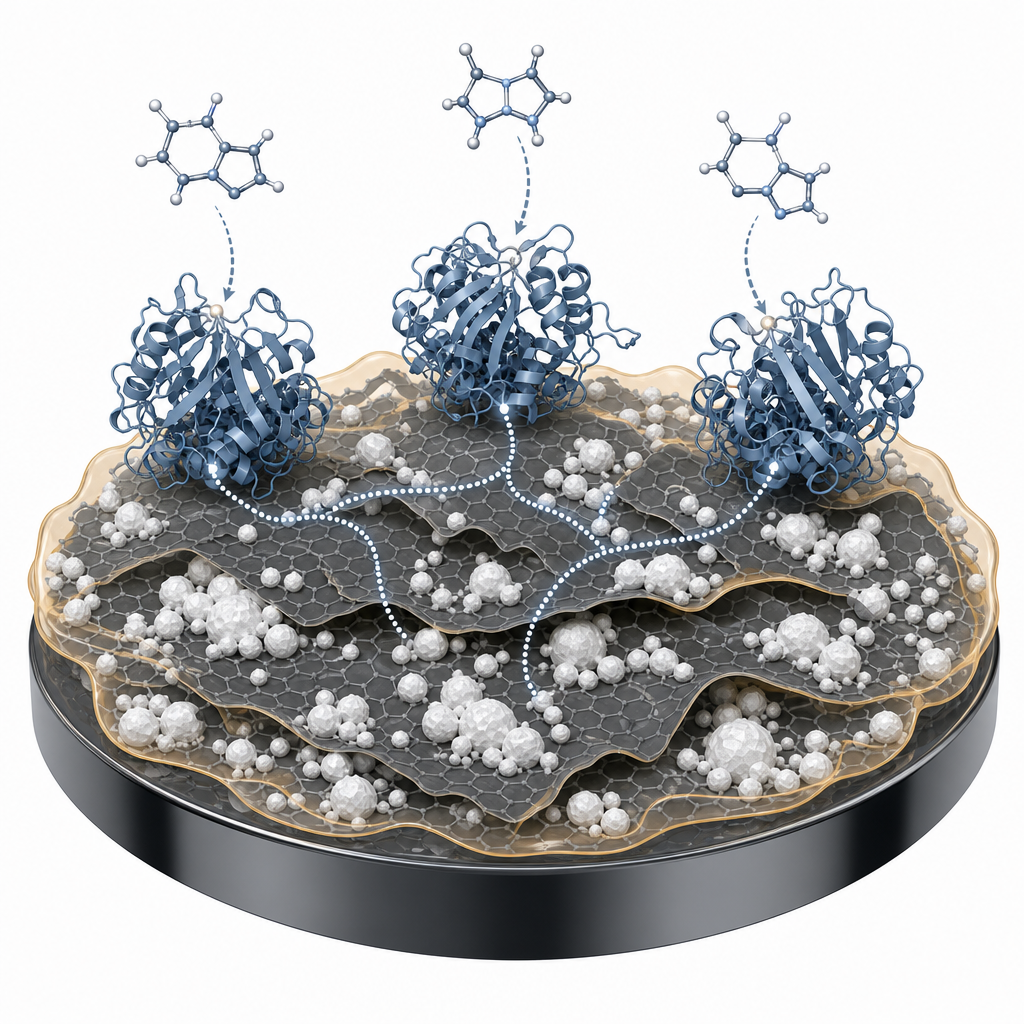
The TiO2-G composite contained ~61% titania by TGA and reached a BET surface area of 136.4 m²/g, higher than the 102.6 m²/g of TiO2 prepared identically without graphene — direct evidence that the ACS Material graphene contributed extra accessible surface for enzyme immobilization. In [Fe(CN)6]³⁻/⁴⁻ cyclic voltammetry the composite electrode showed a peak separation of only 85 mV and an apparent electron-transfer rate of 0.0090 cm s⁻¹, faster than bare glassy carbon. The Nafion/XOD/TiO2-G/GCE biosensor exhibited a linear amperometric response to Hx from 20 to 512 μM with a 9.5 μM detection limit and 4.1 nA/μM sensitivity. Anti-interference testing against equimolar uric acid, ascorbic acid and glucose showed negligible cross-response, with only a 7% signal contribution from xanthine. The device gave 4.3% RSD repeatability and 3.8% RSD reproducibility. When applied to pork tenderloin extracts sampled daily over a seven-day room-temperature spoilage trial, the biosensor's Hx readings correlated with a BioVision colorimetric Hx/Xn assay at r = 0.9795, demonstrating real-sample reliability rather than only a buffered laboratory response.
The demonstrated performance positions the TiO2-G composite as a practical electrode chemistry for portable meat and fish freshness monitors, especially in cold-chain logistics, retail point-of-sale screening, and quality control laboratories where current methods are too slow or too expensive. The same enzyme-on-graphene-metal-oxide architecture is directly transferable to related ATP-degradation markers (xanthine, uric acid) and other oxidase-based biosensors targeting glucose, lactate or cholesterol. The authors point to further work on extending dynamic range, miniaturizing the readout, and validating across additional meat species. The approach also offers a template for combining graphene with other functional oxides (ZnO, CeO2, SnO2) for related sensing applications.
For researchers building enzyme electrodes, metal-oxide/graphene hybrids, or electroanalytical sensors, this study illustrates that commercially sourced graphene of modest specification — here, 98% carbon graphene from ACS Material used without further purification — can serve as a reliable starting material for hydrothermal nanocomposite synthesis and yield reproducible, real-sample-validated biosensor performance. The Graphene Series catalog at ACS Material includes comparable powders, dispersions and functionalized grades suitable for similar electrochemical biosensor development.How ACS Material products were used
- Graphene (98% carbon) (Graphene Series) — “Graphene (98% carbon) was obtained from ACS Material and used as received without further modification.”
Product Performance in this StudyThe ACS Material graphene served as the carbon scaffold that was hydrothermally decorated with TiO2 nanoparticles to form the TiO2-G nanocomposite. It contributed high surface area (raising the composite BET to 136.4 m²/g), maintained electrical conductivity after processing, and enabled fast heterogeneous electron transfer that underpinned the biosensor's catalytic activity toward hypoxanthine.
Related product categories
Frequently asked questionsHow is graphene used in hypoxanthine biosensors for meat freshness testing?
Graphene serves as a conductive, high-surface-area scaffold on which metal oxide nanoparticles such as TiO2 are anchored, creating a composite electrode that immobilizes xanthine oxidase. The graphene preserves electrical conductivity for amperometric readout while the TiO2 provides a biocompatible microenvironment that enables direct electron transfer between the enzyme and the electrode. The result is a sensitive, low-cost transducer capable of detecting hypoxanthine in real meat extracts.
What is the detection limit of a TiO2-graphene amperometric hypoxanthine sensor?
In this Purdue University study, a Nafion/XOD/TiO2-graphene/glassy carbon electrode achieved a linear range of 20–512 μM hypoxanthine, a limit of detection of 9.5 μM, and a sensitivity of 4.1 nA/μM. The sensor showed minimal interference from uric acid, ascorbic acid and glucose, only 7% interference from xanthine, and repeatability and reproducibility better than 5% RSD across replicate measurements.
Why combine TiO2 with graphene for enzyme-based electrochemical sensors?
TiO2 offers biocompatibility and helps mediate direct electron transfer to redox-active enzyme centers, but it is not highly conductive on its own. Graphene contributes high conductivity, mechanical stability, and additional surface area for enzyme loading. Hydrothermal growth of TiO2 on graphene produces covalent Ti-C and Ti-O-C linkages that hold the oxide in place, raising BET surface area (here from ~103 to 136 m²/g) and improving electron-transfer kinetics.