-
Graphite Fluoride Band Gap Study - Palacky University, 2022
Jun 22, 2026 | ACS MATERIAL LLCHrubý, V. et al. (2022). Unveiling the true band gap of fluorographene and its origins by teaming theory and experiment. *Applied Surface Science*. https://doi.org/10.1016/j.apsusc.2022.152839
Applied Surface Science · 2022
Researchers at Palacký University Olomouc used ACS Material graphite fluoride (GFA2) to resolve fluorographene's 5.75 eV optical band gap and its defect origins.
About this research
Researchers at Palacký University Olomouc (CATRIN) used commercially available graphite fluoride supplied by ACS Material (sample GFA2, GT1FS012) to resolve the long-standing controversy over the band gap of fluorographene, demonstrating a direct optical band gap of 5.75 eV measured by diffuse reflectance spectroscopy. By combining spectroscopic experiments with ab initio Bethe-Salpeter calculations on top of the GW0 method, the team showed that the true optical onset originates from a tightly bound Frenkel exciton, while the lower-energy absorption bands reported in earlier studies arise from fluorine-vacancy defects rather than from intrinsic band-to-band transitions. The work reconciles decades of conflicting experimental and theoretical band gap values.
Fluorographene is a fully fluorinated derivative of graphene and a wide-gap two-dimensional semiconductor/insulator with potential in dielectrics, batteries, biosensors, power electronics, high-temperature electronics, and deep-ultraviolet light emission. Despite a well-defined structure, its band gap had remained a conundrum: early optical experiments suggested a gap of about 3 eV, local DFT calculations agreed near 3 eV, hybrid functionals gave 5.2 eV, and GW calculations predicted 7–8 eV. The higher the level of theory, the worse the agreement with experiment. This open challenge limited reliable design of fluorographene-based optoelectronic devices, where the distinction between the electronic (fundamental) gap and the optical gap—separated by a large exciton binding energy—is critical.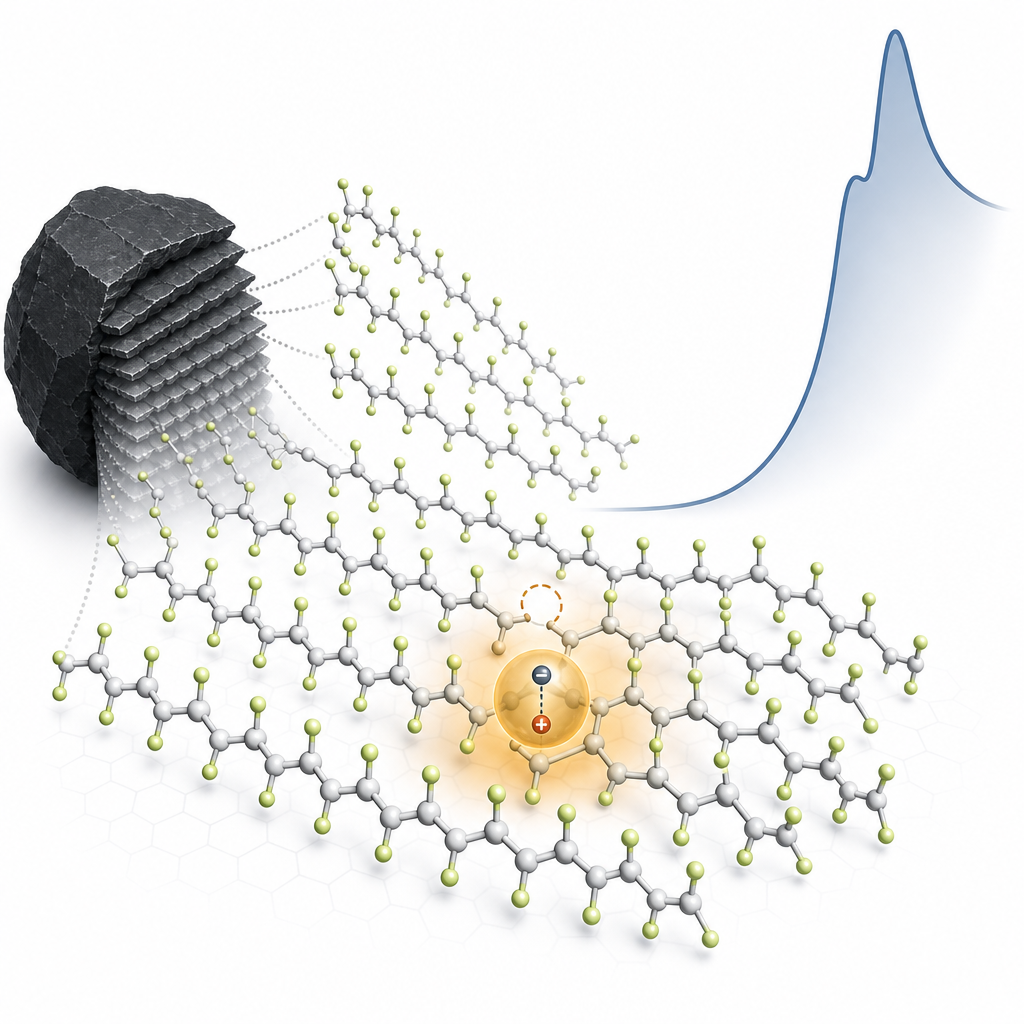
The ACS Material graphite fluoride sample (GFA2) was studied as a less-fluorinated counterpart to a more highly fluorinated reference (GFS from a different supplier). Dry powders were measured by diffuse reflectance spectroscopy against an MgO reference on an Analytik Jena Specord 250 Plus spectrophotometer with an integrating sphere; band gaps were extracted using the Tauc method on Kubelka-Munk transformed spectra. Crucially, a deuterium lamp operating from 185 nm (6.7 eV) extended the measurement into the far UV, a region not inspected in earlier work. The GFA2 powder was further characterized by powder XRD (Co Kα), XPS (which gave a fluorine content of 49.7 at.%), Raman mapping (532 nm), and SEM/AFM/CPEM. No solvents were used to avoid solvation effects or spontaneous defluorination. The defect content within GFA2 made it the key sample for connecting low-energy absorption features to fluorine vacancies.
The diffuse reflectance Tauc analysis revealed sharp absorption onsets at 5.75 eV for GFS and 5.67 eV for GFA2. The GFA2 sample additionally showed two lower-energy features at 2.87 eV and 4.81 eV, also present but roughly two orders of magnitude weaker in GFS. Photoluminescence excitation-emission maps at 80 K corroborated these onsets, with GFA2 emitting at 2.5 eV after excitation at 3.5 and 4.8 eV. XRD showed (001) and (100) reflections of (CF)n sheets, with an additional (002) graphite reflection at 31.6° in GFA2 indicating less-fluorinated particles. Raman mapping confirmed coexisting fluorinated regions (featureless) and defective graphite-like regions (clear D and G bands). XPS gave fluorine contents of 54.7 at.% (GFS) and 49.7 at.% (GFA2). On the theory side, BSE@GW0 calculations placed the excitonic peak at 5.65 eV with an electronic band gap of 7.18 eV, and finite-momentum BSE identified a Frenkel exciton bound to a single atom. Introducing a fluorine radical vacancy produced midgap states yielding absorption peaks at about 3.1, 4.0, and 4.6–4.75 eV, matching the experimental GFA2 features, while biradical (divacancy) defects produced no absorption below 5.5 eV. A defluorinated carbon ring suppressed the excitonic peak and reproduced the visible transparency of highly fluorinated graphene.
These results give a coherent picture of fluorographene's optical behavior and clarify how stoichiometry and defects govern its electronic structure. The work enables more reliable use of fluorographene as a two-dimensional dielectric and as a deep-UV emitter, and it cautions that fluorination-induced defects must be controlled for optoelectronic applications. The findings are relevant to van der Waals heterostructures, power and high-temperature electronics, short-wavelength photonics, and to the broader family of graphene derivatives synthesized from graphite fluoride. The paper itself stresses that precise control of material stoichiometry and structure will be required to exploit fluorographene in devices, pointing toward defect engineering as a follow-up direction.
For researchers working on fluorinated carbon materials, 2D dielectrics, or defect-controlled optoelectronics, the graphite fluoride used here is representative of the graphite fluoride / fluorinated graphene products available from ACS Material. The study shows that commercially sourced graphite fluoride, when carefully characterized for fluorine content and defect distribution, can serve as a reliable model system for fundamental band gap and exciton investigations, supporting reproducible work across spectroscopy and ab initio modeling.How ACS Material products were used
- Graphite Fluoride GFA2 (GT1FS012) (Graphene Series) — “GFS graphite fluoride (372455) was purchased from Sigma-Aldrich and GFA2 (GT1FS012) from ACS Material.”
Product Performance in this StudyThe ACS Material GFA2 graphite fluoride was one of the two principal samples examined. It contained both highly and less fluorinated regions (49.7 at.% F), enabling the study to attribute low-energy absorption bands to fluorine-vacancy defects and to validate the 5.75 eV optical band gap.
Related product categories
Frequently asked questionsWhat is the optical band gap of fluorographene?
Using diffuse reflectance spectroscopy on graphite fluoride powders, the study measured a direct optical band gap onset at 5.75 eV for the highly fluorinated sample and 5.67 eV for the less fluorinated GFA2 sample. Ab initio Bethe-Salpeter calculations placed the excitonic onset at 5.65 eV, in close agreement with experiment, while the electronic (fundamental) gap was 7.18 eV.
Why did earlier studies report a much lower band gap for fluorographene?
The lower band gap values of about 3 eV reported earlier originate from fluorine-vacancy defects rather than the intrinsic gap. The study's GW/BSE calculations showed that fluorine radical vacancies create midgap states giving absorption peaks near 3.1, 4.0, and 4.6 eV. These defect-induced features explain the low-energy absorption seen in less-fluorinated samples and resolve decades of controversy.
How does fluorine content affect the optical properties of graphite fluoride?
Higher fluorination yields the intrinsic excitonic absorption near 5.8 eV, while less-fluorinated regions introduce graphite-like sp2 domains and fluorine vacancies that produce additional low-energy absorption bands around 2.9 and 4.8 eV. XPS showed fluorine contents of 54.7 and 49.7 atomic percent for the two samples, and the lower-fluorine sample showed stronger defect-related features.