-
Graphite Fluoride for Heat-Dissipation Films - Korea National University of Transportation, 2020
Jun 02, 2026 | ACS MATERIAL LLCVu, M. et al. (2020). Ultrathin thermally conductive yet electrically insulating exfoliated graphene fluoride film for high performance heat dissipation. *Carbon*.
Carbon · 2020
Korea National University of Transportation researchers exfoliated ACS Material graphite fluoride into ultrathin EGF films with 242 W/m·K in-plane thermal conductivity.
About this research
Researchers at Korea National University of Transportation used Graphite Fluoride supplied by ACS Material (CAS GTFF012, lateral size 200–500 μm) as the precursor to fabricate ultrathin exfoliated graphene fluoride (EGF) films that simultaneously deliver an in-plane thermal conductivity of 242 W m⁻¹ K⁻¹, a through-plane thermal conductivity of 21.8 W m⁻¹ K⁻¹, and full electrical insulation. Published in Carbon (2020) by Vu and colleagues, the work demonstrates one of the highest thermal conductivities ever reported for an electrically insulating 2D-material film, and shows that the EGF film outperforms commercial polyimide substrates and commercial 5 W m⁻¹ K⁻¹ thermal pads when used as a heat spreader or thermal interface material for high-power LEDs.
The broader challenge addressed by this paper is the conflict between heat removal and electrical isolation in densely integrated, portable, and flexible electronics. Graphene-based heat spreaders can reach thermal conductivities above 1000 W m⁻¹ K⁻¹, but their high electrical conductivity disqualifies them from contact with active circuitry. Boron nitride nanosheet (BNNS) films are insulating but typically remain below 50 W m⁻¹ K⁻¹ in-plane, which is insufficient for high-power devices. Graphene fluoride is attractive because C–F bonds convert sp² carbon to sp³, opening a ~3.8 eV bandgap while theory predicts thermal conductivity up to 1800 W m⁻¹ K⁻¹ at full fluorination. Until this study, scalable routes to defect-free, large-area graphene fluoride films had been lacking, limiting its use as a thermal interface material in flexible electronics, LED packaging, and wearable energy-storage devices.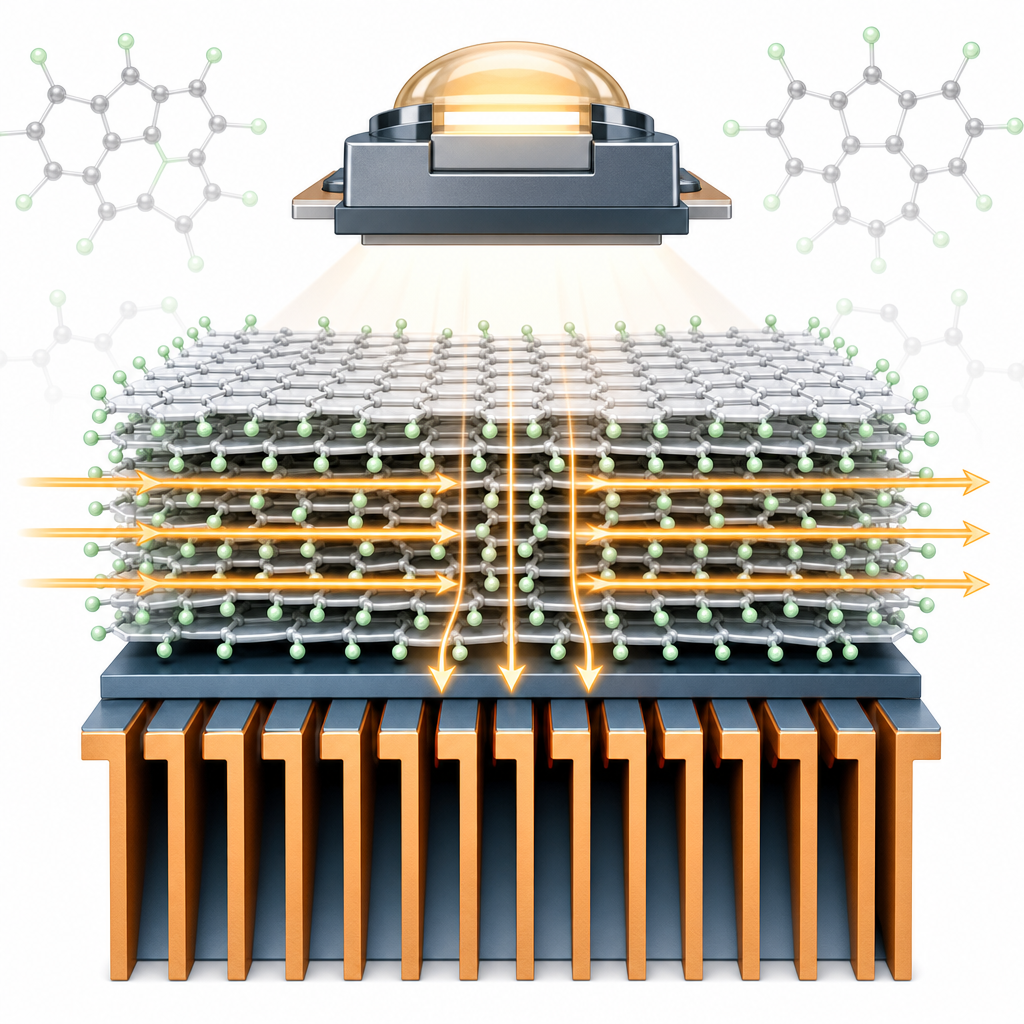
The ACS Material graphite fluoride was the central feedstock for the exfoliation process. 5 g of graphite fluoride was added to 100 mL of N-methyl-2-pyrrolidone (NMP) along with 2 kg of mixed 2 mm and 0.2 mm zirconia balls and milled in a planetary ball mill at 300 rpm for 6 h under nitrogen. The large balls fragment the starting graphite fluoride platelets via high-velocity impact, while the small balls deliver shear forces that split the fragments into few-layer EGF without introducing in-plane defects. After centrifugation at 2000 rpm to remove unexfoliated material, 1.9 g of EGF powder was recovered, corresponding to a 38% yield in only 6 h, far better than prior sonochemical or solvothermal routes. The EGF dispersion (1 mg mL⁻¹) was then vacuum filtered through a 0.1 μm nylon membrane and dried at 60 °C for 48 h to produce free-standing films, with film thickness controlled simply by changing the dispersion volume (20, 50, 100, or 160 mL for 10, 30, 60, or 100 μm films).
DLS measurements gave a mean EGF lateral size of ~800 nm, and AFM showed monolayer thicknesses of 0.846 nm, consistent with single-sheet graphene fluoride. XPS quantified an F/C atomic ratio of 0.69 in the EGF (vs. 0.85 in the starting graphite fluoride), and the F1s peak shifted from 688.2 to 687.8 eV, indicating partial conversion of covalent C–F to semi-ionic C–F bonds. Raman I_D/I_G decreased from 1.48 to 1.21, signaling partial sp² restoration. SEM cross-sections revealed a highly aligned layer-by-layer structure that maximizes phonon transport in the basal plane. The 10 μm film reached 242 W m⁻¹ K⁻¹ in-plane and 21.8 W m⁻¹ K⁻¹ through-plane thermal conductivity—170% and 275% higher than 30 μm and 100 μm films respectively, and 55× greater through-plane than the 100 μm film. Tensile strength reached 38.3 MPa with a Young's modulus of 11.8 GPa for the 10 μm film, and the in-plane thermal conductivity was retained after 2000 bending cycles at a 4 mm radius. Electrical conductivity stayed below 10⁻⁹ S m⁻¹, confirming insulation. In LED dissipation tests, the EGF film as a heat spreader lowered LED temperature by 60 °C compared with polyimide film, and as a TIM lowered it by 25 °C compared with a commercial 5 W m⁻¹ K⁻¹ thermal pad.
The results enable practical heat dissipation pathways for flexible displays, wearable electronics, miniaturized power converters, and high-brightness LED modules, where electrical isolation between heat source and heat sink is mandatory. Because the EGF film is ultrathin, lightweight, and bendable, it can replace bulkier ceramic heat-spreader plates or insulating polymer-BN composite pads. The authors point to extensions including EGF-polymer composites, EGF-metal hybrid heat sinks, and integration into multilayer flexible circuit stacks. Combined with the scalability of ball-mill exfoliation, the approach offers a route from kilogram-scale graphite fluoride feedstock to industrially relevant thermal management films.
For researchers pursuing similar thermal management, EMI shielding, or 2D-fluorinated-carbon device studies, ACS Material's Graphite Fluoride (Carbon Monofluoride) and related fluorinated graphene products provide a consistent, high-fluorine-content starting material with controlled lateral size. The same precursor is applicable to lithium primary battery cathodes, solid lubricants, and gas sensing studies cited throughout the references of this paper, making it a versatile input for fluorinated carbon nanomaterial research.How ACS Material products were used
- Graphite Fluoride (Carbon Monofluoride) (Graphene Series) — “Graphite fluoride (CAS: GTFF012) with average lateral size of 200–500 μm was purchased from ACS Material (USA).”
Product Performance in this Study
The ACS Material graphite fluoride served as the direct precursor for ball-mill exfoliation into graphene fluoride sheets. Its large lateral size (200–500 μm) and high fluorine content enabled production of basal-plane-defect-free EGF sheets with 38% yield, ultimately delivering films with 242 W m⁻¹ K⁻¹ in-plane thermal conductivity.
Related product categories
Frequently asked questions
How does graphene fluoride combine high thermal conductivity with electrical insulation?
Fluorination converts the sp² carbon network of graphene into sp³ C–F bonds, opening a wide bandgap (~3.8 eV) that suppresses electronic conduction while preserving phonon transport along the basal plane. In this study, ball-milled exfoliated graphene fluoride films achieved 242 W m⁻¹ K⁻¹ in-plane thermal conductivity yet kept electrical conductivity below 10⁻⁹ S m⁻¹, demonstrating that controlled fluorine coverage decouples thermal from electrical conduction.
Why is graphite fluoride a preferred precursor for thermally conductive insulating films?
Commercial graphite fluoride starts with high fluorine content (F/C ≈ 0.85) and large lateral sheets (200–500 μm), so liquid-phase ball-mill exfoliation in NMP yields few-layer graphene fluoride sheets with retained basal-plane integrity and minimal defects. This preserves the long phonon mean free path needed for high in-plane thermal conductivity, while the C–F bonds maintain the electrical insulation required for thermal interface materials.
What thickness of graphene fluoride film gives the best heat dissipation performance?
Thinner films perform better. The 10 μm exfoliated graphene fluoride film reached 242 W m⁻¹ K⁻¹ in-plane and 21.8 W m⁻¹ K⁻¹ through-plane thermal conductivity, while 30 μm and 100 μm films dropped to 144 and 88 W m⁻¹ K⁻¹ in-plane. Thinner films contain fewer air gaps between stacked sheets and present more aligned, continuous sheet planes, reducing phonon scattering at sheet boundaries.