-
Graphite Nanoplatelets for Pt Methanol Catalyst - Tianjin University, 2015
Jun 25, 2026 | ACS MATERIAL LLCZhang, G. et al. (2015). Small-Sized and highly dispersed Pt nanoparticles loading on graphite nanoplatelets as an effective catalyst for methanol oxidation. *Nanoscale*. https://doi.org/10.1039/c5nr01882j
Nanoscale · 2015
Tianjin University researchers used ACS Material graphite nanoplatelets to support small, well-dispersed Pt nanoparticles that outperform commercial Pt/C for methanol oxidation.
About this research
Researchers at Tianjin University used graphite nanoplatelets (GNPs) supplied by ACS Material to fabricate a high-performance Pt anode catalyst that outperforms commercial Johnson Matthey Pt/C for methanol oxidation in direct methanol fuel cells (DMFCs). By functionalizing the GNP surfaces with the imidazolium ionic liquid [BMIM][BF4] before depositing Pt, the team produced uniformly dispersed sub-3 nm Pt nanoparticles at a nominal 20 wt% loading, yielding the optimal Pt/I-IL(10)/GNP catalyst. The work, published in Nanoscale (2015, DOI: 10.1039/c5nr01882j), demonstrates a practical route to small, well-anchored noble-metal particles on a defect-poor 2D carbon support, addressing a long-standing problem in DMFC anode design.
Direct methanol fuel cells are attractive power sources for portable and transportation applications because methanol is liquid, energy-dense, and easy to handle. However, the platinum anode catalysts that drive the methanol oxidation reaction (MOR) suffer from sluggish kinetics, CO-intermediate poisoning, high cost, and low utilization. Two-dimensional carbon supports such as reduced graphene oxide offer high surface area and conductivity but are defect-rich, while graphite nanoplatelets retain the conductivity of graphite with fewer functional groups, enabling stable but poorly wettable surfaces. The challenge addressed in this paper is how to graft a dense population of small Pt nanoparticles onto these low-defect GNPs without sacrificing their electronic transport properties. Solving it is essential for cost-effective, durable DMFC anodes and is broadly relevant to electrocatalysis, hydrogen evolution, and oxygen reduction research.
The ACS Material graphite nanoplatelets were specified in the experimental section as having >99.5 wt% carbon content, lateral width 0.5–20 µm, thickness 1–5 nm, specific surface area 110 m²/g, conductivity 80–100 S/cm, and zeta potential −19.6 mV. Before catalyst synthesis the GNPs were probe-sonicated for 2 h to reduce lateral size and aspect ratio. An aqueous dispersion of 20 mg GNPs was then combined with 40 mL ethylene glycol containing variable volumes (0–20 µL) of [BMIM][BF4] and sonicated for 3 h, allowing the positively charged imidazolium cations to electrostatically decorate the negatively charged GNP surfaces. Na2PtCl6 (2.56 mL of 10 mM solution) was added under reflux at 125 °C; PtCl6²⁻ exchanged with the imidazolium sites and was reduced in situ by ethylene glycol over 4 h. The product was filtered, washed, and dried to give Pt/I-IL(x)/GNPs at 20 wt% theoretical metal loading. Without ACS Material's high-conductivity, low-defect GNP support, the dense and uniform Pt distribution achieved here would not be possible.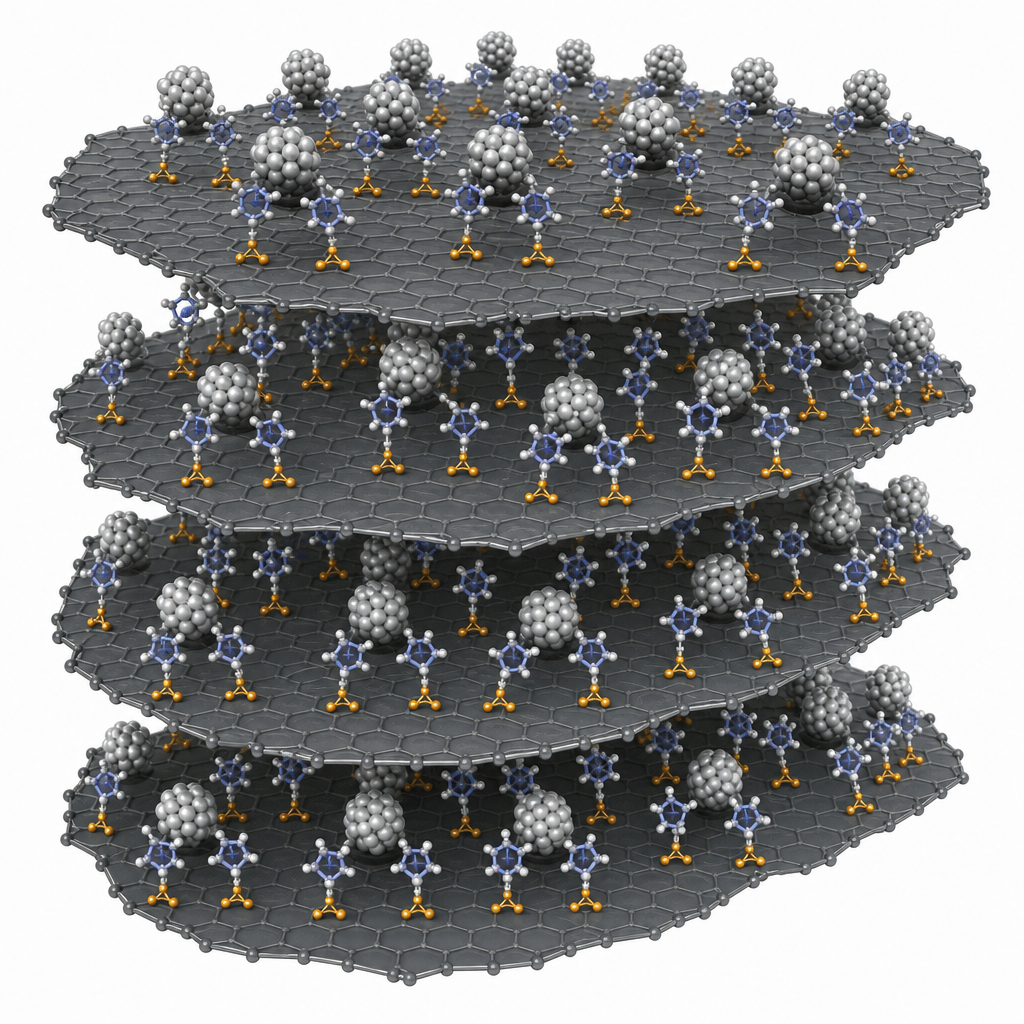
X-ray diffraction confirmed the Pt(111), (200), (220), and (311) reflections expected of face-centered-cubic platinum, with peak broadening consistent with very small crystallites. TEM and HRTEM imaging showed that the I-IL volume directly controls Pt particle size: increasing [BMIM][BF4] from 0 to 10 µL progressively reduced the mean Pt diameter and tightened the size distribution, while 15 and 20 µL led to slight aggregation. The optimal Pt/I-IL(10)/GNP sample displayed small, homogeneously dispersed Pt nanoparticles across the GNP basal planes. Electrochemical characterization in 0.5 M H2SO4 + 1.0 M CH3OH using a thin-film glassy-carbon working electrode (3 µL of catalyst ink containing 2 mg catalyst, 1 mL solvent, 30 µL of 5 wt% Nafion) showed that Pt/I-IL(10)/GNPs delivered the highest mass and specific activities toward MOR among all synthesized samples. Cyclic voltammetry between −0.2 and 1.1 V at 50 mV/s, chronoamperometry at 0.60 V for 3600 s, and electrochemical impedance spectroscopy from 100 kHz to 10 mHz all confirmed that the optimized catalyst outperforms commercial Johnson Matthey Pt/C in both methanol oxidation activity and stability, with lower charge-transfer resistance and higher steady-state current density after one hour of operation.
The catalyst architecture demonstrated here is directly relevant to direct methanol fuel cell stacks, portable power systems, and broader Pt-based electrocatalysis where small, well-anchored particles improve mass activity and lifetime. The same imidazolium-IL functionalization strategy on GNPs should transfer to other carbon-supported precious metal systems used for the oxygen reduction reaction, hydrogen evolution, formic acid oxidation, and ethanol oxidation. The authors point to further optimization of ionic liquid chemistry and Pt alloy formulations (e.g., PtRu, PtCo) on the same GNP scaffold as a logical extension. Researchers working on flexible electrochemical devices, microfluidic fuel cells, or printable electrocatalyst inks can also benefit from the GNP support's combination of high conductivity, mechanical robustness, and processability in aqueous and ethylene glycol media.
For researchers pursuing similar work, the graphite nanoplatelets used in this study are available from ACS Material under the Graphene Series. The reported specifications—high purity, controllable lateral size, nanometer-scale thickness, and three-digit S/cm conductivity—are reproducible at scale, which is what enabled this group to achieve uniform Pt deposition without sacrificing electron transport. Because the GNPs come with low defect density, they avoid the parasitic side chemistry seen on heavily oxidized graphene oxides and offer a clean platform for studying support–metal interactions in electrocatalysis.How ACS Material products were used
- Industrial Thin Layer Graphene Nanoplatelets (Graphene Series) — “Graphite nanoplatelets (GNPs, >99.5 wt% carbon content, width 0.5–20 μm, thickness 1–5 nm, surface area 110 m2 g−1, conductivity 80–100 S cm−1, zeta potential −19.6 mV, ACS Material, USA)”
Product Performance in this StudyThe ACS Material graphite nanoplatelets served as the two-dimensional carbon support for Pt nanoparticles. Their high specific surface area (110 m²/g), good electrical conductivity (80–100 S/cm), and low defect density enabled, after ionic-liquid functionalization, uniform anchoring of small Pt NPs and produced a catalyst that outperformed commercial Pt/C from Johnson Matthey in methanol oxidation activity and stability.
Related product categories
Frequently asked questionsWhy are graphite nanoplatelets a better Pt catalyst support than reduced graphene oxide?
Graphite nanoplatelets retain the high specific surface area and electrical conductivity of graphene-like 2D carbons but contain far fewer structural defects and oxygenated functional groups than reduced graphene oxide. This means stronger electron transport between the carbon and the Pt nanoparticles and less parasitic side chemistry during electrocatalysis. In this study the GNP support, after ionic-liquid functionalization, gave smaller, more uniformly dispersed Pt particles and higher methanol oxidation stability than commercial Pt/C.
How does an imidazolium ionic liquid help disperse Pt nanoparticles on graphite nanoplatelets?
The imidazolium ionic liquid [BMIM][BF4] adsorbs onto the negatively charged GNP surfaces through electrostatic interaction between the [BMIM]+ cation and the GNPs (zeta potential −19.6 mV). The bound imidazolium then exchanges with PtCl6²⁻, enriching the Pt precursor uniformly across the support. During ethylene glycol reduction at 125 °C this produces small, well-anchored Pt nanoparticles. The optimal ionic liquid volume (10 µL) gives the smallest particle size and best methanol oxidation activity.
What specifications of graphite nanoplatelets are recommended for fuel cell catalyst research?
For Pt-based fuel cell anode catalysts, the study used graphite nanoplatelets with >99.5 wt% carbon, 0.5–20 µm lateral width, 1–5 nm thickness, 110 m² per gram specific surface area, and 80–100 S/cm electrical conductivity. These parameters balance accessibility of the basal plane for metal anchoring with the high conductivity required for fast electron transport in the methanol oxidation reaction. Similar specifications are available commercially from ACS Material.