-
Graphite Nanoplatelets for Pt/PANI DMFC Catalyst - Tianjin University, 2013
Jun 18, 2026 | ACS MATERIAL LLCZhang, X. et al. (2013). Preparation and characterization of Pt nanoparticles supported on modified graphite nanoplatelet using solution blending method. *International Journal of Hydrogen Energy*. https://doi.org/10.1016/j.ijhydene.2013.05.038
International Journal of Hydrogen Energy · 2013
Tianjin University researchers used ACS Material graphite nanoplatelets to build a polyaniline-functionalized Pt catalyst that doubled methanol electro-oxidation activity.
About this research
Researchers at Tianjin University used graphite nanoplatelets supplied by ACS Material to fabricate a polyaniline-functionalized platinum electrocatalyst whose methanol oxidation activity was nearly twice that of the unmodified Pt/GNP reference. Published in the International Journal of Hydrogen Energy in 2013 by Xueping Zhang and colleagues from the Department of Applied Chemistry and the State Key Laboratory of Chemical Engineering at Tianjin University, the short communication describes a solution-blending route that uses polyaniline (PANI) as a noncovalent stabilizer to anchor 4-5 nm Pt nanoparticles uniformly across graphite nanoplatelet (GNP) surfaces. The work directly targets one of the key bottlenecks in direct methanol fuel cell (DMFC) development: sluggish methanol electro-oxidation kinetics on carbon-supported platinum.
The DMFC is widely regarded as a strong candidate for portable and micro-power systems because of its simple architecture, low emissions, high specific energy, and rapid refuelling. Practical deployment, however, depends on improving the activity and stability of the anode catalyst, which is typically platinum or a platinum alloy dispersed on a carbon support. Graphene-based supports are attractive for their conductivity and surface area, but defect-rich graphene oxides can be unstable in acidic fuel cell media and lose conductivity after reduction. Graphite nanoplatelets offer a compromise: they preserve much of the graphitic conductivity while providing accessible basal-plane and edge sites for metal anchoring. The challenge addressed in this paper is to functionalize GNP without disrupting its sp2 network, and the team's approach is to use conjugated polyaniline as a noncovalent linker that bridges Pt precursor reduction and the carbon surface.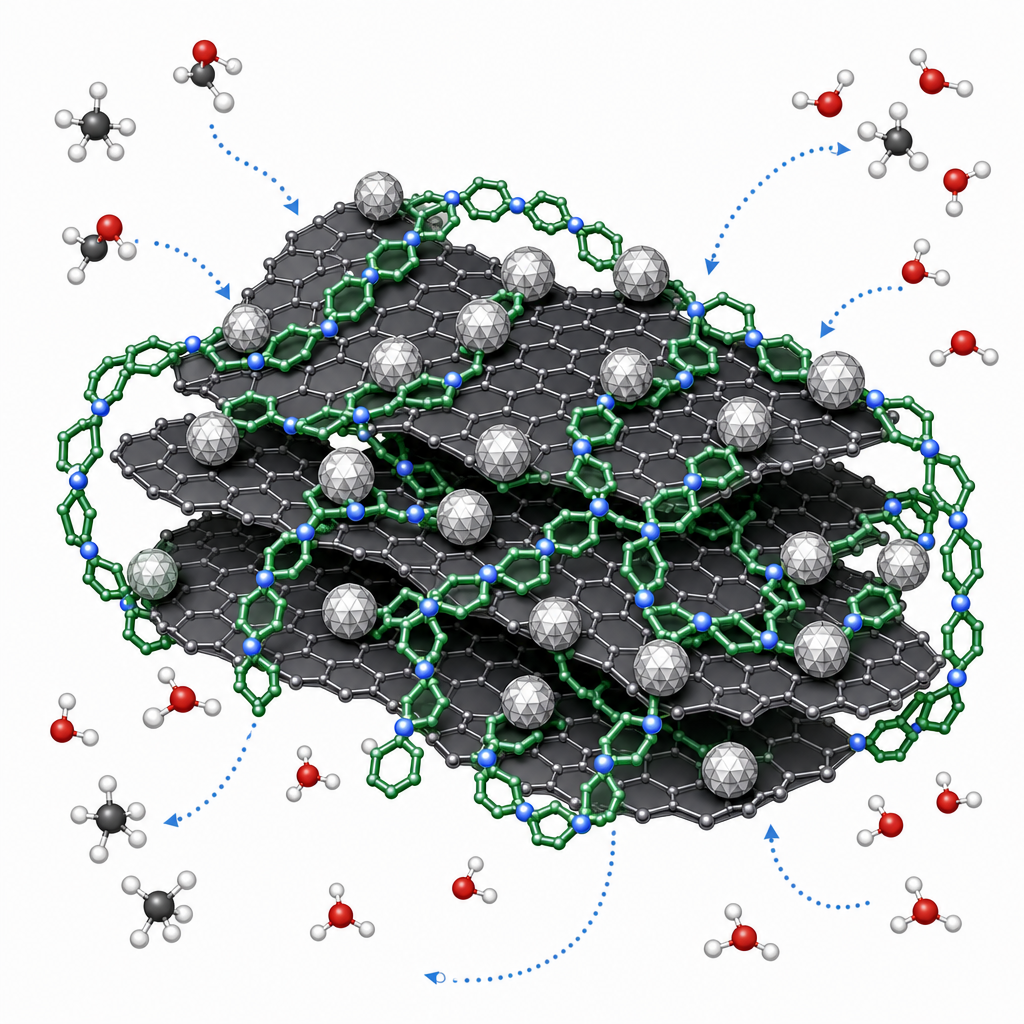
The graphite nanoplatelets from ACS Material are specified in the experimental section as having >99.5% carbon content, particle sizes of 0.5-20 μm, a specific surface area exceeding 90 m2/g, and a thickness of 1-5 nm. Before metal deposition the GNPs were ultrasonically tip-treated to fragment large platelets and reduce their aspect ratio, then dispersed in N-methyl pyrrolidone (NMP). Polyaniline, separately dissolved in NMP, was mixed with the GNP suspension and stirred at room temperature for 24 hours to allow π-π and hydrogen-bonding interactions between the conjugated polymer and the graphitic basal planes. The resulting PANI-GNP solid was filtered, redispersed in an ethylene glycol/water mixture, and reduced in the presence of 0.01 mol L⁻¹ H2PtCl6 at 130 °C for 4 hours to give a Pt loading of 20 wt%. Three PANI-to-(PANI+GNP) mass ratios, 1, 2, and 5 wt% (samples PANI1, PANI2, PANI5), were screened against a polymer-free Pt/GNP control.
XRD confirmed the expected face-centered-cubic Pt reflections (111), (200), and (220) on top of the graphite (002) and (004) peaks in all four catalysts. High-resolution TEM showed that on bare GNP the Pt nanoparticles aggregated, while introduction of polyaniline produced markedly more uniform distributions; PANI2, with 2 wt% polymer, yielded the most homogeneous coverage with particles around 4-5 nm in diameter. XPS analysis indicated that the polyaniline-modified samples contained a higher fraction of metallic Pt0 and a larger population of oxygen-containing surface groups, together with nitrogen atoms originating from the polymer backbone. Electrochemical testing was performed in 2 mol L⁻¹ methanol with 0.5 mol L⁻¹ sulfuric acid using a three-electrode cell with saturated calomel and platinum foil electrodes. Cyclic voltammetry between 0.0 and 1.24 V at 10 mV s⁻¹ revealed that the Pt/PANI-GNP catalyst delivered nearly double the mass-specific methanol oxidation current of the Pt/GNP reference. Chronoamperometry at 0.68 V for 2400 s showed that the polyaniline-modified catalyst also maintained higher current density during prolonged operation. The authors attribute the improvement to four cooperating factors: uniform particle dispersion, an increased Pt0 fraction with more oxygen-containing groups, the presence of basic nitrogen sites, and a modified reaction pathway facilitated by the polymer.
The practical implication is a simpler, room-temperature route to higher-performance DMFC anode catalysts that avoids harsh oxidative treatments of the carbon support. Because polyaniline doping is reversible and tunable, the same strategy could be extended to PtRu, PtCo, and other binary alloy systems used for methanol or ethanol oxidation, and to oxygen reduction catalysts. Graphite nanoplatelet supports also have potential uses beyond fuel cells, including electrochemical sensors, supercapacitor electrodes, and electromagnetic interference shielding films, where their balance of conductivity, surface area, and processability is valuable.
For researchers working on supported metal nanoparticles, electrocatalysts, or graphitic carbon composites, the relevant graphite nanoplatelet material remains available from ACS Material as part of the Graphene Series catalog. The specifications quoted in the paper - >99.5% carbon, 1-5 nm thickness, sub-micrometer to 20 μm lateral size, and >90 m2/g surface area - provide a reproducibility benchmark for groups attempting to replicate or extend this Pt/PANI-GNP methodology in their own DMFC and electrocatalysis research.How ACS Material products were used
- Industrial Thin Layer Graphene Nanoplatelets (Graphene Series) — “Graphite nanoplatelets (carbon content >99.5%, particle size: 0.5-20 μm, specific surface area >90 m2/g, ACS Material. Com) have a thickness in the range of 1-5 nm with a width of 0.5-20 μm.”
Product Performance in this StudyThe graphite nanoplatelets from ACS Material served as the conductive carbon support for Pt nanoparticles. After noncovalent functionalization with polyaniline, they enabled uniform dispersion of 4-5 nm Pt particles, producing a Pt/PANI-GNP catalyst with roughly twice the methanol electro-oxidation activity of the unmodified Pt/GNP reference.
Related product categories
Frequently asked questionsHow do graphite nanoplatelets improve platinum catalysts for direct methanol fuel cells?
Graphite nanoplatelets combine high electrical conductivity, large specific surface area, and chemical stability in acidic media, making them effective conductive supports for platinum nanoparticles. In this Tianjin University study, GNPs with surface area above 90 m2/g and thickness of 1-5 nm provided anchoring sites that, after polyaniline functionalization, yielded uniform 4-5 nm Pt particles and roughly double the methanol electro-oxidation mass activity of unmodified Pt/GNP catalysts.
Why is polyaniline used to functionalize graphite nanoplatelets before platinum deposition?
Polyaniline is a conjugated polymer that interacts with the graphitic basal planes of nanoplatelets through π-π and hydrogen bonding without disrupting their sp2 network. This noncovalent coating provides nitrogen and oxygen-containing anchoring sites that stabilize platinum nuclei during ethylene glycol reduction, producing well-dispersed 4-5 nm Pt particles, raising the Pt0 fraction observed in XPS, and improving methanol electro-oxidation activity and chronoamperometric stability.
What specifications of graphite nanoplatelets were used to build the Pt/PANI-GNP catalyst?
The authors used graphite nanoplatelets from ACS Material with carbon content above 99.5%, lateral sizes between 0.5 and 20 μm, thickness in the 1-5 nm range, and a specific surface area greater than 90 m2/g. Prior to platinum deposition the platelets were tip-sonicated in N-methyl pyrrolidone to fragment them and reduce the width-to-thickness aspect ratio before solution blending with polyaniline.