-
H-ZSM-5 Zeolite for Methanol-to-Aromatics - KAUST, 2021
Jun 01, 2026 | ACS MATERIAL LLCShoinkhorova, T. et al. (2021). Highly selective and stable production of aromatics via high-pressure methanol conversion. *ACS Catalysis*. https://doi.org/10.1021/acscatal.0c05133
King Abdullah University of Science and Technology · ACS Catalysis · 2021
KAUST researchers used H-ZSM-5 zeolites (SiO2/Al2O3 = 52, 371) from ACS Material to achieve ~50% aromatics selectivity at 30 bar in methanol conversion.
About this research
Researchers at King Abdullah University of Science and Technology (KAUST), in collaboration with the University of the Basque Country, demonstrated that high-pressure methanol-to-aromatics (MTA) conversion over H-ZSM-5 zeolites — including samples with SiO2/Al2O3 ratios of 52 (P-52) and 371 (P-371) sourced from ACS Material — delivers nearly 50% aromatics selectivity, ~20% BTX yield, and over 70 hours of stable operation at 400 °C and 30 bar. The work, published in ACS Catalysis (2021), reveals how reaction pressure and zeolite acidity together control aromatics selectivity, coke formation, and irreversible dealumination. The findings point to moderate-pressure, low-acidity ZSM-5 catalysts as a practical route to selective benzene, toluene, and xylene (BTX) production from methanol.
Benzene, toluene, and xylenes are foundational petrochemicals whose global demand has outpaced supply since naphtha steam-cracking shifted toward lighter olefin feedstocks. Methanol-to-aromatics offers an alternative pathway that can be fed from coal-, biomass-, or CO2-derived methanol, making it strategically attractive in regions without large oil reserves. The persistent obstacle has been the trade-off between aromatic selectivity and catalyst lifetime: promoting the aromatic cycle on ZSM-5 invariably accelerates coke formation and zeolite deactivation. The authors therefore searched for operating windows where high partial pressures of both methanol-derived olefins and in-situ steam could simultaneously enhance aromatization and suppress coke, addressing a long-standing limitation of MTH chemistry.
The ACS Material H-ZSM-5 zeolites (P-52 and P-371) anchored the low-acidity end of a five-catalyst acidity series (HZ23, HZ52, HZ80, HZ280, HZ371) used to map the coupled effects of acid-site density and pressure. As supplied, the materials were already in protonic form and were combined with commercial NH4-form ZSM-5 zeolites that the authors calcined in-house at 550 °C. All catalysts were pelletized, crushed to 250–425 μm, mixed with SiC (1:6) to suppress hot spots, and pretreated under N2 at 550 °C. They were then tested in a four-channel Avantium Flowrence XD reactor at WHSV = 8 h−1 across pressures from 1 to 60 bar and temperatures from 350 to 525 °C. The HZ371 catalyst sourced from ACS Material provided a critical low-acidity reference: with very few Brønsted sites, it isolated the role of acid-site density on hydrogen-transfer pathways, methylation chemistry, and steam-induced dealumination measured by 27Al MAS NMR.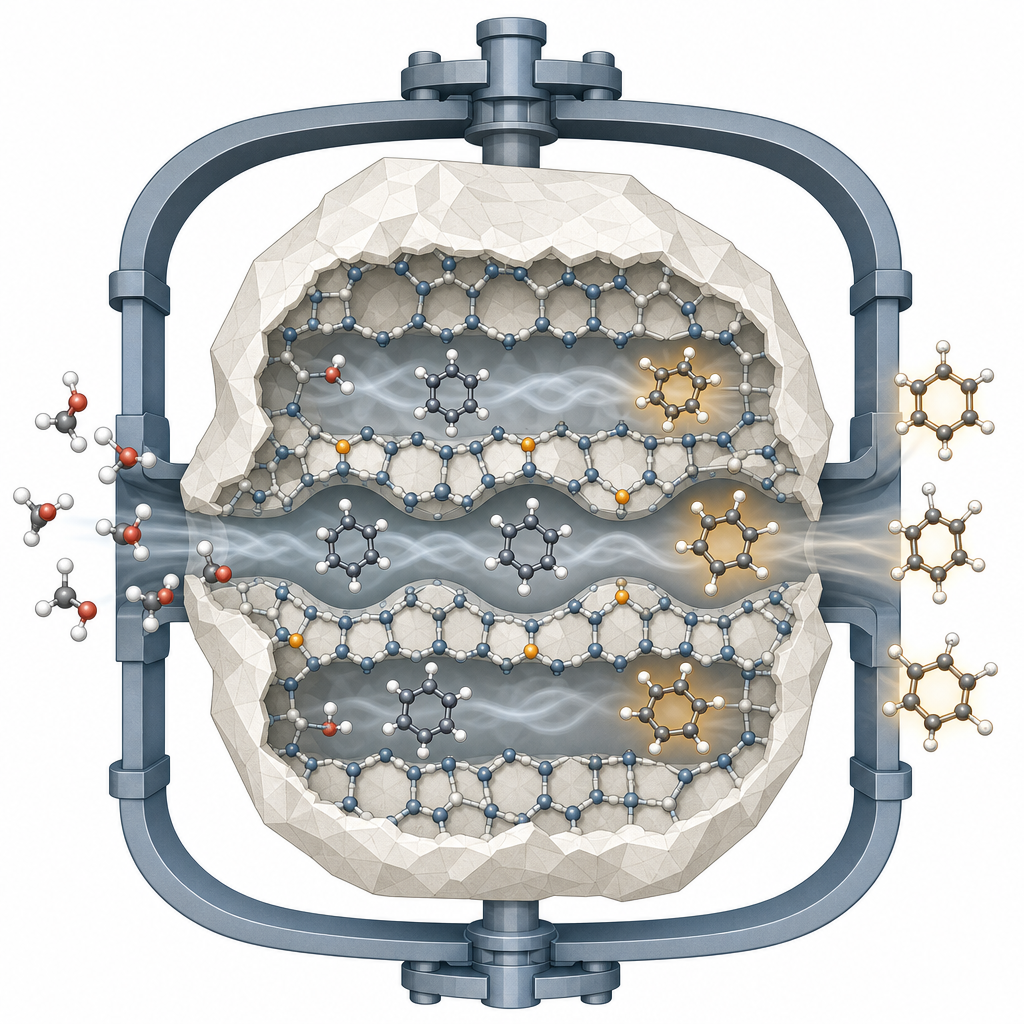 Increasing total pressure from 1 to 60 bar raised total aromatic selectivity over the most acidic HZ23 zeolite from roughly 30% to 52%, while BTX selectivity peaked near 15 bar before higher pressures shifted product distribution toward C9–10 methylated aromatics. TGA-TPO showed coke deposition falling from 13.1 wt% at 1 bar to substantially lower levels at 30 and 60 bar, with the dominant coke combustion peak shifting from 611 °C to 587 °C — evidence that pressure not only suppresses coke quantity but alters its nature toward less condensed structures. Across the acidity series at 30 bar, total aromatic selectivity counter-intuitively increased with SiO2/Al2O3 ratio, reaching about 50% on HZ280 with stable operation for more than 70 hours and BTX selectivity of ~20%. The ACS Material HZ371 catalyst showed the lowest coke loading of all samples tested under water co-feed (0.5 wt% vs. 5.9 wt% for HZ80) and the smallest loss of framework AlIV by 27Al NMR (87% initial preserved at ~93% apparent post-reaction, reflecting loss of extra-framework Al). Two reaction cycles with intermediate 550 °C air regeneration confirmed that low-acidity zeolites recover activity with minimal irreversible damage. Control experiments feeding ethylene/water at 30 bar showed paraffin/aromatic carbon ratios of 2.4, versus 1.0 in MTA, confirming that methanol-driven hydrogen transfer (not pure oligomerization) dominates the aromatic-forming pathway.
The practical implication is a viable high-pressure window — 30 bar, 400 °C, low-acidity ZSM-5 — for sustained BTX production from methanol that could integrate with syngas- or CO2-to-methanol upstream units. Beyond petrochemicals, the mechanistic insights into water-mediated suppression of coking and the role of acid-site density inform broader zeolite catalysis problems: methanol-to-olefins, ethanol-to-aromatics, dimethyl-ether conversion, and bifunctional Fischer–Tropsch-aromatization cascades. The clear demonstration that high-silica ZSM-5 resists dealumination under steaming conditions also has direct relevance for fluid catalytic cracking and methanol-fueled aromatization plants where hydrothermal stability dictates catalyst replacement schedules.
For researchers working on zeolite-catalyzed C1 chemistry, this study underscores why catalyst sourcing matters: subtle differences in SiO2/Al2O3 ratio, defect density, and aluminum coordination drive performance under realistic conditions. The high-silica H-ZSM-5 samples used here, including the P-52 and P-371 grades acquired from ACS Material, are part of the broader molecular-sieves and zeolite catalog that ACS Material LLC supplies to laboratories investigating MTA, MTO, MTG, and related processes. Reliable access to well-characterized H-ZSM-5 across a wide acidity range supports the kind of systematic mechanistic work demonstrated in this paper.How ACS Material products were used
- H-ZSM-5 Zeolite (SiO2/Al2O3 = 371, P-371) (Molecular Sieves) — “H-ZSM-5 zeolites with SiO2/Al2O3 52 (P-52) and 371 (P-371) were acquired from ACS Material.”
- H-ZSM-5 Zeolite (SiO2/Al2O3 = 52, P-52) (Molecular Sieves) — “H-ZSM-5 zeolites with SiO2/Al2O3 52 (P-52) and 371 (P-371) were acquired from ACS Material.”
Product Performance in this StudyThe two ACS Material H-ZSM-5 samples (HZ52 and HZ371) served as the lower-acidity members of the catalyst series used to map the acidity-pressure landscape. HZ371 proved exceptionally stable at 30 bar with negligible coke (0.5 wt %), validating the conclusion that low-acidity ZSM-5 is preferred for stable methanol-to-aromatics operation.
Related product categories
Frequently asked questionsWhy does high pressure improve methanol-to-aromatics selectivity on H-ZSM-5?
Higher operating pressure raises the partial pressure of primary olefin intermediates and methanol, which promotes olefin-induced hydrogen transfer and methylation/oligomerization pathways that lead to aromatics. Simultaneously, the elevated partial pressure of in-situ steam from methanol dehydration competes with hydrocarbons for Brønsted acid sites and sweeps away coke precursors. The combined effect is higher aromatic selectivity, up to ~50% at 30 bar and 400 °C, with greatly extended catalyst lifetime.
How does the SiO2/Al2O3 ratio of H-ZSM-5 affect catalyst stability in MTA?
Lower-acidity, high-silica H-ZSM-5 (such as SiO2/Al2O3 = 280 or 371) shows dramatically better stability at high pressure because reduced Brønsted acid site density slows methylbenzene condensation and coke formation. In this study, HZ371 deposited only 0.5 wt% coke versus 5.9 wt% on HZ80 under identical conditions. High-silica samples also resist hydrothermal dealumination, preserving framework AlIV under steam-rich MTA conditions.
What is the role of water cofeeding in methanol-to-aromatics over ZSM-5?
Water adsorbs competitively on Brønsted acid sites, modulating acidity and inhibiting dealkylation and condensation of polymethylbenzenes toward coke precursors. This extends catalyst lifetime substantially, particularly for moderately acidic zeolites. However, on high-aluminum zeolites such as HZ23, excessive steam partial pressure causes irreversible dealumination, while on very low-acidity zeolites like HZ371 it suppresses overall reactivity by limiting available acid sites.