-
Hierarchical SAPO-11 and SAPO-34 Zeotypes - ETH Zurich, 2014
May 26, 2026 | ACS MATERIAL LLCVerboekend, D., & Milina, M. (2014). Hierarchical silicoaluminophosphates by postsynthetic modification: influence of topology, composition, and silicon distribution. *Chemistry of Materials*. https://doi.org/10.1021/cm501774s
Chemistry of Materials · 2014
ETH Zurich researchers use ACS Material SAPO-11 and SAPO-34 to study postsynthetic acid and base treatments that create hierarchical silicoaluminophosphates.
About this research
Researchers at the Institute for Chemical and Bioengineering at ETH Zurich used ACS Material SAPO-11 and SAPO-34 molecular sieves to systematically map how postsynthetic acid and base treatments convert microporous silicoaluminophosphates (SAPOs) into hierarchical, mesoporous analogues. Published in Chemistry of Materials (2014) by Verboekend, Milina, and Pérez-Ramírez, the study compared AlPO-5, SAPO-5, SAPO-11, and SAPO-34, isolating the roles of framework topology, bulk composition, and silicon distribution. The headline outcome is a 4-fold increase in external surface area and mesopore volume in SAPO-11 after controlled base leaching, accompanied by retained crystallinity and improved catalytic activity in benzyl alcohol alkylation with toluene.
This research matters because SAPO-11 is a workhorse hydroisomerization catalyst and SAPO-34 is the standard methanol-to-olefins (MTO) zeotype, yet diffusion limitations in their narrow micropores throttle activity, selectivity, and lifetime. The mainstream route to mesoporosity in zeolites - desilication in NaOH - cannot simply be transferred to SAPOs, because aluminophosphate frameworks amorphize aggressively in inorganic base. The community needed a clear, generalized picture of which postsynthetic chemistries actually work on which SAPO topologies and compositions. By benchmarking a panel of acid (HCl, H4EDTA, Na2H2EDTA) and base (NaOH, NaOH+TPABr, TPAOH, diethylamine) treatments against four parent materials, the paper provides the missing rationale for designing hierarchical SAPO catalysts and clarifies the role of charge-balancing cations in zeotype stability.
The ACS Material SAPOs entered the workflow as well-defined parent zeotypes. SAPO-11 (coded SP11B-P, bulk composition Si0.06Al0.43P0.51O2 by ICP-OES) and SAPO-34 (coded SP34-P, Si0.14Al0.45P0.41O2) were used alongside a second SAPO-11 of different silicon distribution and an AFI-type SAPO-5/AlPO-5 pair. Each parent was exposed to acid or base under identical reactor conditions in a Mettler Toledo Easymax 102 (33 g L^-1 solid-to-liquid ratio; 65 °C for 30 min for base, 100 °C for 4 h for acid), then filtered, washed, dried at 65 °C, ion-exchanged in 0.1 M NH4NO3 when applicable, and finally calcined at 550 °C. The resulting solids were characterized by XRD, N2 sorption with t-plot and BJH analysis, ICP-OES, XPS, SEM, TEM, 27Al/29Si/31P MAS NMR, NH3-TPD, and FTIR of adsorbed pyridine and 2,6-di-tert-butylpyridine. The catalytic role of the ACS Material SAPO-11 was tested in the alkylation of toluene with benzyl alcohol at 160 °C.
Key quantitative results define the postsynthetic landscape. SAPO-11 remained fully crystalline across all acid treatments (HCl, H4EDTA, Na2H2EDTA), whereas SAPO-34 amorphized severely under the same acids. In aqueous NaOH (treatment B1), SAPOs broadly amorphize; switching to organic bases such as tetrapropylammonium hydroxide (TPAOH) or diethylamine (DEA) preserved crystallinity. The most effective protocols delivered up to a 4-fold increase in external surface area (Smeso) and mesopore volume (Vmeso) for SAPO-11 while retaining micropore volume. Base leaching was selective to phosphorus and produced either Al- or Si-enrichment depending on the silicon distribution of the parent SAPO-11: zeolitic-like Si-domains resisted dissolution better than AlPO domains, and the composition changes were concentrated on the external surface (confirmed by XPS versus bulk ICP-OES). Acidity probes showed a small reduction in total Brønsted sites after base treatment but a substantial increase in Lewis sites and, critically, in the Brønsted sites associated with the mesopore surface (probed by 2,6-di-tert-butylpyridine at 1530 cm^-1). In benzyl alcohol alkylation, hierarchical SAPO-11 outperformed the parent, validating the porosity-acidity engineering.
The practical implications span petrochemical and fine-chemical catalysis. Hierarchical SAPO-11 with elevated external Brønsted acidity is directly relevant to hydroisomerization of long n-paraffins, where bulky transition states are diffusion-limited. Hierarchical SAPO-34 with preserved CHA framework is promising for MTO, methanol-to-propylene, and CO2 hydrogenation cascades that suffer from coking. The framework-cation generalization the authors propose (across AlPOs, SAPOs, and aluminosilicate zeolites) gives researchers a predictive map for choosing acid versus base postsynthetic protocols based on Si distribution and charge balance. Follow-up work pointed to in the paper includes finer control of Si zoning, alternative organic base systems for sensitive topologies, and extension to metal-substituted SAPOs for redox-acid bifunctional catalysis.
For researchers working on shape-selective catalysis, hierarchical zeotype design, or molecular sieve postsynthetic modification, this paper is a useful reference point. The SAPO-11 and SAPO-34 used as parents are commercially available from ACS Material under its Molecular Sieves catalog, alongside SAPO-34, beta zeolite, ZSM-5 series, MOFs, and mesoporous silicas. Reliable, reproducible parent SAPOs of defined composition are a prerequisite for any quantitative postsynthetic study, and this work shows what can be achieved when the starting solids are well characterized and topology-matched.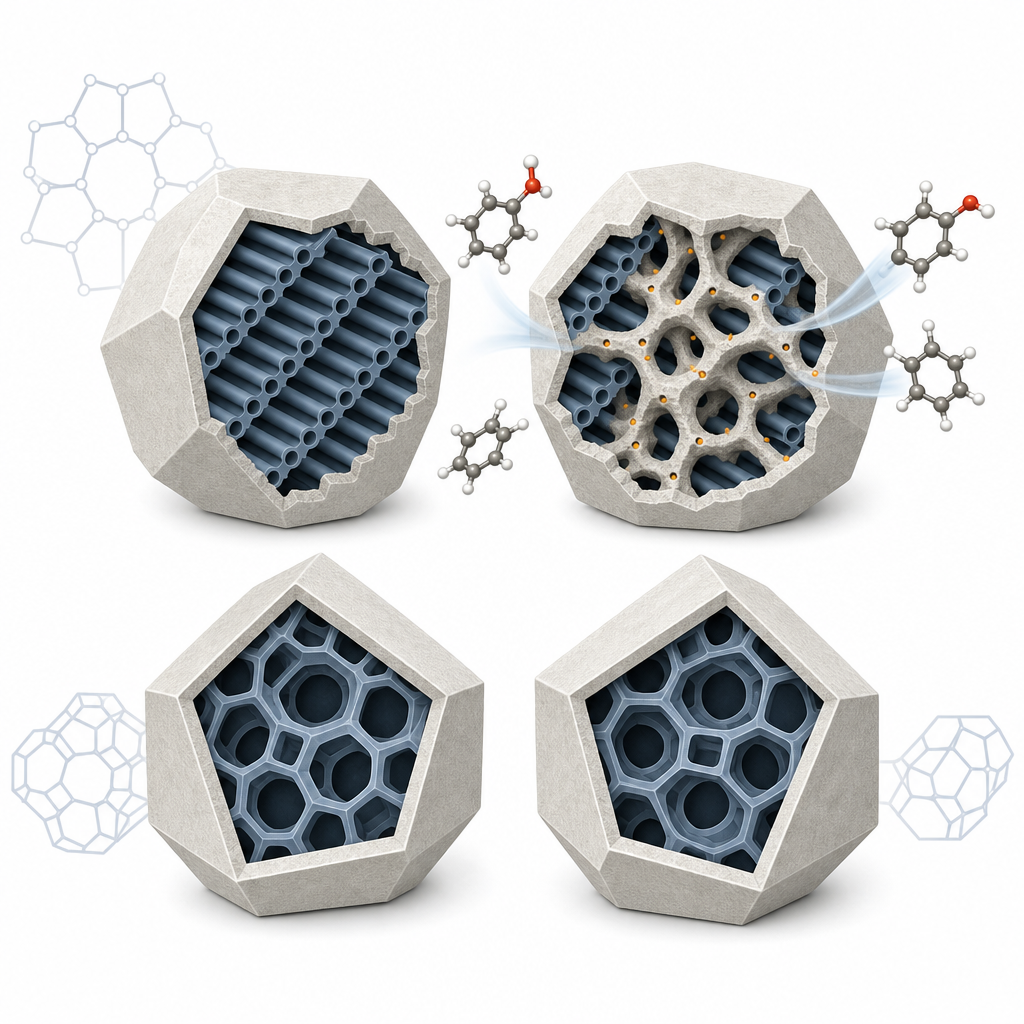
How ACS Material products were used
- SAPO-11 (Molecular Sieves) — “SAPO-11 ... Si0.06Al0.43P0.51O2 ... supplied by ACSMaterial”
- SAPO-34 (Molecular Sieves) — “SAPO-34 ... Si0.14Al0.45P0.41O2 ... supplied by ACSMaterial”
Product Performance in this Study
The ACS Material SAPO-11 (sample SP11B-P) was a key parent zeotype examined for postsynthetic hierarchical modification. It retained full crystallinity under acid treatments and developed up to a 4-fold increase in external surface area and mesopore volume after base treatment, demonstrating excellent suitability for hierarchical SAPO synthesis.
Related product categories
Frequently asked questions
Why does SAPO-34 amorphize in acid while SAPO-11 stays crystalline?
The acid stability of silicoaluminophosphates correlates with bulk silicon content rather than framework topology. SAPO-34 has a relatively high Si content (Si0.14Al0.45P0.41O2) and amorphizes strongly in HCl, H4EDTA, and Na2H2EDTA. SAPO-11, with a lower Si content (Si0.05-0.06), retained full crystallinity under the same acid treatments. Conversely, SAPO-34's high Si content gives it superior resistance in alkaline media compared with low-Si analogues.
How does base treatment generate mesoporosity in SAPO-11?
Base treatment of SAPO-11 with organic bases such as TPAOH or diethylamine selectively leaches phosphorus from AlPO domains while leaving zeolitic-like Si-domains intact. This selective dissolution removes framework material to form intercrystalline mesopores, yielding up to a 4-fold increase in external surface area and mesopore volume. The remaining solid becomes enriched in either Si or Al on the external surface depending on the original Si distribution.
What grade of SAPO is suitable for postsynthetic hierarchical modification?
Quantitative postsynthetic studies require parent SAPOs with well-defined bulk composition, narrow Si distribution control, and high initial crystallinity. The Verboekend study used SAPO-11 and SAPO-34 supplied by ACS Material with ICP-OES-verified stoichiometries of Si0.06Al0.43P0.51O2 and Si0.14Al0.45P0.41O2 respectively. Reliable parent solids of this type are essential to attribute observed property changes to the treatment chemistry rather than to batch variability.