-
HZSM-5 Cracking of Spirulina Pyrolysis Vapors - University of Bologna, 2017
Jun 24, 2026 | ACS MATERIAL LLCBianchini, E. et al. (2017). Pyrolysis of spirulina and zeolite cracking over HZSM-5. An analytical investigation on the chemical route of bio-Oil from cultivation to combustion. *Journal of Analytical and Applied Pyrolysis*. https://doi.org/10.1016/j.jaap.2017.06.004
Journal of Analytical and Applied Pyrolysis · 2017
Researchers at the University of Bologna used HZSM-5 zeolite from ACS Material to crack spirulina pyrolysis vapors into aromatic-rich bio-oil at 500 °C.
About this research
Researchers at the University of Bologna, working with the Italian National Research Council's Istituto Motori, used HZSM-5 zeolite purchased from ACS Material to convert pyrolysis vapors of the cyanobacterium Arthrospira platensis (spirulina) into an aromatic-rich bio-oil at 500 °C. The study traces the chemical route of algal bio-oil from cultivation through catalytic cracking to single-droplet combustion testing, and demonstrates that a 1:10 biomass-to-zeolite ratio yields a deoxygenated liquid product dominated by monoaromatic and polyaromatic hydrocarbons with negligible carboxylic-acid content.
The broader motivation is the search for sustainable, drop-in liquid fuels from non-food biomass. Microalgae such as spirulina grow rapidly on simple nutrients, fix CO2, and accumulate proteins, lipids and carbohydrates that can be thermochemically converted to bio-oil. Raw algal pyrolysis oil, however, is highly oxygenated, acidic, viscous and chemically unstable, which prevents direct use in combustion engines. Catalytic upgrading over acidic zeolites - especially HZSM-5 with its medium-pore MFI framework - is the most studied route for in-situ deoxygenation and aromatization of pyrolysis vapors. Understanding how zeolite cracking redistributes carbon and nitrogen across the various product fractions is essential for designing integrated cultivation-pyrolysis-combustion processes for algal biofuels and for assessing the fate of biomass nitrogen, which is a critical issue for NOx emissions and catalyst lifetime.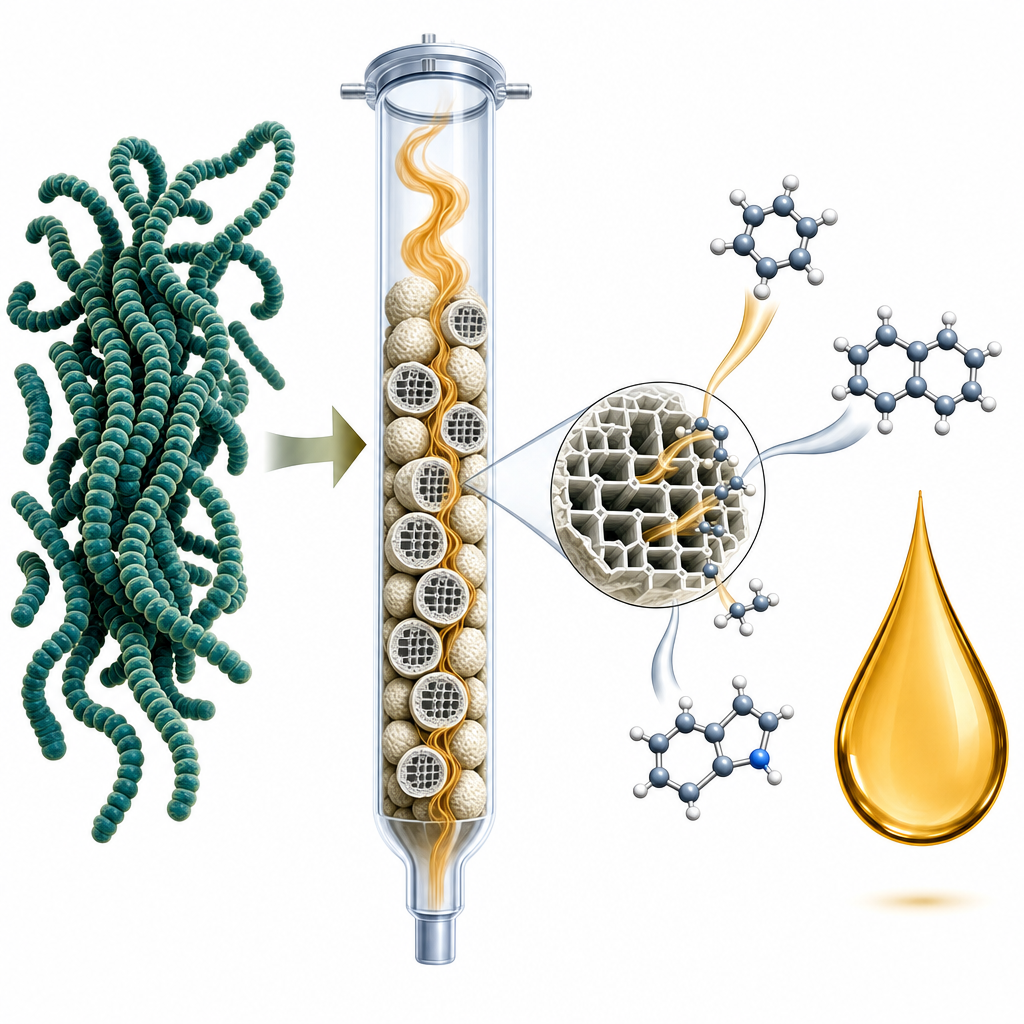
The ACS Material HZSM-5 used in this work was supplied as pellets with a SiO2/Al2O3 molar ratio of 38, a pore size of approximately 5 Å, and a specific surface area greater than 250 m² g⁻¹. Before each cracking run, the zeolite was activated by calcination in a muffle furnace at 550 °C for six hours. Temperature-programmed desorption of ammonia (TPD-NH3) measured a total acidity of 0.13 ± 0.03 mmol kg⁻¹, slightly lower than expected from the Si/Al ratio because of the binder dilution effect in the pellets. About 40 g of zeolite was loaded as a fixed bed downstream of a quartz basket containing roughly 4 g of dried spirulina biomass, giving a biomass-to-catalyst ratio of 1:10. Pyrolysis vapors generated by lowering the basket into the 500 °C zone of a vertical tubular quartz reactor under 100 mL min⁻¹ nitrogen flow were swept directly through the HZSM-5 bed, where in-situ catalytic cracking occurred. Condensable products were collected in an ice-cooled cold trap; non-condensable organics were trapped on an XAD-2 resin tube; gases were collected in Tedlar bags for GC-TCD quantification.
The mass balance closed at 96%, with the following yields: char 28%, aqueous phase 25%, gas 17%, coke 15%, bio-oil 5.2%, and XAD fraction 5.2%, giving a combined organic liquid yield of about 10%. Gas was dominated by CO2 (70.5 ± 0.6%) and CO (26 ± 0.4%), with minor CH4 (3.2%) and H2 (0.15%). Karl-Fischer titration showed the raw bio-oil still contained 23 ± 2% water. GC-MS analysis on an FFAP column identified 152 compounds and revealed that the bio-oil consisted of monoaromatic hydrocarbons (MAHs, 46 ± 3%, principally C1-C7 alkylbenzenes and hydrogenated indenes/naphthalenes), polyaromatic hydrocarbons (PAHs, 29 ± 2%, mostly C0-3 indenes and C0-6 naphthalenes), and nitrogen-containing compounds (NCCs, 21 ± 4%, dominated by C0-4 indoles plus carbazoles, benzonitriles, methylpyrroles and aniline). Importantly, oxygenated species and acetic acid - the principal stability problems of raw bio-oil - were essentially absent. Elemental analysis derived from molecular composition gave 89% C, 8.6% H, 2.1% N and <0.03% O for the bio-oil. Nitrogen partitioning was unfavourable for fuel quality: 40% of the algal nitrogen ended up in the aqueous phase and 37% in the carbonaceous solids (char + coke), but a non-trivial fraction remained in the liquid organics as heterocyclic compounds. Single-droplet microcombustion in shadowgraph configuration up to 750 °C showed that the catalytic bio-oil burned with features comparable to commercial diesel.
The results position HZSM-5-cracked spirulina bio-oil as a partially deoxygenated, hydrocarbon-rich blendstock suitable for further hydrotreating toward jet- and diesel-range fuels. The findings also frame the next research questions: reducing nitrogen incorporation into the liquid via tandem catalysis or hydrothermal pretreatment, valorising the protein-derived NH3 stream, and reusing biochar as a soil amendment. The chemistry shown here is directly relevant to integrated biorefineries combining microalgal cultivation, fast pyrolysis, and catalytic upgrading for sustainable aviation fuel, marine fuel, and aromatic chemical feedstocks.
For research groups developing algal biofuel routes, biomass-to-aromatics catalysis, or zeolite-based deoxygenation, ACS Material supplies HZSM-5 and a broad range of related zeolites and molecular sieves with defined SiO2/Al2O3 ratios. The performance reported in this paper - clean aromatic product slate, full mass balance, and reproducible triplicate runs - illustrates how well-defined commercial HZSM-5 supports rigorous, publishable catalysis research without requiring in-house synthesis of the catalyst.How ACS Material products were used
- HZSM-5 Zeolite (pellet, SiO2/Al2O3 = 38, ~5 Å pore, >250 m²/g) (Molecular Sieves) — “Zeolite HZSM-5 in pellet (SiO2/Al2O3 molar ratio 38, pore size ca. 5 Å, specific surface area > 250 m2 g-1) was purchased from ACS MATERIAL.”
Product Performance in this StudyThe HZSM-5 pellets, after calcination at 550 °C, served as the cracking catalyst that converted spirulina pyrolysis vapors into an aromatic-rich bio-oil. With a 1:10 biomass-to-catalyst ratio, the zeolite produced a bio-oil dominated by monoaromatic hydrocarbons (~46%) and polyaromatic hydrocarbons (~29%), confirming its effectiveness for catalytic upgrading of algal pyrolysis vapors.
Related product categories
Frequently asked questionsWhy is HZSM-5 chosen for catalytic cracking of microalgae pyrolysis vapors?
HZSM-5 has a medium-pore MFI framework and tunable Brønsted acidity that promote in-situ deoxygenation, aromatization and cracking of oxygenated pyrolysis intermediates. In this study, HZSM-5 with a SiO2/Al2O3 ratio of 38 converted spirulina pyrolysis vapors into a bio-oil dominated by monoaromatic and polyaromatic hydrocarbons with essentially no carboxylic acids or phenols, which are the main causes of acidity and instability in raw algal bio-oil.
How does the biomass-to-zeolite ratio influence aromatic yield in algal bio-oil?
A high catalyst loading drives more complete cracking and aromatization. The authors selected a 1:10 biomass-to-HZSM-5 ratio based on previous reports showing that this loading maximizes aromatic hydrocarbon formation. Under these conditions, monoaromatics reached about 46% and polyaromatics about 29% of the GC-detectable bio-oil, while oxygenates were nearly eliminated. Lower catalyst-to-biomass ratios typically leave more oxygenated and acidic compounds in the liquid product.
What happens to nitrogen during HZSM-5 cracking of spirulina pyrolysis vapors?
Spirulina is protein-rich (about 69% protein), so nitrogen management is critical. The mass balance in this study shows that around 40% of the algal nitrogen ends up in the aqueous phase, 37% in the carbonaceous char and coke, and the remainder distributed between gas and bio-oil mostly as heterocyclic indoles, carbazoles, pyrroles and benzonitriles. Reducing this residual N is the main downstream challenge for using algal bio-oil as a transport fuel.