-
Iodine-Doped Graphene ORR Catalyst for PEM Fuel Cells - ICSI Rm. Valcea, 2019
Jun 22, 2026 | ACS MATERIAL LLCMarinoiu, A. et al. (2019). Iodinated carbon materials for oxygen reduction reaction in proton exchange membrane fuel cell. Scalable synthesis and electrochemical performances. *Arabian Journal of Chemistry*. https://doi.org/10.1016/j.arabjc.2016.12.002
Arabian Journal of Chemistry · 2019
ICSI Rm. Valcea researchers used ACS Material single-layer graphene to prepare iodine-doped graphene catalysts that boost PEMFC power density by 15%.
About this research
Researchers at the National R&D Institute for Cryogenics and Isotopic Technologies (ICSI Rm. Valcea, Romania) used ACS Material single-layer graphene powder (specific surface area 750 m²/g) as the starting carbon framework to synthesize iodine-doped graphene (GrI 4) for the oxygen reduction reaction (ORR) in proton exchange membrane fuel cells (PEMFCs). When iodine-doped graphene was incorporated alongside a commercial Pt/C cathode catalyst, the assembled membrane electrode achieved a peak power density of 0.551 W/cm² at 0.52 V in a H2/air single cell, a 15% improvement over a reference Pt/C cathode with identical Pt loading (0.468 W/cm²). The study demonstrates a scalable route to halogen-doped graphene cathode additives that reduce platinum dependence while preserving fuel cell performance.
The broader motivation is the cost barrier of platinum group metals (PGMs) in PEMFC commercialization. Doped graphene materials have emerged as promising metal-free or hybrid ORR catalysts, but their power density typically lags behind Pt-based systems due to limited mass transport in the cathode layer. Heteroatom doping (N, S, B, halogens) alters the electronic structure of the sp² carbon network and creates active sites for O₂ adsorption and four-electron reduction to water. Iodine is particularly attractive because its electronegativity (2.66) is slightly higher than carbon (2.55), polarizing adjacent carbon atoms, and because its large atomic radius enables partially ionic -I⁺- bonds that facilitate charge transfer. A scalable, low-cost synthesis route that delivers iodine-doped graphene with retained surface area and crystallinity is therefore directly relevant to lowering the PGM content in fuel cell stacks for transportation and stationary power.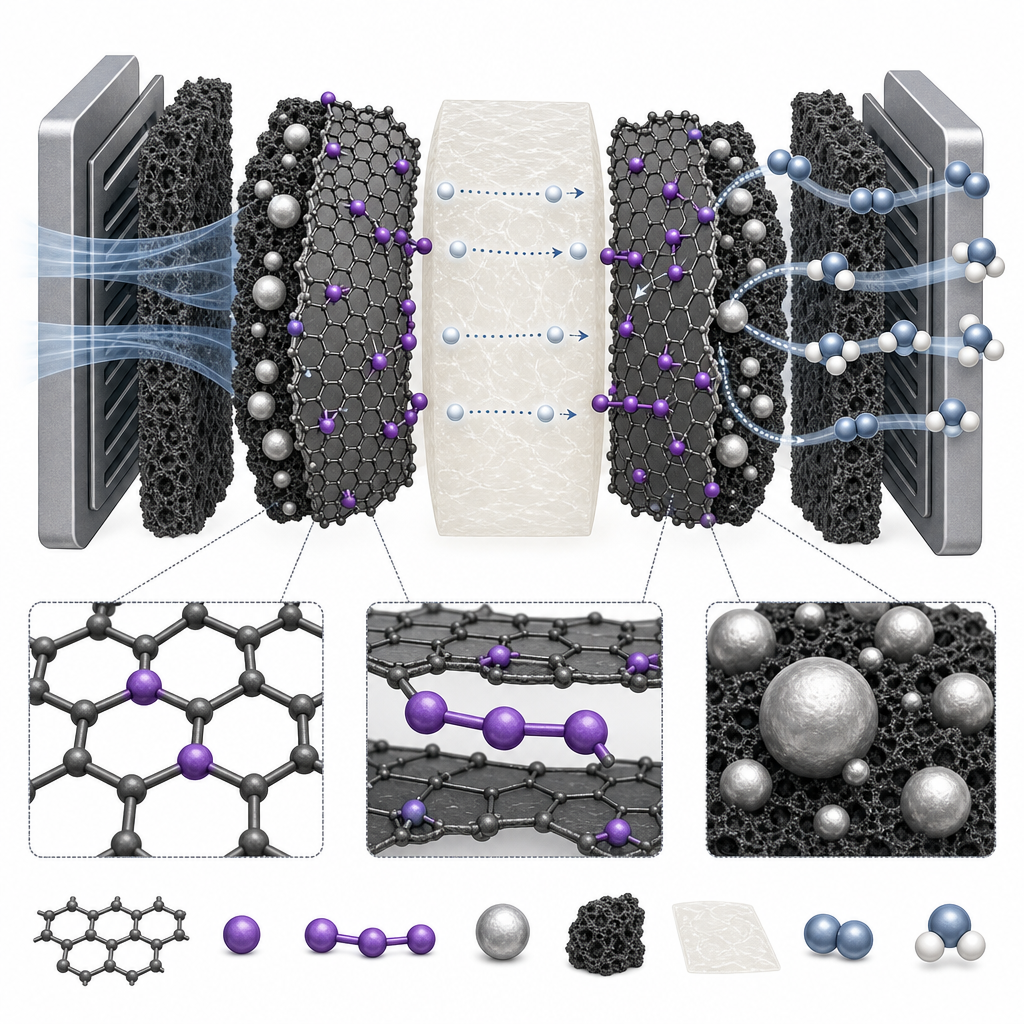
The authors compared four iodination protocols, including nucleophilic substitution of graphene oxide with HI (with and without an AlI₃ catalyst, samples GrI 1 and GrI 2) and direct electrophilic substitution of two commercial graphene precursors using a KI/NaIO₄ system in concentrated H₂SO₄ (samples GrI 3 and GrI 4). GrI 4 specifically used the ACS Material single-layer graphene powder, 750 m²/g, as raw feedstock. After iodination at 30–35 °C for 24 h, elemental iodine was removed by repeated Soxhlet extraction with acetone until the extract was colorless, followed by vacuum drying at 50 °C. Materials were characterized by WDXRF, SEM, HRTEM with EDAX elemental mapping, FT-IR (C–I stretch at 725 cm⁻¹), Raman (D, G, 2D bands and triiodide/pentaiodide signatures at 104 and 163 cm⁻¹), XPS (I 3d5/2 deconvolution), and BET nitrogen sorption. Cathode inks were sprayed onto Nafion membranes with Hispec 4000 Pt/C, and the iodine-doped graphene was deposited either on the membrane or on the gas diffusion layer to act as a microporous layer.
Key quantitative results follow. WDXRF gave iodine mass fractions of 0.33% (GrI 1), 0.10% (GrI 2), 0.69% (GrI 3) and 0.08% (GrI 4); the lower iodine uptake of GrI 4 was attributed to the high surface area of the ACS Material precursor, which restored a more graphitic structure during functionalization. BET areas were 410, 480, 70 and 440 m²/g for GrI 1–4 respectively. In single-cell PEMFC tests at 60 °C with H₂ (100 mL/min) and air (300 mL/min) at 1 bar, the four cathode configurations gave peak power densities of 0.606 W/cm² at 0.52 V (0.4 mg/cm² Pt/C), 0.468 W/cm² at 0.48 V (0.2 mg/cm² Pt/C), 0.217 W/cm² at 0.45 V (0.2 mg/cm² iodine-doped graphene alone), and 0.551 W/cm² at 0.52 V (0.2 mg/cm² Pt/C plus 0.2 mg/cm² iodine-doped graphene on the GDL). The hybrid electrode reached an electrochemically active surface area of 82 m²/g Pt at 60 °C and 90 m²/g Pt at 80 °C, roughly three times that of the reference Pt/C cathode at identical Pt loading. The ORR cathodic peak shifted positively from −0.21 V to −0.15 V.
The practical implication is a route to lower-PGM PEMFC cathodes. Adding a thin iodine-doped graphene microporous layer improved performance in both the ohmic and mass-transport regions, attributed to better electrical contact and additional pathways for water removal that mitigate flooding. The approach is compatible with standard catalyst-coated membrane manufacturing and uses scalable solution-phase iodination. Beyond automotive and backup-power PEMFCs, iodine-doped graphene framework materials are of interest for direct methanol fuel cells, metal-air batteries, and electrocatalytic water splitting where halogen-induced charge polarization can promote O₂ activation. The authors note that further work on iodine content optimization and on the exact doping mechanism is required to clarify the contribution of triiodide (I₃⁻) and pentaiodide (I₅⁻) species detected by Raman and XPS.
For researchers working on halogen-doped carbon catalysts and PEMFC electrodes, the high-surface-area single-layer graphene powder used as the GrI 4 precursor is available from ACS Material. Selecting a precursor with controlled layer count and surface area is critical because, as the authors show, the trade-off between surface area and accessible doping sites directly determines the iodine loading and the resulting ORR activity. ACS Material's graphene series and related 2D carbons support reproducible synthesis of doped graphene electrocatalysts at laboratory and pilot scale.How ACS Material products were used
- Single Layer Graphene (ACS Material) (Graphene Series) — “the starting raw material was single layer graphene powder (specific surface area 750 m2 g-1, ACS Material, USA)”
Product Performance in this StudyThe ACS Material single-layer graphene served as the precursor for GrI 4, iodinated by electrophilic substitution. The high surface area (750 m2/g) preserved a partially exfoliated structure after iodination, yielding GrI 4 with a BET area of 440 m2/g; however the high surface area limited the iodine functionalization grade compared to the lower-surface-area precursor used for GrI 3.
Related product categories
Frequently asked questionsHow does iodine doping improve graphene's oxygen reduction activity?
Iodine has higher electronegativity (2.66) than carbon (2.55), so it polarizes adjacent carbon atoms in the graphene lattice and forms partially ionic -I+- bonds. These features facilitate O2 adsorption, weaken the O-O bond, and promote charge transfer during the four-electron reduction to water. Raman and XPS evidence of I3- and I5- species on the surface further suggests reactive sites that contribute to enhanced ORR kinetics.
What performance gain does iodine-doped graphene give to a Pt/C PEMFC cathode?
When a 0.2 mg/cm² iodine-doped graphene layer was sprayed on the gas diffusion layer alongside a 0.2 mg/cm² Pt/C catalyst, the H2/air single cell reached 0.551 W/cm² at 0.52 V, a 15% improvement over an identical Pt/C cathode without iodine-doped graphene (0.468 W/cm²). The electrochemically active surface area increased to roughly 82-90 m²/g Pt, about three times the Pt/C reference.
Why is high-surface-area single-layer graphene important as a precursor for halogen doping?
A high-surface-area starting graphene exposes more edge and basal sites for halogen substitution, but as the authors observed for the ACS Material 750 m²/g precursor, an excessively pristine sp² network can partially restore during functionalization, reducing iodine uptake. Choosing a graphene precursor with controlled layer count and surface area lets researchers balance doping density against retained conductivity and porosity, both of which determine cathode performance.