-
KIT-6 Templated Ceria-Zirconia for Soot Combustion - Politecnico di Torino, 2016
May 29, 2026 | ACS MATERIAL LLCPiumetti, M. et al. (2016). Investigations into nanostructured ceria–zirconia catalysts for soot combustion. *Applied Catalysis B: Environmental*. https://doi.org/10.1016/j.apcatb.2015.06.018
Applied Catalysis B: Environmental · 2016
Politecnico di Torino used ACS Material KIT-6 mesoporous silica to template ordered Ce0.9Zr0.1O2 catalysts for Diesel soot combustion at T50% = 531 °C.
About this research
Researchers at Politecnico di Torino used ACS Material KIT-6 mesoporous silica as the hard template to nanocast an ordered mesoporous Ce0.9Zr0.1O2 catalyst (Ce0.9Zr0.1O2-M) that achieved T10% = 460 °C, T50% = 531 °C and T90% = 582 °C in Diesel soot combustion under loose contact conditions. The work, published in Applied Catalysis B: Environmental (2016) by Piumetti, Bensaid, Russo and Fino, systematically compared nano-polyhedra (CexZr1-xO2-NP), the KIT-6-templated mesoporous oxide, FAU-supported nano-polyhedra and a solution-combustion-synthesized reference, isolating the contributions of composition, morphology and textural properties on oxidation activity.
Diesel particulate matter—largely solid soot—requires temperatures above 600 °C to burn off, while exhaust gases typically sit between 200 and 500 °C. Catalysts integrated into Diesel particulate filters (DPFs) must therefore lower the soot ignition temperature while remaining thermally stable and resistant to deactivation. Ceria-based oxides are leading candidates because of the Ce3+/Ce4+ redox couple and high oxygen mobility, and Zr4+ substitution into the ceria lattice further improves oxygen storage capacity and surface reducibility. However, the effects of Zr loading, exposed crystal planes, and porous architecture remain entangled in the literature. The Turin team addressed this by preparing a controlled catalyst library with the same Ce/Zr ratio but different morphologies, including a nanocast ordered mesoporous oxide.
The ACS Material KIT-6 mesoporous silica was the key structural template. As described in the Methods, 0.15 g of KIT-6 was dispersed in an ethanolic solution containing 0.35 g Ce(NO3)3·6H2O and 0.05 g ZrO(NO3)2, stirred at 60 °C, dried, calcined at 350 °C and re-impregnated to reach the target loading. After a final calcination at 550 °C, the silica was removed by repeated 2 M NaOH treatment, leaving an inverse mesoporous Ce-Zr oxide replica. Low-angle XRD confirmed retention of the (211) and (220) reflections characteristic of the KIT-6 Ia3d symmetry, and TEM revealed evenly spaced parallel channels with ~8 nm pore walls and (111) ceria lattice fringes (d ≈ 0.30 nm). EDS confirmed near-complete silica removal (<1 wt% Si). The resulting Ce0.9Zr0.1O2-M oxide exhibited a BET surface area of 121 m²/g and a total pore volume of 0.24 cm³/g—far higher than the unsupported nano-polyhedra (≤3 m²/g) and the solution-combustion-synthesized reference (20 m²/g).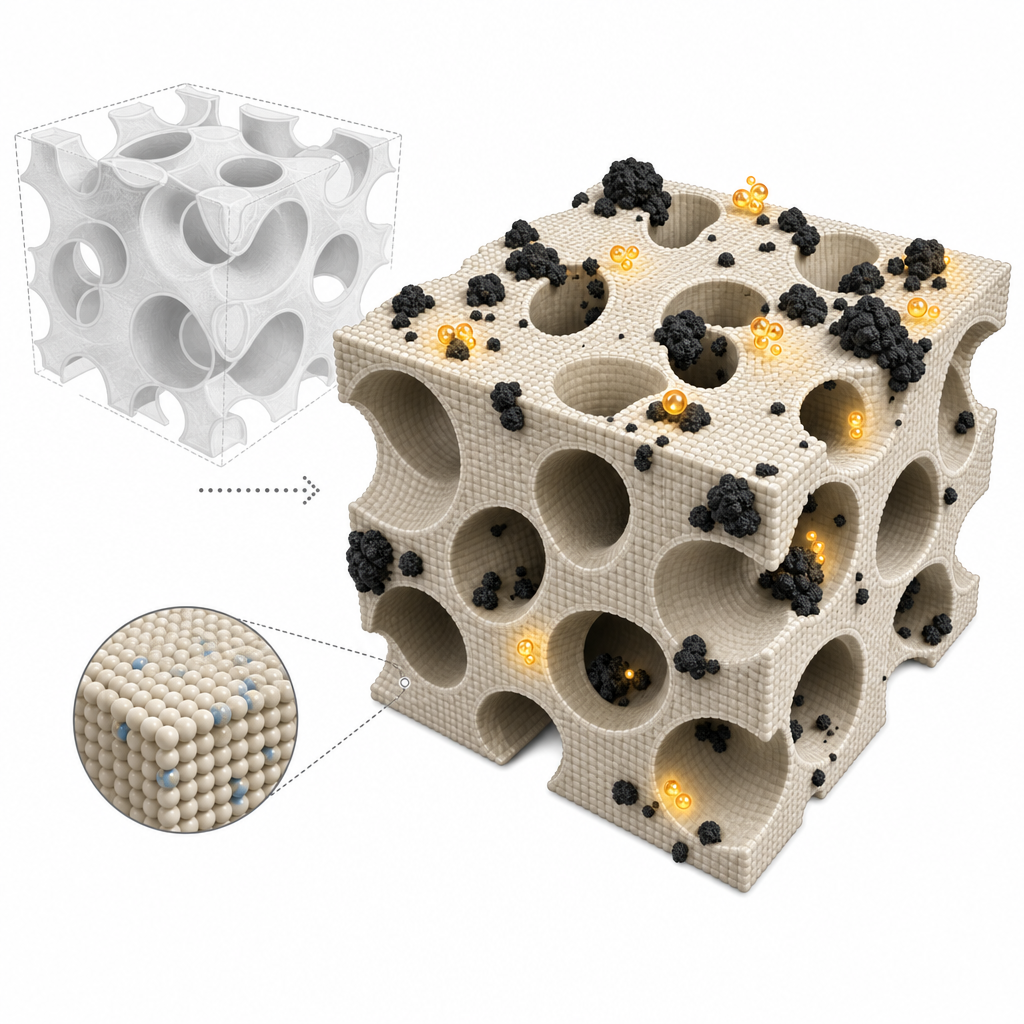
Key performance metrics span structural, redox and catalytic characterization. Powder XRD indexed all samples to the cubic fluorite Fm3m phase with crystallite sizes of 16–18 nm for nano-polyhedra and ~23 nm for the KIT-6-templated oxide. H2-TPR placed the main reduction peak of Ce0.9Zr0.1O2-M at 603 °C, higher than Ce0.9Zr0.1O2-NP (549 °C), indicating that the nano-polyhedra possess easier surface reducibility. XPS analysis gave a Ce3+ fraction of 12.6 at.% for Ce0.9Zr0.1O2-M versus 13.9 at.% for the most active Ce0.9Zr0.1O2-NP, and an Oα/Oβ ratio of 0.52 for the mesoporous sample (vs. 0.10 for the nano-polyhedra), reflecting more surface-adsorbed oxygen species. Raman spectra confirmed an oxygen-vacancy band near 600 cm⁻¹ in all samples. In soot oxidation tests under loose contact, the activity ordering was Ce0.9Zr0.1O2-NP (T50% = 491 °C) > Ce0.9Zr0.1O2-M (T50% = 531 °C) > Ce0.9Zr0.1O2-SCS (T50% = 590 °C). The KIT-6 templated catalyst clearly outperformed the solution-combustion reference by ~59 °C at T50%, demonstrating that mesoporous textural control delivers meaningful catalytic gains even when nano-polyhedra with reactive (100)/(110) facets remain the global benchmark. Tight-contact tests and three-cycle stability runs confirmed stable performance with no measurable deactivation up to 700 °C.
These results are directly relevant to Diesel particulate filter formulation, lean-burn engine aftertreatment, and more broadly to any low-temperature oxidation chemistry (CO oxidation, VOC abatement, soot from biomass combustion) where oxygen mobility and accessible surface area both matter. The nanocasting strategy demonstrated here—using a well-defined silica hard template to imprint long-range mesoporosity on a redox-active oxide—extends naturally to other reducible oxides (MnOx, Co3O4, CuOx) and to mixed ceria systems doped with Pr, La or Cu. The authors point to further kinetic modeling and improved soot-catalyst contact engineering as the next steps toward practical DPF integration.
For researchers working on templated oxide catalysts, the KIT-6 mesoporous silica molecular sieve used in this study is available from ACS Material as a catalog item under the Molecular Sieves category. Its three-dimensional Ia3d pore network, narrow pore-size distribution, and high surface area make it a reliable hard template for nanocasting ordered mesoporous oxides, carbons, and metal nitrides, and the present paper provides a quantitative benchmark of how that templating translates into measurable catalytic activity differences for a demanding gas-solid-solid oxidation reaction.How ACS Material products were used
- KIT-6 Mesoporous Silica Molecular Sieve (Molecular Sieves) — “0.15 g of KIT-6 (mesoporous silica molecular sieve by ACS materials) was added to this solution and heated at 60 °C under vigorous stirring for 30 min”
Product Performance in this StudyKIT-6 served as the hard template for nanocasting the ordered mesoporous Ce0.9Zr0.1O2-M catalyst. The replication preserved the (211) and (220) reflections of the template, yielding a 121 m²/g BET surface area and an ordered channel structure, although the final ceria-zirconia surface area was lower than that of the parent KIT-6 (710 m²/g).
Related product categories
Frequently asked questionsWhy use KIT-6 mesoporous silica as a template for ceria-zirconia catalysts?
KIT-6 provides an ordered three-dimensional Ia3d mesoporous network with narrow pore-size distribution and high surface area (~710 m²/g), making it an effective hard template for nanocasting reducible oxides. In this study it imparted ordered mesoporosity to Ce0.9Zr0.1O2, raising the BET surface area to 121 m²/g and producing a structured oxide replica that improved soot oxidation activity compared with a non-templated solution-combustion reference.
How does Zr loading affect ceria-zirconia soot combustion performance?
Increasing Zr content introduces structural defects and oxygen vacancies that distort the oxygen sublattice, but it also reduces the surface density of redox-active Ce3+/Ce4+ centres. For nano-polyhedra calcined below 600 °C, Ce0.9Zr0.1O2-NP showed the best balance and lowest T50% (491 °C), outperforming Ce0.8Zr0.2O2-NP (526 °C) and Ce0.7Zr0.3O2-NP (580 °C). Excess Zr therefore depresses activity in this regime.
What is the role of mesoporosity versus exposed crystal planes in soot oxidation catalysts?
Both factors contribute. Nano-polyhedra exposing reactive (100) and (110) planes show the highest intrinsic activity even with very low surface areas (≤3 m²/g), while mesoporous KIT-6-templated Ce0.9Zr0.1O2 improves access to surface oxygens and lowers ignition temperatures relative to non-porous references. The most effective architectures combine reactive facets with sufficient porosity to maximize soot-catalyst contact points.