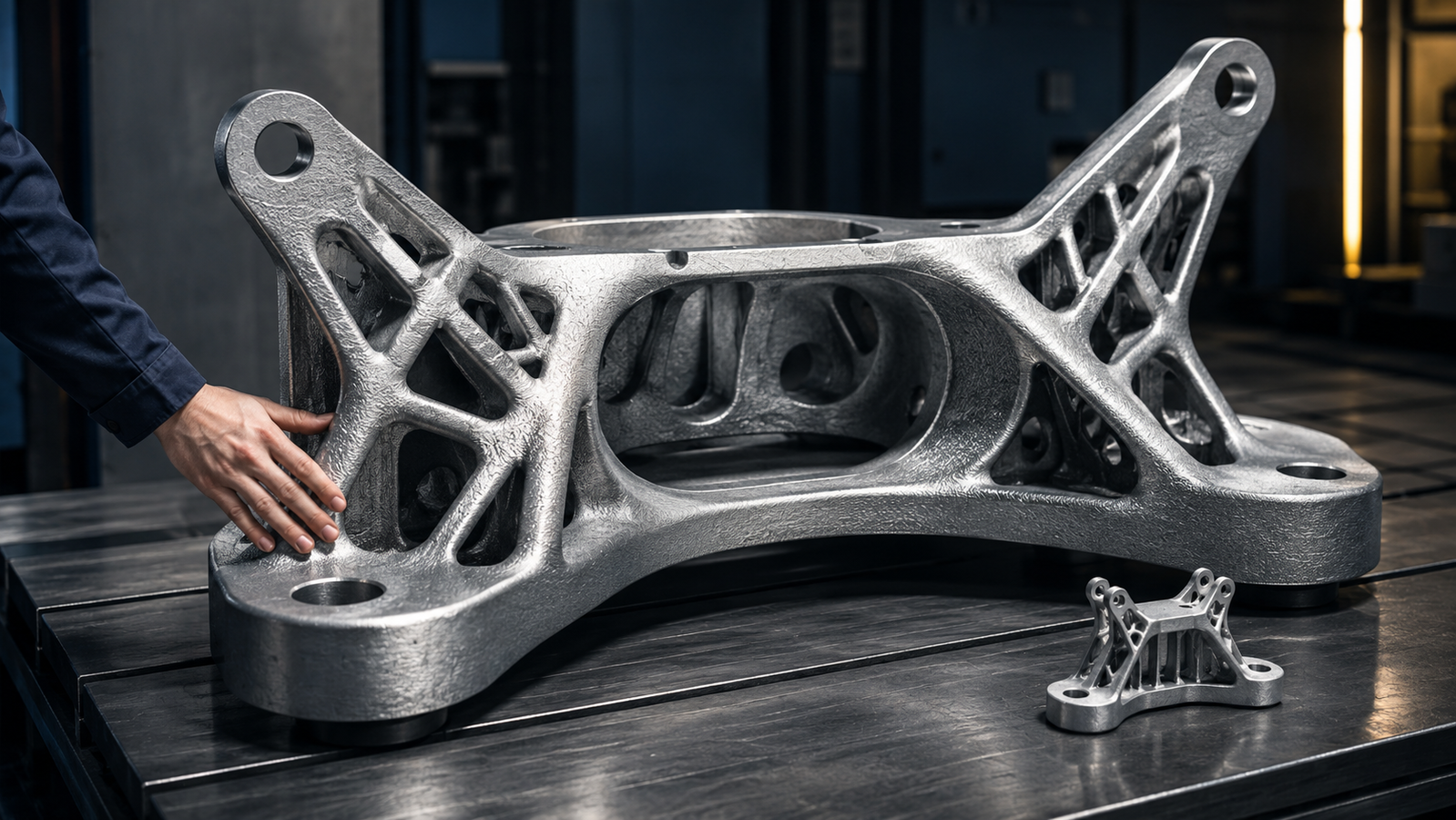
Most metal 3D printing is small. Typical laser powder bed fusion machines build parts that fit within a few hundred millimeters, so when a project needs a large metal part — a meter-scale tool, an aerospace structure, a big mold or die — the usual advice is “that’s too big to print.” That is increasingly untrue. This guide explains why metal additive manufacturing has been size-limited, the three practical routes to large metal parts (large-format laser powder bed fusion, directed energy deposition, and wire-arc additive manufacturing), how they trade size against precision and quality, and where large-format powder bed fusion — with build volumes up to 2000 mm — fits.1,2
Why metal 3D printing has been size-limited
Metal additive manufacturing builds a part by adding material layer by layer, and its dominant process — laser powder bed fusion (LPBF) — melts a bed of metal powder point by point with a laser.1,3 That point-by-point melting is precise, but it is also serial: the build rate is limited by how fast a small melt pool can be moved through the whole part, so bigger parts take dramatically longer. The single biggest impediment to scaling powder bed fusion to larger volumes is exactly this throughput ceiling.4,5
Three other factors compound the size limit. First, the build chamber itself is finite; a part cannot exceed the machine’s envelope, and most industrial LPBF machines are built around modest chambers. Second, residual stress scales with size: the rapid heating and cooling of laser melting builds up internal stress, and the larger and taller the part, the more that stress can distort or crack it.6,7 Third, keeping a large melt area uniform — consistent inert-gas flow, powder spreading, and thermal history across a wide bed — is genuinely hard, and the cost of a very large, high-power machine is high.8,9 These are the reasons “metal 3D printing” has been synonymous with small parts — and the reasons large-format approaches have to solve real engineering problems, not just build a bigger box.
Three routes to large metal parts
When a metal part is too large for a conventional powder-bed machine, three additive routes are practical. They occupy different points on the trade between size, speed, precision, and surface quality.8
Large-format laser powder bed fusion (LPBF)
The same powder-bed process, in a much larger machine. It preserves what powder bed fusion is good at — fine features, near-full-density metal, and good dimensional control — while extending the build envelope to large parts (ACS Material’s service reaches 2000 × 2000 × 650 mm). Research on scaling powder-bed printing — from parallel large-area pulsed melting to multi-laser systems — is aimed squarely at lifting the throughput ceiling that has held large LPBF back.5 This is the route to choose when a large part still has to meet the precision and density expectations of powder bed fusion.9
Directed energy deposition (DED)
DED feeds metal powder or wire into a focused laser, electron beam, or arc, melting and depositing it directly where the part is being built — no powder bed, so the part is not constrained by a chamber of powder. Under the standard classification, DED and powder bed fusion are the two direct metal AM families; DED trades some resolution for a much higher deposition rate, making it well suited to medium-to-large components as well as repair and remanufacturing.10
Wire-arc additive manufacturing (WAAM)
WAAM is an arc-based member of the DED family: an electric welding arc melts a wire feedstock and deposits it layer by layer. Its defining strengths are very high deposition rates (reported on the order of several kilograms per hour) and inexpensive wire feedstock, which make it one of the most efficient ways to build large, near-net-shape metal components — at the cost of a rougher surface and looser tolerance that generally require finish machining.10,11,12 WAAM has drawn strong interest for large aerospace, automotive, and tooling parts precisely because it can produce meter-scale geometries that are impractical for a powder bed.11
Large-format laser powder bed fusion
Large-format LPBF is ACS Material’s focus because it is the route that keeps powder-bed quality at large size. A high-power laser fully melts each powder layer, so even a large component reaches near-full density (relative densities above 99 % are routine for well-parameterized LPBF), with the fine features, internal channels, and dimensional control that DED and WAAM cannot match — across stainless steels, aluminum, titanium, and nickel alloys.13,14,15,16,17
The engineering challenge is doing that over a large area without giving up quality or waiting forever. Throughput is addressed by scaling the process — larger build volumes, more lasers working in parallel, and research approaches such as large-area pulsed melting that consolidate powder in parallel rather than serially.5 Residual stress, which grows with part size, is managed through build-plate stress relief and, where required, hot isostatic pressing to close residual porosity and stabilize properties.7,18 The result is what makes the approach distinctive: a metal part measured in the hundreds or thousands of millimeters that still behaves like a powder-bed part — dense, detailed, and precise — produced as a single, seamless print rather than welded from sections, with the fine solidification microstructure characteristic of laser melting.19,20,21
Interactive: build-size explorer
Drag the part-size slider to see which metal AM processes can realistically build a part that large, and what each one trades away as size grows.
A schematic guide to typical maximum build sizes; actual limits depend on the specific machine, alloy, and geometry, and always warrant a conversation with the provider.
Large-format processes compared
The table contrasts the three routes on the attributes that matter for large parts. Values are typical published ranges and vary widely with machine, alloy, and part.8,22
| Attribute | Large-format LPBF | DED (laser/EB, powder or wire) | WAAM (wire-arc) |
|---|---|---|---|
| Typical maximum size | Up to ~2000 mm (powder bed) | Meter-scale and up | Meter-scale and up (very large) |
| Deposition / build rate | Slower (serial melting) | High | Very high (kg/h scale) |
| Precision & detail | Best; fine features & channels | Moderate | Coarsest; simple geometries |
| As-built surface | Moderate (often machined on critical faces) | Rough → machining | Roughest → machining |
| Density | Near-full (> 99 %) | High | High (weld-quality) |
| Feedstock | Metal powder | Powder or wire | Wire (inexpensive) |
| Best for | Large parts needing precision & density | Large parts, cladding, repair | Largest, simplest near-net-shape parts |
The pattern is clear: as parts get larger, the practical processes trade precision and surface quality for size and speed. Large-format powder bed fusion sits at the precise, dense end of that spectrum; WAAM sits at the fast, very-large end; DED is in between and adds repair and cladding.10 For batch production of many complex mid-size metal parts, sinter-based binder jetting is a separate alternative worth weighing.23
The challenges of going big
Large metal AM is not simply small metal AM at scale. Several effects intensify with size:
- Residual stress and distortion. Internal stress accumulates with every layer, and larger, taller parts store more of it — risking warping or cracking. Orientation, supports, scan strategy, preheating, and post-build stress relief all become more important as parts grow.6,24
- Build time and cost. Serial melting means large powder-bed parts take a long time; the economics of metal AM favor consolidating a large part where it replaces an assembly or enables a geometry impossible to machine, rather than printing bulk for its own sake.25,26
- Thermal and process uniformity. Keeping gas flow, powder spreading, and thermal history uniform across a wide bed or a long deposition path is demanding, and non-uniformity shows up as defects and property variation.8,27,28
- Post-processing at scale. Stress relief, support and substrate removal, machining of critical faces, and (where needed) HIP all have to be sized to the part — large parts need large furnaces, machines, and fixtures.18
Applications
Large metal AM is pulled by parts that are expensive, complex, or impossible to make conventionally at size. Tooling and molds — including large die-casting and injection tools with conformal cooling — are a major driver, since a printed tool can embed cooling channels a machined block cannot.8 Aerospace and defense use large structural brackets, frames, and near-net-shape preforms to cut material waste on expensive alloys; energy uses large impellers, manifolds, and heat exchangers; and repair and remanufacturing of high-value components is a natural fit for DED.10,29 Which process wins depends on how much precision and density the large part actually needs.30
The bigger picture
“Too big to print” is now a question, not a verdict. Large metal parts can be built three ways, and the choice is a trade: large-format laser powder bed fusion for size with precision and density; DED and WAAM for the largest, fastest, near-net-shape parts that will be machined to final tolerance.31
ACS Material’s metal 3D printing service is built on large-format laser powder bed fusion, producing fully dense metal parts at build volumes up to 2000 mm — a scale beyond the build envelope of many conventional industrial LPBF systems, and with the powder-bed precision that large DED and WAAM parts cannot match. If you are choosing among processes, our comparison of SLM vs DMLS vs binder jetting covers the powder-bed options in depth, and our guide to metal 3D printing precision and tolerance covers what accuracy to expect at size; we also supply the XDM metal 3D printers. Send us your large part’s size, material, and requirements and we will advise on the right approach.
FAQs
How large can a metal part be 3D printed?
It depends on the process. Conventional laser powder bed fusion is usually limited to a few hundred millimeters, but large-format powder bed fusion reaches up to 2000 mm, and directed energy deposition (DED) and wire-arc additive manufacturing (WAAM) can build meter-scale and larger near-net-shape parts. The trade is that the very largest processes have coarser surfaces and looser tolerances that typically require machining.
What is the largest-format metal 3D printing process?
For the biggest metal parts, wire-arc additive manufacturing (WAAM) and directed energy deposition (DED) lead, because they deposit material fast without a powder-bed chamber. Among powder-bed processes — which keep the best precision and density — large-format laser powder bed fusion extends the build volume up to 2000 mm.
Is large-format LPBF better than WAAM or DED?
Neither is universally better; they serve different needs. Large-format laser powder bed fusion keeps fine detail and near-full density at large size, so it wins when a big part must be precise and dense. WAAM and DED build larger, simpler parts faster and cheaper, so they win when raw size and near-net-shape speed matter more than as-built precision.
Why is it hard to 3D print large metal parts?
Powder bed fusion melts metal point by point, so large parts take a long time; build chambers are finite; and residual stress grows with part size, risking distortion or cracking. Large-format approaches address these with bigger envelopes, multiple lasers or parallel melting, careful orientation and supports, and post-build stress relief.
Do large 3D-printed metal parts need machining?
Critical surfaces usually do. All metal AM leaves an as-built surface rougher than machining, and DED and WAAM in particular are near-net-shape processes finished by machining. Large-format LPBF holds tighter tolerances, but mating faces, sealing surfaces, and fits are still typically machined after stress relief.
Can a large metal part be printed as one piece?
Yes — that is a key advantage of large-format printing. A part that would otherwise be welded or bolted from sections can be produced as a single, seamless component, removing joints that add weight, cost, and potential failure points, provided the part fits the build envelope.
References
This article is provided by ACS Material LLC for educational purposes and describes large-format metal 3D printing (metal additive manufacturing), including large-format laser powder bed fusion, directed energy deposition (DED), and wire-arc additive manufacturing (WAAM). Maximum build sizes, deposition rates, densities, and tolerance behavior cited are typical figures from the referenced studies and general process characteristics; the size and quality achievable for any specific part depend on the machine, alloy, geometry, and post-processing, and must be confirmed for your application. Consult product datasheets and safety data sheets for grade-specific specifications and handling guidance. The interactive build-size explorer is a schematic teaching tool based on representative maximum-size ranges, not predictive design software.