-
MCM-41 for Amine-Grafted CO2 Capture - ICMAB-CSIC, 2014
Jul 10, 2026 | ACS MATERIAL LLCLópez-Aranguren, P. et al. (2014). Understanding the Performance of New Amine-Functionalized Mesoporous Silica Materials for CO2 Adsorption. *Industrial & Engineering Chemistry Research*. https://doi.org/10.1021/ie502945r
Instituto de Ciencia de Materiales de Barcelona (ICMAB—CSIC), Campus de la UAB, 08193 Bellaterra, Spain · Industrial & Engineering Chemistry Research · 2014
Researchers at ICMAB-CSIC grafted aminosilanes onto ACS Material MCM-41 in supercritical CO2, reaching 1.3 mmol/g CO2 uptake with stable cycling.
About this research
Researchers at the Instituto de Ciencia de Materiales de Barcelona (ICMAB—CSIC), Campus de la UAB, 08193 Bellaterra, Spain used MCM-41 mesoporous silica supplied by ACS Materials as the support for a new family of amine-functionalized CO2 adsorbents, achieving CO2 uptakes up to 1.3 mmol/g at 45 °C from a 10/90 vol% CO2/N2 stream with stable performance over ten adsorption/desorption cycles. The work, published in Industrial & Engineering Chemistry Research in 2014 by López-Aranguren, Builes, Fraile, Vega and Domingo, demonstrates that supercritical-CO2 grafting of 3-(methylamino)propyltrimethoxysilane (MAP) onto periodic MCM-41 yields hybrid sorbents that combine high amine loading with above-average reaction efficiency, outperforming many liquid-phase-grafted analogues in the literature.
The broader context is post-combustion carbon capture, where amine-functionalized silicas are widely viewed as a less energy-intensive alternative to aqueous alkanolamine scrubbing. The performance of such sorbents depends on the amine chemistry, the silica texture, and the grafting method. Conventional toluene-based silanization can yield uneven coverage and uses hazardous solvents, while physical impregnation can leak amine over cycles. A clean, solvent-free supercritical-CO2 grafting route offers uniform amine distribution and a green processing chemistry, but its CO2 adsorption performance relative to literature benchmarks needed systematic evaluation. By comparing a periodic MCM-41 support against a low-cost disordered silica gel across a wide loading window, this paper clarifies how pore geometry and amine surface density jointly govern CO2 capacity, selectivity, and kinetics.
The ACS Materials MCM-41 entered the workflow as the periodic mesoporous support. As reported in the Experimental section, the material has 4 nm unidirectional hexagonal pores, a BET surface area of 1127 m²/g, and a pore volume of 0.92 cm³/g. The authors functionalized it with MAP in supercritical CO2 to give a series of hybrid products (1_MCM-41/MAP through 6_MCM-41/MAP) covering low, medium, and high amine loadings ranging from 0.40 to 3.99 mmol N/g, corresponding to amine surface densities of 0.2 to 2.9 molecules/nm². Pore volume and surface area after grafting were measured by N2 physisorption to quantify pore blocking. CO2 adsorption isotherms were recorded at 25 °C up to 25 kPa on a Micromeritics ASAP 2020, while cyclic CO2/N2 separation was studied on a Rubotherm-type magnetic-suspension microbalance using a 10/90 vol% CO2/N2 feed at 200 sccm and adsorption temperatures of 25 and 45 °C, with desorption under N2 at 105 °C.
The headline results center on the highly loaded 6_MCM-41/MAP sample (3.99 mmol N/g, 2.9 amines/nm²). Despite almost complete pore blocking at low temperature (pore volume of 0.01 cm³/g), this hybrid adsorbed 1.0 mmol CO2/g at 25 °C and 1.3 mmol CO2/g at 45 °C, because increased temperature enhanced both amine chain mobility and CO2 diffusivity. Medium-loaded 3_MCM-41/MAP (1.81 mmol N/g) reached 0.9 mmol CO2/g at 25 °C with a CO2/amine molar ratio of 0.50, equal to the theoretical maximum for dry carbamate chemistry. The disordered silica-gel analogue 3_CC/MAP captured 0.87 mmol CO2/g at 45 °C with efficiency 0.33. At equivalent amine surface density, MCM-41-based sorbents consistently outperformed silica-gel sorbents because the 4 nm periodic pores favor pairwise carbamate formation. Kinetic analysis of the microbalance curves identified three regimes: a fast adsorption slope s1, a slow approach-to-equilibrium slope s2, and a desorption slope s3. For 6_MCM-41/MAP, s1 rose from 0.05 mmol/g·min at 25 °C to 0.22 mmol/g·min at 45 °C. Across ten cycles, no significant capacity loss was observed for any of the supercritically prepared hybrids.
These findings have direct applications in post-combustion CO2 capture from coal- and gas-fired flue streams, as well as in CO2/N2 separation more generally and in direct air capture, where regenerability and amine retention are decisive. The supercritical grafting route avoids organic solvent waste and yields thermally stable sorbents, which is attractive for industrial scale-up. The authors suggest that the combination of high amine loading and 0.4–0.5 reaction efficiency makes their MCM-41/MAP system a credible candidate for further optimization, particularly under humid conditions, where amine-silica hybrids typically exhibit enhanced uptake.
For researchers developing solid sorbents, supported catalysts, or amine-tethered hybrid materials, MCM-41 of the grade used here is available from ACS Material as part of its molecular sieves catalog, alongside related mesoporous silicas such as SBA-15, MCM-48 and KIT-6. The paper provides a useful benchmark for how a well-characterized periodic mesoporous silica performs when paired with a green grafting chemistry, and it supports specification of MCM-41 as a starting material for CO2 capture, adsorption, and porous-hybrid research.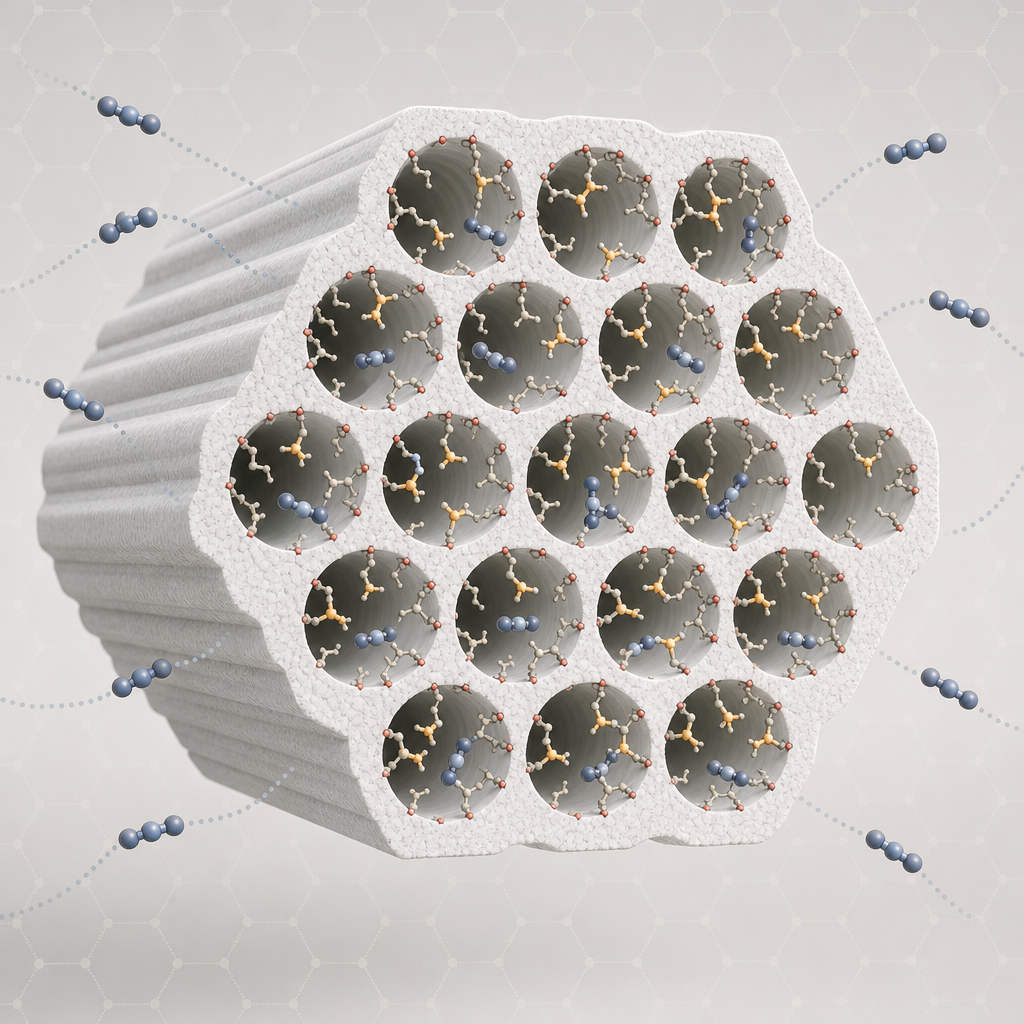
How ACS Material products were used
- MCM-41 mesoporous silica (Molecular Sieves) — “Two different supports were investigated: periodic MCM-41 (ACS Materials) and disordered silica gel (Cleancat Iberamigo S.A.) with pore diameters (Pd) of 4 and 9 nm and surface areas (Sa) of 1127 and 440 m2 gp−1, respectively”
Product Performance in this Study
MCM-41 from ACS Material served as the periodic mesoporous silica support that was supercritically grafted with monoaminosilane. The high surface area (1127 m²/g) and 4 nm pore size enabled the hybrid sorbent to reach exceptional CO2 adsorption (1.3 mmol/g at 45 °C) with stable performance over at least 10 adsorption/desorption cycles.
Related product categories
Frequently asked questions
Why is MCM-41 a good support for amine-based CO2 capture?
MCM-41 offers a high BET surface area near 1127 m²/g, a uniform 4 nm hexagonal pore structure, and abundant surface silanols for aminosilane grafting. In this work, MCM-41 from ACS Materials supported up to 3.99 mmol N/g of MAP aminosilane and delivered 1.3 mmol CO2/g at 45 °C. The narrow periodic pores favor neighboring amine pairs forming carbamates, raising CO2 efficiency above what disordered silica gels achieve.
How does supercritical CO2 grafting compare to toluene-based silanization?
Supercritical CO2 grafting avoids organic solvents, distributes aminosilanes more uniformly on the silica surface, and yields hybrids with reaction efficiencies up to 0.5 mol CO2 per mol amine, matching the theoretical maximum for dry carbamate chemistry. The MCM-41/MAP sorbents prepared this way matched or exceeded literature CO2 uptakes for toluene-grafted analogues and retained capacity over ten adsorption/desorption cycles without significant degradation.
What CO2 adsorption capacity did the MCM-41/MAP sorbent achieve?
The most loaded sample, 6_MCM-41/MAP (3.99 mmol N/g, 2.9 amines/nm²), captured 1.0 mmol CO2/g at 25 °C and 1.3 mmol CO2/g at 45 °C from a 10/90 vol% CO2/N2 mixture. Medium-loaded 3_MCM-41/MAP reached 0.9 mmol CO2/g at 25 °C with the theoretical maximum CO2/amine molar ratio of 0.50. Capacity remained stable over at least ten adsorption/desorption cycles.