-
MCM-41 Mesoporous Silica for Bentazone Removal - University of Turin, 2016
Jun 25, 2026 | ACS MATERIAL LLCBruzzoniti, M. C. et al. (2016). Adsorption of bentazone herbicide onto mesoporous silica: application to environmental water purification. *Environmental Science and Pollution Research*. https://doi.org/10.1007/s11356-015-5755-1
Environmental Science and Pollution Research · 2016
University of Turin researchers used ACS Material MCM-41 and SBA-type mesoporous silica to remove bentazone herbicide from lake water and wastewater.
About this research
Researchers at the University of Turin, working with the University of Florence and Polytechnic of Turin, used MCM-41-type mesoporous silica (MS1) and SBA-type mesoporous silica (MS2) purchased from ACS Material, LLC to demonstrate the first reported use of mesoporous silica adsorbents for removing the herbicide bentazone from environmental water. The MCM-41 material achieved 61–73% bentazone removal from spiked lake water and wastewater, supported quantitative removal in column tests, and could be regenerated and reused. The study, published in Environmental Science and Pollution Research in 2016, establishes mesoporous silica as a viable sorbent for trace organic contaminant control in real water matrices.
Bentazone is a post-emergence thiadiazine herbicide widely used to control broadleaf weeds and sedges. Because it is highly water-soluble, mobile in soil, resistant to hydrolysis, and poorly removed by activated sludge in conventional wastewater treatment plants, bentazone has been repeatedly detected in European surface and groundwater above the 0.1 µg L⁻¹ limit of EU Directive 98/83/CE, and at concentrations up to 14 µg L⁻¹ in some Asian rice-field groundwaters. Photocatalysis, membrane filtration, and adsorption have all been explored, but a sorbent that combines high uptake, fast kinetics, regenerability, and compatibility with organic-rich matrices remains needed. The authors hypothesised that ordered mesoporous silica, with its high surface area and tunable silanol chemistry, could fill that gap and decided to evaluate two well-defined commercial reference materials rather than synthesise sorbents in-house.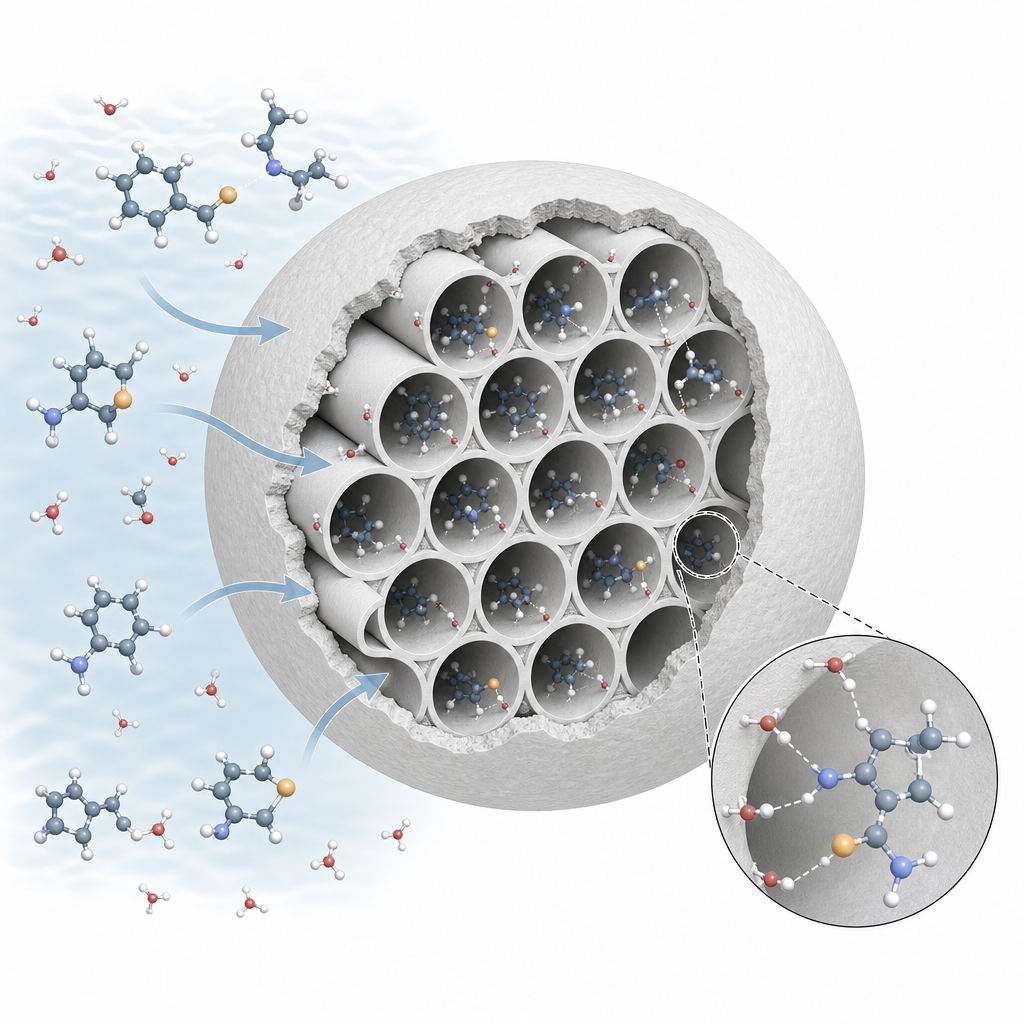
The MS1 (MCM-41-type) and MS2 (SBA-type) mesoporous silicas were obtained directly from ACS Material, LLC (Medford, MA, USA) as stated in the Experimental section: "MS1 and MS2 materials were purchased from ACS Material, LLC." Both sorbents were characterised by N₂ adsorption-desorption on a Quantachrome Autosorb1 to extract BET surface area and NLDFT pore volume (cylindrical pore model on silica), and morphology was imaged by field-emission SEM. MS1 was additionally characterised by FT-IR after vacuum outgassing to confirm surface silanol chemistry relevant to hydrogen-bonding interactions with bentazone. For batch experiments, 1 g of MS1 was contacted with 50 mL of 2 mg L⁻¹ bentazone at pH 2.5 to study kinetics, and 0.2 g of MS1 with 10 mL of 0.5–100 mg L⁻¹ bentazone for isotherms. MS1 was benchmarked against MS2, pillared montmorillonite (Sigma-Aldrich), and a black-carbon SPE sorbent (Agilent). Residual bentazone was quantified by HPLC-UV at 252 nm using a PuroSphere RP-18 column with 17.5 mM HCOONa/CH₃CN eluent.
The MCM-41 adsorbent showed fast uptake of bentazone, with equilibrium reached well within the 26 h contact time used for the isotherms. The adsorption isotherm was best described by the Freundlich model, indicating heterogeneous surface adsorption. Uptake was strongly pH-dependent over pH 2–7: affinity was highest at acidic pH where the carbonyl and sulfonyl groups of bentazone form hydrogen bonds with silica silanols, and dropped to negligible levels around neutral pH as bentazone deprotonates (pKa ≈ 3.3) and the silica surface loses interaction sites. Regeneration experiments tested H₂O, methanol, ethanol, 2-propanol, acetonitrile, 80% CH₃OH, and 0.1 M NaOH; a CH₃OH–NaOH mixture gave the best recovery at 70%, while water alone still desorbed an appreciable 47%, allowing simple low-impact reuse. Applied to lake water (Avigliana, Turin) and wastewater drawn from an MBR-equipped septic-tank/landfill-leachate treatment line, both with significant dissolved organic carbon loads, MS1 removed 61–73% of bentazone from samples spiked at 2 mg L⁻¹. When deployed in 0.2 g packed Bio-Rad Poly-Prep columns under flow, repeated recycling of the spiked solution and a four-column-in-series configuration both delivered effectively quantitative bentazone removal, confirming that the fast kinetics translate into practical hydraulic operation.
The results position MCM-41 and related mesoporous silicas as candidate materials for tertiary or polishing treatment steps targeting polar, weakly retained herbicides that current activated-sludge plants fail to remove. Because the adsorbent is reusable with mild solvents and works at column flow rates, it is compatible with point-of-source treatment of agricultural runoff, decentralised purification of drinking-water intakes, and finishing of MBR effluents before discharge. The pH dependence also suggests opportunities for selective separation in mixed-contaminant streams and for analytical sample-preparation applications such as solid-phase extraction of acidic pesticides, complementing the QuEChERS clean-up workflows referenced by the authors. Future work could explore surface functionalisation (amine grafting, hydrophobic capping) to extend retention into the neutral pH range and to broaden the herbicide spectrum addressed.
For researchers working on pesticide remediation, environmental sorbent screening, or scaled-up water-treatment columns, this paper highlights the value of starting from well-characterised, commercially supplied mesoporous silicas. ACS Material offers MCM-41 and SBA-15 mesoporous silica products of the type used here, supporting reproducible benchmarking across labs. The study itself does not endorse a particular vendor beyond identifying the source of MS1 and MS2; its broader contribution is to demonstrate that off-the-shelf mesoporous silica can deliver meaningful removal of a recalcitrant herbicide from realistic, organic-rich water matrices.How ACS Material products were used
- MCM-41 Mesoporous Silica (Molecular Sieves) — “MS1 and MS2 materials were purchased from ACS Material, LLC (Medford, MA, USA).”
- SBA-15 Mesoporous Silica (Molecular Sieves) — “another MS material, commercialized as SBA-type (following identified as MS2)... MS1 and MS2 materials were purchased from ACS Material, LLC”
Product Performance in this StudyThe MCM-41-type mesoporous silica (MS1) from ACS Material served as the central adsorbent investigated for bentazone removal, showing reversible adsorption, fast kinetics and effective removal yields of 61–73% from lake water and wastewater.
Related product categories
Frequently asked questionsHow effective is MCM-41 mesoporous silica at removing bentazone from real water?
In this study, MCM-41-type mesoporous silica purchased from ACS Material removed 61–73% of bentazone from lake water and MBR wastewater spiked at 2 mg L⁻¹, despite both matrices having significant dissolved organic carbon. In packed-column flow tests using 0.2 g of sorbent, repeated recycling and a four-column-in-series configuration both achieved effectively quantitative removal of bentazone, demonstrating that the material works under realistic hydraulic conditions.
Why does pH control bentazone adsorption on mesoporous silica?
Bentazone has a pKa near 3.3, so at acidic pH it remains neutral and its carbonyl and sulfonyl groups hydrogen-bond effectively with silanol groups on the mesoporous silica surface. As pH rises toward 7, bentazone deprotonates and the silica surface becomes less able to donate hydrogen bonds, so adsorption drops sharply. The authors therefore operated at pH 2.1–2.5 to maximise uptake while preserving material stability.
Can the mesoporous silica adsorbent be regenerated after bentazone uptake?
Yes. The authors tested water, methanol, ethanol, 2-propanol, acetonitrile, 80% methanol and 0.1 M NaOH for desorption. A CH₃OH–NaOH mixture gave the best result with 70% bentazone recovery, while water alone still desorbed 47% of the bound bentazone. This indicates that the MCM-41 sorbent can be reused for multiple cycles, with mild aqueous or methanol-based regeneration suitable for low-impact operation.