-
MCM-41 Silica for PEI-Functionalized CO2 Capture - ICMAB-CSIC, 2013
Jul 08, 2026 | ACS MATERIAL LLCLópez-Aranguren, P., Vega, L. F., & Domingo, C. (2013). A new method using compressed CO2 for the in situ functionalization of mesoporous silica with hyperbranched polymers. *Chemical Communications*. https://doi.org/10.1039/c3cc47931e
Chemical Communications · 2013
ICMAB-CSIC researchers use ACS Material MCM-41 mesoporous silica and compressed CO2 to graft hyperbranched polyethyleneimine for reversible CO2 adsorption.
About this research
Researchers at the Instituto de Ciencia de Materiales de Barcelona (ICMAB-CSIC) used MCM-41 mesoporous silica supplied by ACS Material to demonstrate a fast, solvent-free route for grafting hyperbranched polyethyleneimine (PEI) into porous supports using compressed CO2 as both reaction medium and catalyst. The hybrid sorbents reached amine loadings of 6-8 mmol N per g and reversibly captured up to ~1 mmol CO2 per g at 25 °C in only 10 minutes of reaction time. The work, published in Chemical Communications (2013), establishes an eco-efficient alternative to organic-solvent and vapor-phase grafting routes for producing CO2 capture materials.
Amine-functionalized mesoporous silica is one of the most studied platforms for post-combustion CO2 capture, gas separation, and acid-gas scrubbing. Hyperbranched polyamines such as PEI are preferred over aminosilanes because their higher amine density gives better CO2 uptake per gram of sorbent. However, the conventional liquid-phase ring-opening polymerization of aziridine inside silica pores consumes large quantities of organic solvent, suffers from diffusion limitations, and produces materials with limited thermal stability. A previously reported vapor-phase route avoided solvents but still required 24 h reaction time at 80 °C. A faster, greener method that delivers high amine loading and good thermal stability would make hyperbranched PEI/silica sorbents more attractive for industrial deployment.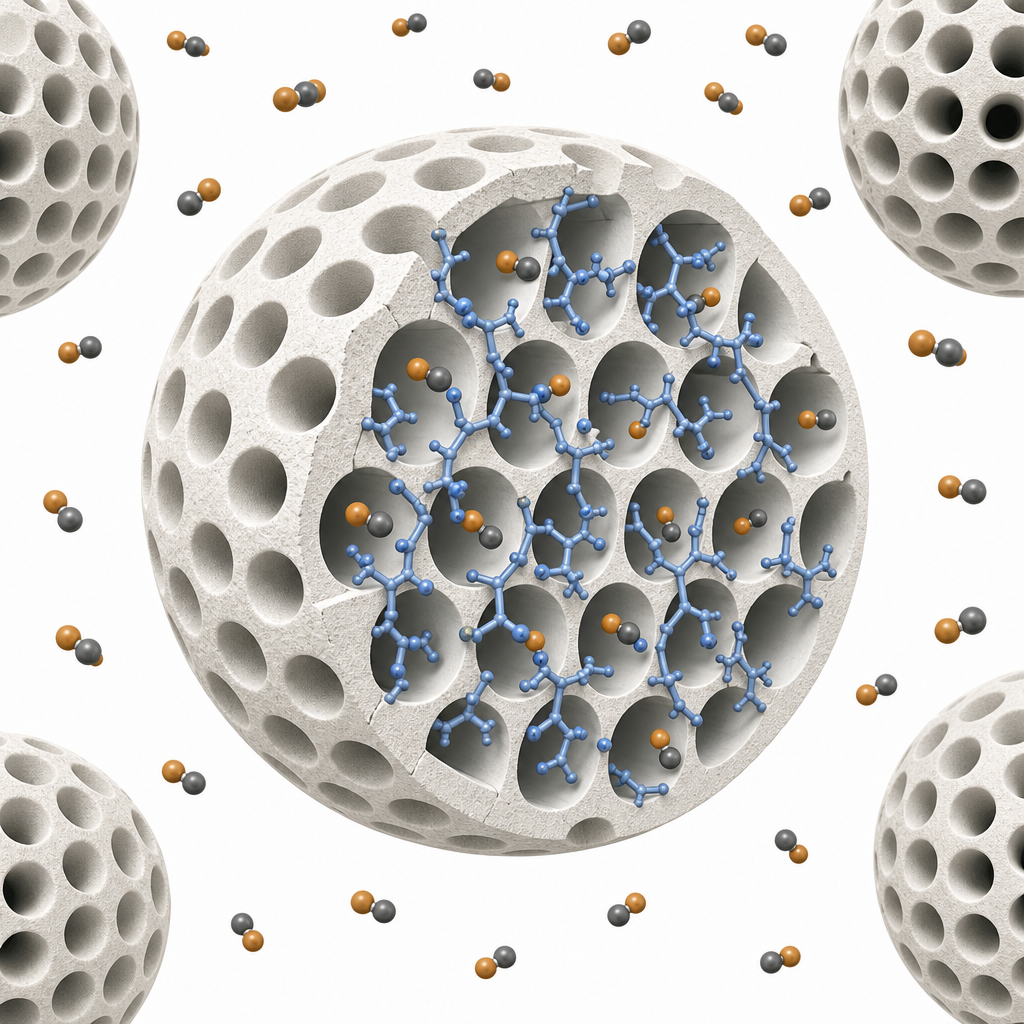
The ACS Material MCM-41 mesoporous silica acts as the structural host that confines the in situ polymerization. The authors selected this grade for its 3.8 nm pore diameter and high surface area, which together provide accessible volume for the amine polymer while preserving open porosity. Experiments were carried out in a 100 mL TharDesign high-pressure autoclave. Typically, 300 mg of MCM-41 and 1 mL of aziridine were placed separately inside the vessel, which was then pressurized with CO2 at room temperature. At about 1 MPa, a dense vapor cloud and a 4-6 °C exotherm marked the onset of CO2-catalyzed ring-opening polymerization. The reaction was held at 45 °C for 10 minutes, with the system pressure set to 6 MPa for the medium-loaded sample (MLPEI@MCM) or 10 MPa for the highly loaded sample (HLPEI@MCM). CO2 transports the monomer into the mesopore network and catalyzes polymerization to PEI, which forms covalent bonds with the silica surface.
Thermogravimetric analysis gave amine loadings of 6 mmol N per g for MLPEI@MCM and 8 mmol N per g for HLPEI@MCM, with elemental analysis confirming 5.4 mmol N per g for the medium-loaded material. Decomposition onset shifted from 200-250 °C in literature PEI/silica analogues to ~340 °C in the compressed-CO2 samples, indicating substantially higher thermal stability. BJH pore volume dropped from 0.92 cm³ g⁻¹ for bare MCM-41 to 0.21 cm³ g⁻¹ for MLPEI@MCM and 0.07 cm³ g⁻¹ for HLPEI@MCM, consistent with intra-pore polymerization. Pure-CO2 isotherms at 25 °C up to 100 kPa showed CO2 uptakes of 1.56 mmol g⁻¹ for MLPEI@MCM and 0.89 mmol g⁻¹ for HLPEI@MCM; raising the temperature to 75 °C boosted HLPEI@MCM uptake to 1.43 mmol g⁻¹ as diffusion limitations relaxed. Under a more realistic 10 vol% CO2/N2 mixture at 45 °C, the materials adsorbed ~0.6 mmol CO2 per g and showed no loss in capacity over 20 temperature-swing cycles between 45 °C (adsorption) and 105 °C (regeneration in N2). Amine efficiency was 0.1-0.2 mol CO2 per mol N, comparable to PEI/silica benchmarks prepared by conventional methods.
The results point to several application directions. The compressed-CO2 polymerization route can be transferred to other amine monomers and to alternative mesoporous hosts such as SBA-15 or pore-expanded silicas, broadening the design space for solid amine sorbents. Industrially, the combination of short reaction time, no organic solvent, and CO2 as a renewable, recyclable medium aligns with current process-intensification and decarbonization goals for post-combustion capture. Beyond CO2 scrubbing, hyperbranched-amine-grafted silica is relevant to heavy-metal sequestration, acid-gas removal (H2S, SO2), pharmaceutical adsorption, and catalysis where high-density tethered amines are useful. The authors note that further pressure optimization should bring the process to milder operating windows.
For researchers developing CO2 capture materials, supported amine catalysts, or functionalized mesoporous supports, this work shows that the choice of mesoporous silica directly governs amine loading, pore accessibility, and adsorption kinetics. The MCM-41 used here is available from ACS Material's molecular sieves catalog, along with related SBA-15, MCM-48, and aluminosilicate variants suitable for functionalization studies. Selecting a well-characterized commercial silica simplifies reproducibility and lets the synthesis team focus on the surface chemistry rather than the support preparation.How ACS Material products were used
- MCM-41 Mesoporous Silica (Molecular Sieves) — “The 3-membered ring ethyleneimine (Menadiona S.A.), also referred as aziridine (Fig. 1a), was chosen to impregnate the mesoporous (3.8 nm pore diameter) silica MCM-41 (ACS Materials).”
Product Performance in this StudyMCM-41 from ACS Material served as the mesoporous host for in situ aziridine ring-opening polymerization. After functionalization, the silica accommodated 6-8 mmol N per g of polyethyleneimine, enabled reversible CO2 capture up to ~1 mmol CO2 per g, and retained performance over 20 adsorption-desorption cycles, demonstrating that the support's well-defined 3.8 nm pore framework was essential to the method.
Related product categories
Frequently asked questionsWhy is MCM-41 mesoporous silica used as a support for polyethyleneimine in CO2 capture?
MCM-41 provides an ordered mesopore network (around 3.8 nm pores in this study) with high surface area, giving aziridine monomers access to internal silanols where they can polymerize and covalently bond to the silica wall. The resulting hyperbranched PEI/MCM-41 hybrid offers a high density of primary and secondary amines (6-8 mmol N per g) for selective, reversible CO2 chemisorption through carbamate formation.
How does compressed CO2 act as both solvent and catalyst for PEI synthesis inside mesoporous silica?
At pressures of 6-10 MPa, CO2 has high diffusivity and zero surface tension, so it transports liquid aziridine into MCM-41 pores without bulk solvent. CO2 also activates the aziridine ring, driving exothermic ring-opening polymerization at just 45 °C in 10 minutes. Unsubstituted aziridine is known to polymerize with CO2 catalysis without incorporating CO2 into the chain, yielding pure polyethyleneimine grafted to the silica.
What CO2 adsorption capacity can hyperbranched PEI grafted into MCM-41 achieve?
The sorbents reached up to 1.56 mmol CO2 per g in pure CO2 at 25 °C and 100 kPa, with the more lightly loaded MLPEI@MCM sample. Under a more realistic 10 vol% CO2 in N2 at 45 °C, uptake was ~0.6 mmol CO2 per g. The materials retained capacity over 20 adsorption-desorption cycles between 45 °C and 105 °C, demonstrating practical reversibility and high thermal stability up to about 340 °C.