-
MCM-41 Supported Pt for Glycerol Oxidation - Université de Lille, 2019
Jul 02, 2026 | ACS MATERIAL LLCRoz, A. E. et al. (2019). Glycerol to Glyceraldehyde Oxidation Reaction Over Pt-Based Catalysts Under Base-Free Conditions. *Frontiers in Chemistry*. https://doi.org/10.3389/fchem.2019.00156
Frontiers in Chemistry · 2019
Pt/SiO2 catalysts built on ACS Material MCM-41 deliver the highest glyceraldehyde selectivity in base-free glycerol oxidation, Université de Lille reports.
About this research
Researchers at Université de Lille (CNRS, Centrale Lille, ENSCL, Université d'Artois, UMR 8181-UCCS) used MCM-41 mesoporous silica supplied by ACS Material as the support for a Pt/SiO2 catalyst that delivered the highest glyceraldehyde selectivity in the base-free aqueous oxidation of glycerol. Working in collaboration with Université Lyon 1, the team compared four Pt-based catalysts on SiO2, TiO2, ZSM-5 and γ-Al2O3 supports, all loaded at a nominal 1.5 wt% Pt and tested in a semi-batch reactor at 80 °C under 2 bar O2. The study is reported in Frontiers in Chemistry (2019) and addresses the long-standing problem of selectively producing glyceraldehyde, a valuable C3 platform chemical, without adding base to the reaction mixture.
Glycerol is the main by-product of biodiesel production, accounting for roughly 10 wt% of the starting plant oil. Converting this large surplus into high-value oxygenates such as glyceraldehyde, glyceric acid, dihydroxyacetone and tartronic acid is a central goal of biorefining. Conventional glycerol oxidation routes over Au or Pt catalysts require added NaOH or KOH to deprotonate glycerol and stabilize the carboxylate products. Base addition, however, generates salt waste, complicates downstream separation, and makes recovering the neutral aldehyde glyceraldehyde particularly difficult. Base-free oxidation is therefore attractive both environmentally and economically, but it demands catalysts that activate molecular oxygen at moderate temperatures while controlling the selectivity between primary and secondary oxidation products. Identifying which oxide support best balances Pt dispersion, particle size and surface acidity for this chemistry remains an open question.
In this work the ACS Material MCM-41 mesoporous silica served as the high-surface-area support for one of the four Pt catalysts. The Methods section states explicitly: "Different supports were used for the synthesis of the catalysts: SiO2 MCM-41 from ACS Material and three oxide supports, gamma alumina, titanium oxide, and zeolite ZSM-5, all from Alfa Aesar." Each support (about 5 g) was suspended in 75 cm3 of ultrapure water at 67 °C, then a K2PtCl6·6H2O solution was added dropwise to achieve 1.5 wt% Pt loading. NaBH4 in 2-fold stoichiometric excess was used to chemically reduce the Pt precursor, with the pH adjusted to 7 with 0.3 M NaOH. The recovered gray solid was filtered, washed with distilled water and dried at 110 °C for 24 h. Pt/SiO2 (MCM-41) was then characterized alongside the other catalysts by N2 physisorption (BET), ICP-AES, H2 chemisorption, XRD, TEM and XPS to quantify surface area, pore structure, Pt loading, dispersion and particle size.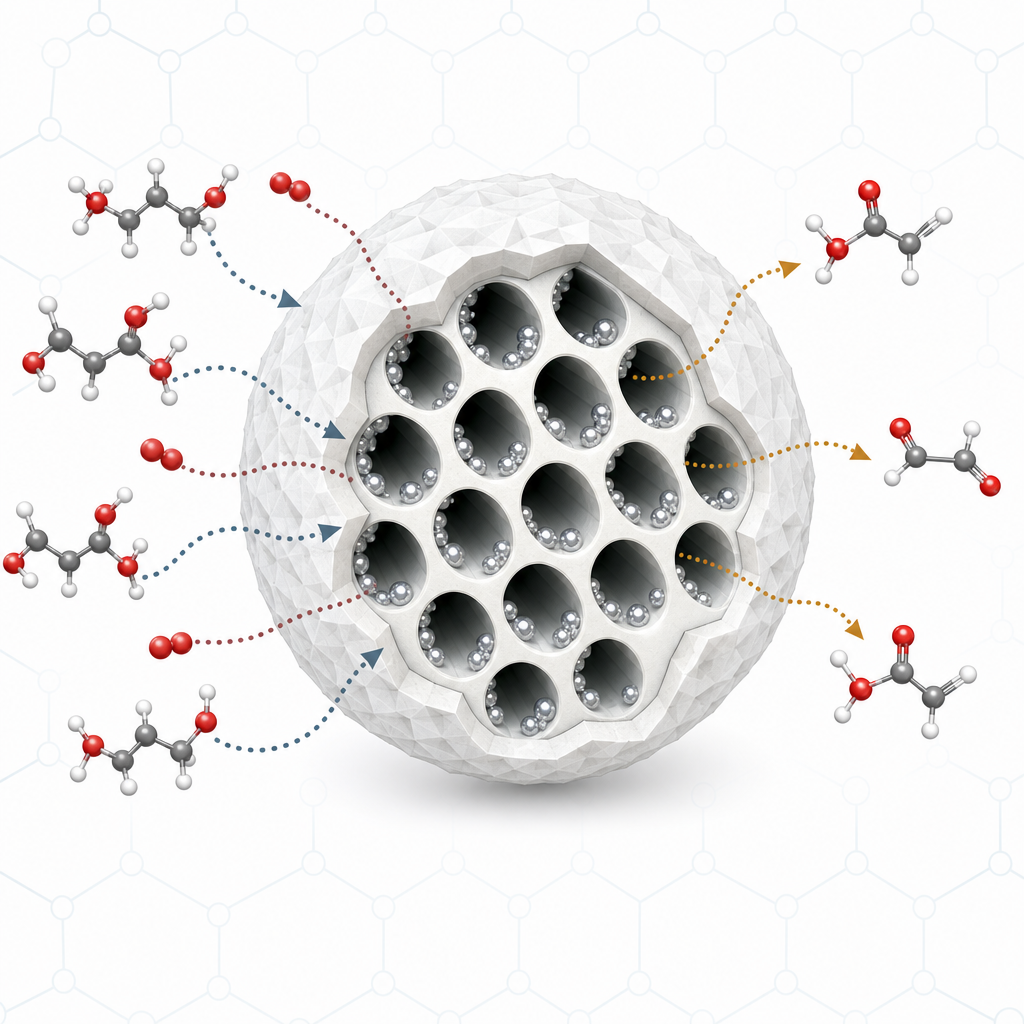
ICP confirmed an actual Pt loading of 1.20 wt% on the MCM-41 silica, compared with 1.36 wt% on ZSM-5, 1.15 wt% on TiO2 and 1.29 wt% on γ-Al2O3. H2 chemisorption revealed strikingly support-dependent Pt dispersion: only 1% on SiO2 and 1.5% on ZSM-5, but 24.5% on TiO2 and 32.7% on γ-Al2O3. Catalytic tests were performed in a 300 cm3 PARR 5500 semi-batch reactor with 200 cm3 of 0.1 M glycerol, 0.5 g catalyst, 80 °C and 2 bar O2, with products quantified by HPLC on an Aminex HPX-87H column. Pt/γ-Al2O3 was the most active catalyst, consistent with its high Pt dispersion, but its selectivity to glyceraldehyde declined markedly with time on stream as the primary aldehyde was further oxidized to glyceric acid and downstream products. Pt/SiO2 (MCM-41) showed a slower glycerol conversion rate but maintained the highest selectivity to glyceraldehyde of the four catalysts. The authors observed a general inverse relation: as glycerol conversion increases on a given catalyst, glyceraldehyde selectivity decreases, confirming that glyceraldehyde is a kinetically sensitive intermediate.
Because Pt/SiO2 on MCM-41 produces glyceraldehyde at a slow but selective rate, the authors propose pairing it with continuous extraction of glyceraldehyde from the reaction mixture to drive higher net productivity without sacrificing selectivity. This concept is directly relevant to bio-based fine chemical and pharmaceutical intermediate production, where glyceraldehyde and its derivatives feed into chiral synthesis, cosmetic formulations and medical applications. The dataset also informs broader green chemistry efforts on glycerol valorization, including the design of multifunctional Pt-bimetallic catalysts and reactive separation reactor concepts. Follow-up work suggested by the paper includes tuning Pt nanoparticle size on mesoporous silica, exploring lower oxygen pressures, and integrating membrane or sorbent-based glyceraldehyde recovery.
For researchers working on selective oxidation, biomass valorization, or supported precious metal catalysts, the MCM-41 mesoporous silica grade used here is available from ACS Material as part of its molecular sieves portfolio. The well-defined pore structure and high surface area make it a reliable platform on which to deposit Pt, Au, Pd or bimetallic nanoparticles when low dispersion combined with high selectivity is required. The paper's results justify considering MCM-41 not only as a textbook mesoporous support but as a practical choice for selective oxidation chemistries where over-oxidation must be suppressed.How ACS Material products were used
- MCM-41 mesoporous silica (Molecular Sieves) — “Different supports were used for the synthesis of the catalysts: SiO2 MCM-41 from ACS Material”
Product Performance in this StudyPt deposited on the ACS Material MCM-41 SiO2 support yielded the catalyst with the highest selectivity to glyceraldehyde among the tested supports, attributed to a slower reaction rate that limits over-oxidation.
Related product categories
Frequently asked questionsWhy is MCM-41 mesoporous silica a good support for Pt glycerol oxidation catalysts?
MCM-41 provides a high specific surface area and an ordered mesopore network that disperses Pt precursor uniformly. In this study, Pt deposited on MCM-41 from ACS Material gave a slower glycerol conversion rate than Pt on TiO2 or γ-Al2O3 but produced the highest selectivity to glyceraldehyde. The slower kinetics limit further oxidation of the aldehyde, which makes MCM-41 attractive when intermediate selectivity matters more than raw activity.
What is base-free glycerol oxidation and why is it important?
Base-free glycerol oxidation runs without added NaOH or KOH, using only molecular oxygen and a heterogeneous catalyst. Avoiding base eliminates salt waste, simplifies product purification and preserves neutral aldehyde products such as glyceraldehyde that would otherwise be consumed or trapped as carboxylates. This route is critical for converting biodiesel-derived glycerol into pharmaceutical, cosmetic and fine-chemical building blocks with a low environmental footprint.
How does Pt dispersion affect glyceraldehyde selectivity in glycerol oxidation?
Higher Pt dispersion increases the number of active sites and accelerates glycerol conversion, but it also drives over-oxidation of glyceraldehyde to glyceric and tartronic acids. In this paper Pt/γ-Al2O3 reached 32.7% dispersion and was most active, yet lost glyceraldehyde selectivity with time. Pt/MCM-41 SiO2 had only about 1% dispersion, ran more slowly, and therefore preserved glyceraldehyde, demonstrating an explicit activity-selectivity trade-off.