-
MCM-41 Water Adsorption Mechanisms - IBM Research, 2016
Jul 01, 2026 | ACS MATERIAL LLCSaliba, S. et al. (2016). Combined influence of pore size distribution and surface hydrophilicity on the water adsorption characteristics of micro- and mesoporous silica. *Microporous and Mesoporous Materials*. https://doi.org/10.1016/j.micromeso.2015.12.029
Microporous and Mesoporous Materials · 2016
IBM researchers use ACS Material MCM-41 to show how pore size and surface silanols jointly govern water adsorption isotherms in micro- and mesoporous silica.
About this research
Researchers at IBM Research Zurich and IBM Almaden Research Center used MCM-41 mesoporous silica obtained from ACS Material as the ordered-pore benchmark in a systematic investigation of how pore size distribution and surface hydrophilicity jointly govern water vapor adsorption on porous silica. Reporting in Microporous and Mesoporous Materials (2016), the team compared MCM-41 against industrial RD-type silica and two custom-templated micro/mesoporous silicas (PSM1, PSM2), demonstrating that hydroxylation during the first water sorption cycle dramatically reshapes the adsorption isotherm for materials containing micropores, while ordered mesoporous MCM-41 preserves its Type V isotherm. The findings reframe how adsorbents are selected for low-grade heat-driven adsorption heat pumps.
Adsorption heat pumps are promising energy-efficient alternatives to vapor compression cooling, particularly where low-grade waste heat below 100 °C is abundant in datacenters, industrial processes, and solar thermal installations. Water is the preferred working fluid because of its high latent heat, low cost, and environmental benignity, and porous silica remains one of the most widely used adsorbents. However, conventional silica gels suffer from limited water cycling capacity within the narrow relative pressure window defined by the heat pump's evaporator, condenser, and regeneration temperatures. Understanding how surface silanol chemistry and pore architecture combine to set the isotherm shape is therefore central to engineering next-generation adsorbents for heating, cooling, desiccation, and dehumidification.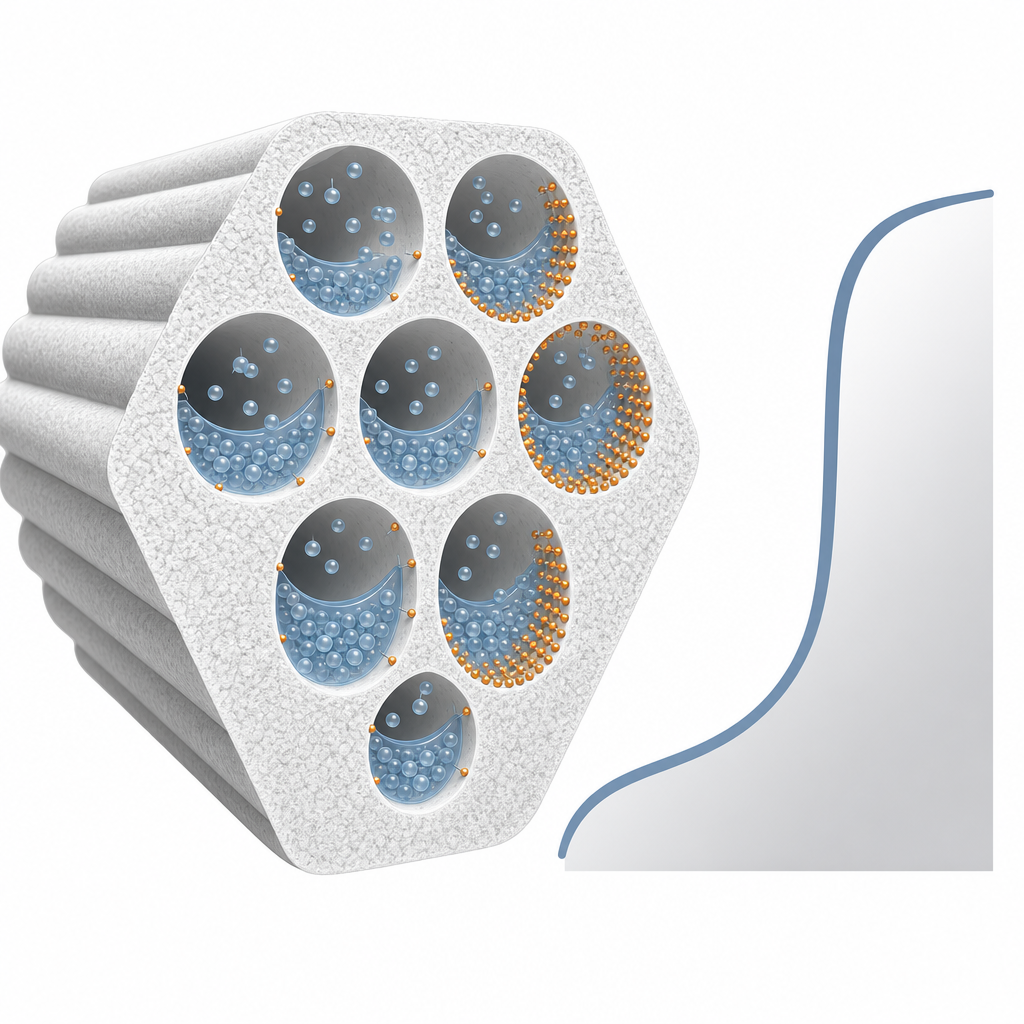
MCM-41 from ACS Material was selected as the model ordered-mesoporous silica because of its uniform cylindrical pores and narrow pore size distribution. The as-received powder was calcined at 600 °C for 3 hours in air to remove residual template and standardize surface silanol coverage before measurements. Nitrogen physisorption at 77 K on a Micromeritics ASAP2020 gave a BJH pore diameter of 3.1 nm, a Gurvich-derived d4V/S of 3.9 nm, total pore volume of 0.89 cm³/g, and BET surface area of 915 m²/g. Water sorption isotherms at 50 °C were recorded on a DVS Vacuum 1 apparatus, with the sample first degassed at 90 °C below 10⁻⁴ mbar. Two successive adsorption/desorption cycles were collected without intermediate treatment to capture the hydroxylation-induced transition. DRIFT spectroscopy, Raman, and TGA were used to quantify silanol coverage on dry and moisture-exposed samples.
For the calcined dry MCM-41, the first water adsorption isotherm was a textbook Type V curve, with real capillary condensation occurring sharply at p/psat ≈ 0.70, consistent with the 3.9 nm pore size and a fitted water contact angle of ~46° via the corrected Kelvin equation. The initial silanol density was 0.87 OH/nm², the lowest of the four materials, reflecting the hydrophobic character imparted by 600 °C calcination. After the first sorption cycle, TGA showed the silanol coverage rose to 2.28 OH/nm² and DRIFT revealed loss of the 3740 cm⁻¹ isolated silanol band and growth of hydrogen-bonded OH features at 3300–3600 cm⁻¹. Despite this hydroxylation, MCM-41 retained its Type V shape in the second adsorption cycle because it lacks appreciable microporosity. In the heat-pump-relevant window of p/psat = 0.20–0.42, MCM-41 cycled 0.027 g/g in the first branch and 0.045 g/g in the second (a 1.7× gain). In contrast, the micro/mesoporous PSM1 and PSM2 samples showed a complete reorganization of the isotherm with cycling capacities increasing 3.2× to 0.22 g/g and 6.8× to 0.21 g/g respectively, while RD silica increased 1.5× to 0.098 g/g. The authors propose that in the first cycle, hydrophobic micropore surfaces suppress micropore filling and force it to merge with mesopore capillary condensation as an apparent single step; after hydroxylation, micropore filling reemerges at low p/psat.
These mechanistic insights directly inform the design of porous silica adsorbents for hot-water-cooled datacenter cooling, solar-driven adsorption chillers, dehumidification, and desiccant systems where cycling capacity within a narrow relative pressure window outweighs total capacity at saturation. The work also clarifies that a single water adsorption isotherm cannot fully characterize the micro/mesoporous structure of calcined silica because micropore and mesopore filling collapse into one apparent capillary condensation regime; a second isotherm after hydroxylation is required. The findings suggest that engineered silicas with deliberately narrow but mixed micro/mesoporous distributions, like PSM1/PSM2, can outperform ordered MCM-41 in heat-pump duty.
For researchers working on adsorption-based thermal management, sorption desalination, or moisture buffering, MCM-41 remains an indispensable benchmark material because of its well-defined cylindrical mesopores. ACS Material supplies MCM-41 and a broad portfolio of related molecular sieves including SBA-15, MCM-48, ZIF-8, and zeolites suitable for water sorption, gas separation, and catalysis studies. Access to consistent, calcination-ready ordered mesoporous silica supports reproducible isotherm work and enables direct comparison with the IBM dataset reported here.How ACS Material products were used
- MCM-41 mesoporous silica (Molecular Sieves) — “MCM-41 (ACS Material) and RD-type silica (Fuji Silysia Chemical) were obtained from the suppliers and also calcined at 600°C for 3 hours in air prior to use.”
Product Performance in this StudyMCM-41 from ACS Material served as the ordered mesoporous reference material. It exhibited a well-defined BJH pore diameter of 3.1 nm, BET surface area of 915 m²/g, and total pore volume of 0.89 cm³/g, providing the benchmark Type V water adsorption isotherm dominated by real capillary condensation.
Related product categories
Frequently asked questionsHow does MCM-41 differ from industrial silica gel in water adsorption behavior?
MCM-41 has ordered cylindrical mesopores around 3.1 nm with a narrow pore size distribution, producing a sharp Type V isotherm dominated by real capillary condensation near p/psat = 0.70. Industrial RD-type silica gel has a disordered network with wide pore size distribution including micropores, yielding nearly linear water uptake spread over a much broader relative pressure range. The two materials respond very differently to surface hydroxylation after first water exposure.
Why does the water adsorption isotherm change after the first sorption cycle?
During the first cycle, water exposure hydroxylates the calcined silica surface. TGA showed silanol density on MCM-41 rising from 0.87 to 2.28 OH/nm² after one cycle, with similar increases for RD silica and PSM samples. The new hydrogen-bonded silanols make the surface more hydrophilic, shifting capillary condensation to lower relative pressure and, in micro/mesoporous samples, enabling distinct micropore filling at low p/psat that was previously suppressed.
Why is MCM-41 important for adsorption heat pump research?
MCM-41 serves as a model ordered mesoporous silica for benchmarking water sorption mechanisms because its uniform 3.1 nm pores isolate capillary condensation from micropore filling. In a typical datacenter heat pump operating between p/psat = 0.20 and 0.42, MCM-41 cycles 0.045 g/g of water after first hydroxylation, providing a clear reference against which engineered micro/mesoporous adsorbents like PSM1 (0.22 g/g) can be evaluated for capacity within the working window.