-
MnO2-Graphene Asymmetric Supercapacitor - McMaster University, 2017
Jun 22, 2026 | ACS MATERIAL LLCLiu, Y., Shi, K., & Zhitomirsky, I. (2017). Asymmetric supercapacitor, based on composite MnO 2 -Graphene and N-Doped activated carbon coated carbon nanotube electrodes. *Electrochimica Acta*. https://doi.org/10.1016/j.electacta.2017.03.028
Electrochimica Acta · 2017
McMaster researchers used ACS Material single-layer graphene to build a MnO2-graphene asymmetric supercapacitor reaching 3.3 F cm-2 at 30 mg cm-2 loading.
About this research
Researchers at McMaster University used Single Layer Graphene from ACS Material LLC to build a MnO2-graphene composite positive electrode that delivered an areal capacitance of 3.3 F cm-2 at an unusually high active mass loading of 30 mg cm-2, then paired it with an N-doped activated carbon coated multiwalled carbon nanotube (AC-MWCNT) negative electrode to produce a balanced asymmetric supercapacitor operating at 1.8 V. The work was published in Electrochimica Acta in 2017 by Yangshuai Liu, Kaiyuan Shi and Igor Zhitomirsky. By avoiding the conventional KMnO4-graphene redox route, which sacrifices part of the graphene structure, the authors preserved the high electronic conductivity of the carbon scaffold throughout the composite.
Manganese dioxide remains the leading positive-electrode material for aqueous supercapacitors thanks to its 1370 F g-1 theoretical specific capacitance and box-shaped cyclic voltammograms in mild electrolytes. In practice, however, gravimetric capacitance collapses as mass loading rises above a few mg cm-2 because MnO2 is poorly conductive and electrolyte transport becomes limiting. For practical pouch and prismatic devices, active loadings above 10 mg cm-2 are required, yet most reported MnO2-graphene composites in the literature operate well below 1.5 F cm-2 areal capacitance. The asymmetric architecture, with an activated carbon counter electrode, helps widen the voltage window but is typically bottlenecked by the much lower capacitance of the AC side. Addressing both problems simultaneously, at relevant mass loadings, is the core motivation of this paper.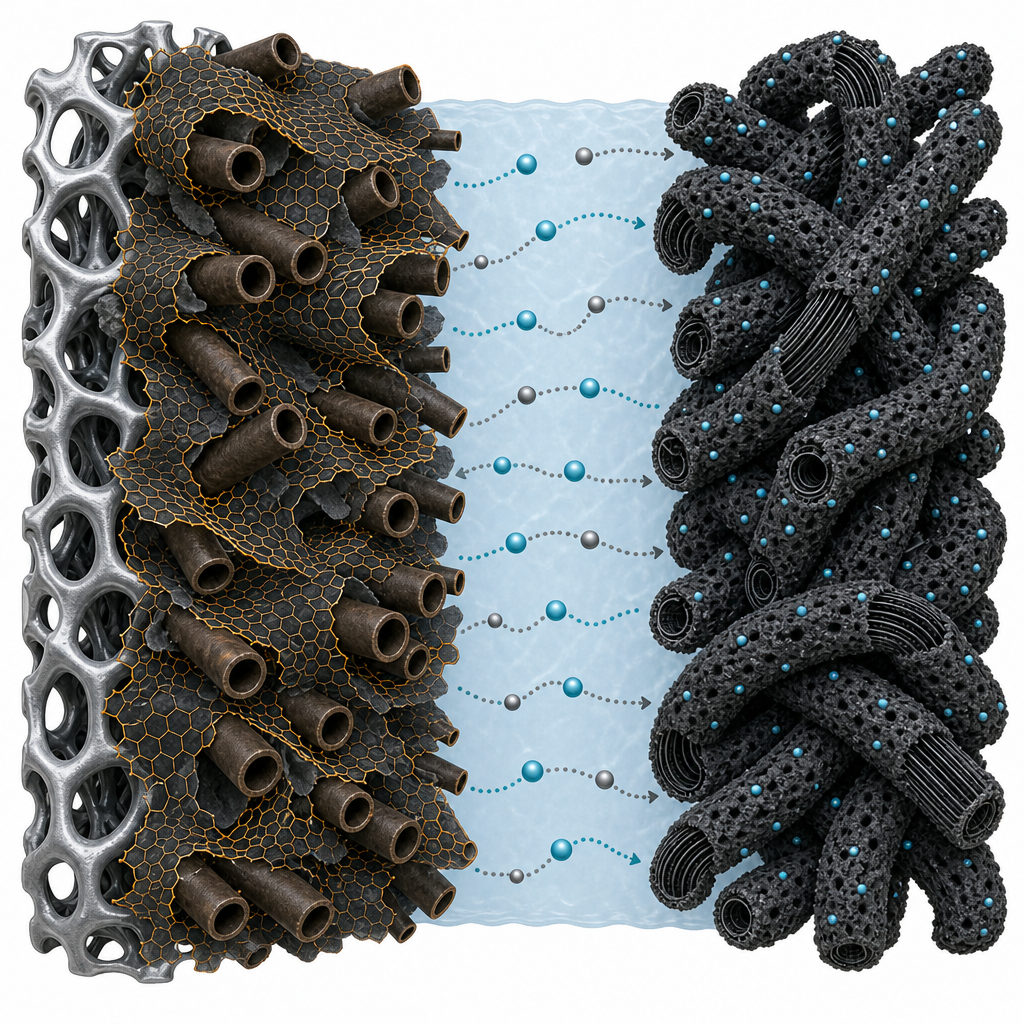
The ACS Material single-layer graphene served as the conductive backbone of the positive electrode. The authors dispersed graphene and pre-synthesized MnO2 nanotubes together in aqueous suspension using poly[1-[4-(3-carboxy-4-hydroxyphenylazo)benzenesulfonamido]-1,2-ethanediyl, sodium salt] (PAZO) as a co-dispersant. PAZO carries chelating aromatic monomers that adsorb on both MnO2 and graphene surfaces, providing the electrosteric stabilization needed for uniform co-dispersion. The mixed colloid was then cast onto nickel foam current collectors to produce composite electrodes with 30 mg cm-2 active mass loading. Crucially, because the graphene is incorporated as a pre-formed conductive additive rather than being consumed as a reductant for KMnO4 (a reaction that would generate carbonate byproducts and degrade the carbon network), the graphene retains its intrinsic conductivity inside the thick electrode film. MnO2 nanotubes themselves were synthesized hydrothermally from KMnO4/HCl at 120 °C, and the AC-MWCNT negatives were produced by glucose hydrothermal coating of MWCNTs followed by melamine-assisted nitrogen doping at 700 °C in argon.
The positive electrodes reached 3.3 F cm-2 at 2 mV s-1 and retained 64% of that capacitance as the scan rate was increased from 2 to 100 mV s-1, an unusually flat rate response for a 30 mg cm-2 MnO2-based film. The AC-MWCNT negatives, with their thick uniform AC coating on the nanotube cores, were tuned to match this performance at identical mass loading, eliminating the capacitance imbalance that normally limits MnO2 // AC devices. Assembled into a full asymmetric cell, the device delivered 1.42 F cm-2 at 2 mV s-1, with 52% capacitance retention between 2 and 100 mV s-1 over a 1.8 V voltage window in aqueous electrolyte. The cyclic voltammograms remained close to rectangular across the operating range, consistent with predominantly capacitive behavior on both electrodes, and the matched electrode design preserved efficient charge balancing.
These results have direct implications for the practical scale-up of aqueous asymmetric supercapacitors used in load-leveling, regenerative braking buffers, and back-up power for IoT and grid-edge electronics. The combination of high areal capacitance, high mass loading, and a 1.8 V aqueous window improves volumetric and gravimetric energy density without the safety overhead of organic electrolytes. The PAZO co-dispersion strategy demonstrated here is also transferable to other oxide-graphene composites, including those based on Fe3O4, NiCo2O4, or V2O5, where graphene degradation by in-situ redox routes is a recurring obstacle. The matched AC-MWCNT negative-electrode approach provides a template for balancing capacitance in other hybrid metal-oxide / carbon devices.
For researchers working on thick, high-loading metal oxide-graphene supercapacitor electrodes, the single-layer graphene used in this study is available from ACS Material as a standard catalog product. Reproducible monolayer-rich graphene with stable dispersion behavior is a recurring requirement when porting laboratory-scale MnO2-graphene films into the 10-30 mg cm-2 loading regime that practical devices demand, and the conductive scaffold role demonstrated here is one of its most cited use cases in the energy-storage literature.How ACS Material products were used
- Single Layer Graphene (Graphene Series) — “graphene (single layer, ACS Material LLC, USA)”
Product Performance in this StudySingle-layer graphene from ACS Material was used as the conductive scaffold in MnO2-graphene positive electrodes. Co-dispersed with MnO2 using PAZO, it enabled high active mass loading (30 mg cm-2) and an areal capacitance of 3.3 F cm-2 at 2 mV s-1, while avoiding the graphene degradation common to KMnO4 redox routes.
Related product categories
Frequently asked questionsHow does single-layer graphene improve high-mass-loading MnO2 supercapacitor electrodes?
Single-layer graphene acts as a high-conductivity scaffold inside the MnO2 composite, compensating for the intrinsically poor electronic conductivity of manganese dioxide. When co-dispersed with MnO2 using a PAZO polyelectrolyte, the graphene remains intact and conductive even at 30 mg cm-2 active loading, enabling 3.3 F cm-2 at 2 mV s-1 and 64% capacitance retention from 2 to 100 mV s-1 in aqueous electrolyte.
Why avoid the KMnO4-graphene redox route when making MnO2-graphene composites?
The reaction 4KMnO4 + 3C + H2O → 4MnO2 + K2CO3 + 2KHCO3 consumes graphene carbon as a sacrificial reductant. This degrades the graphene lattice and lowers its electrical conductivity, limiting electrode performance. Using pre-formed MnO2 and pre-formed graphene co-dispersed by PAZO preserves the carbon network, which is essential for thick, high-mass-loading electrodes where conductive percolation paths control rate capability.
What is the role of AC-MWCNT negatives in MnO2-graphene asymmetric supercapacitors?
Activated carbon coated multiwalled carbon nanotube (AC-MWCNT) negatives combine the high surface area of AC with the conductive backbone of MWCNTs. With thick uniform AC coatings, their areal capacitance can be tuned to match the MnO2-graphene positive at the same mass loading. This balance lets the cell operate stably at 1.8 V, reaching 1.42 F cm-2 at 2 mV s-1 with 52% retention to 100 mV s-1.