-
N-Doped Graphene Nanosheets for Li-Ion Anodes - University of Arkansas, 2017
Jun 09, 2026 | ACS MATERIAL LLCMeng, X. et al. (2017). Atomic Layer Deposition of Aluminum Sulfide: Growth Mechanism and Electrochemical Evaluation in Lithium-Ion Batteries. *Chemistry of Materials*. https://doi.org/10.1021/acs.chemmater.7b02175
University of Arkansas · Chemistry of Materials · 2017
University of Arkansas and Argonne researchers used ACS Material N-doped graphene nanosheets as a scaffold for ALD aluminum sulfide anodes, reaching 640 mAh/g.
About this research
Researchers at the University of Arkansas, in collaboration with Argonne National Laboratory, used nitrogen-doped graphene nanosheets (NGNS) supplied by ACS Material as the conductive 3D scaffold for an atomic-layer-deposited (ALD) aluminum sulfide coating, producing a NGNS-AlSx nanocomposite anode that sustained 640 mAh/g over 60 discharge–charge cycles at 100 mA/g in a lithium-ion half-cell. The study, published in Chemistry of Materials in 2017 by Meng, Cao, Libera, and Elam, also establishes a new ALD process for aluminum sulfide using tris(dimethylamido)aluminum (TDMA-Al) and hydrogen sulfide and provides a detailed in situ mechanistic picture. The work converts a high-capacity but historically unstable conversion-type sulfide into a practically cyclable anode by combining atomic-scale film control with a high-surface-area graphene support.
Aluminum sulfide (Al2S3) has long been attractive as a lithium-ion battery anode because of its theoretical capacity above 1400 mAh/g — roughly four times that of commercial graphite — through a combined conversion (Al2S3 + 6Li → 2Al + 3Li2S) and alloying (Al + Li → LiAl) mechanism. In practice, however, bulk micro-sized Al2S3 suffers from poor electronic conductivity, large volume changes during alloying, and irreversible structural evolution, causing capacity to drop from ~1200 mAh/g to ~200 mAh/g within ten cycles in prior reports. Solving these problems requires both nanostructuring of the active sulfide and embedding it within a conductive, mechanically flexible carbon network — a combination that ALD on a graphene host is uniquely suited to provide.
The ACS Material nitrogen-doped graphene nanosheets used in this study have a Brunauer–Emmett–Teller surface area of 500–700 m²/g, consist of 1–5 atomic-layer graphene sheets, and contain 1.0–3.0 at.% nitrogen plus 7.0–7.5 at.% oxygen as residual functional groups. These specifications make NGNS an ideal substrate for nucleating thin sulfide films: the heteroatom doping creates surface sites that promote uniform ALD growth, while the porous, thin-layer morphology provides electron percolation pathways and a flexible matrix that buffers volume change. The authors loaded 59 mg of NGNS into a viscous-flow ALD reactor and performed 50 cycles of TDMA-Al/H2S exposures at 100 °C using a 60–60–120–60 s timing sequence, yielding a NGNS-AlSx composite of 195 mg total mass — corresponding to an exceptionally high AlSx loading of approximately 70 wt.%. SEM and EDX mapping confirmed that AlSx coated the NGNS uniformly, increasing the apparent wrinkle thickness from less than 1 nm to roughly 15 nm, implying an effective growth-per-cycle of about 1.4 Å/cycle on the high-surface-area carbon.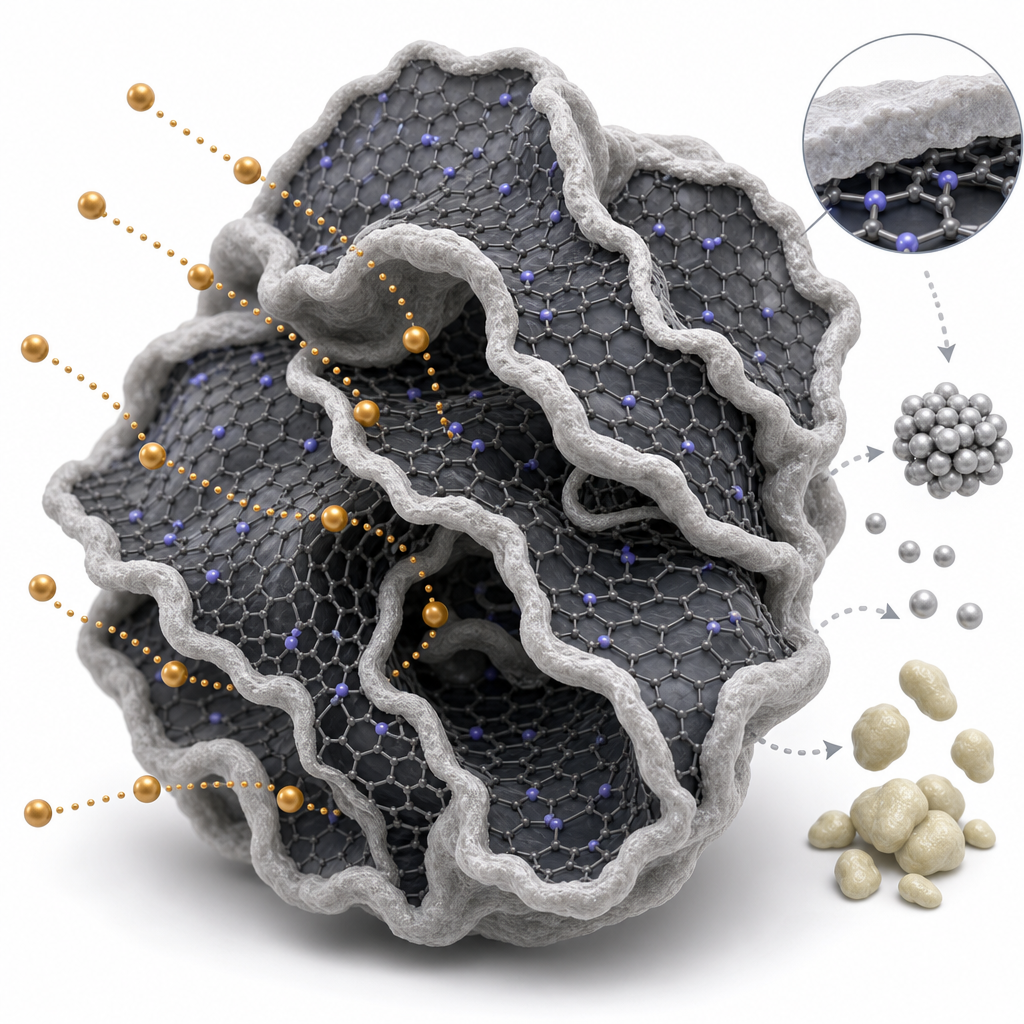
In situ quartz crystal microbalance, quadrupole mass spectrometry, and FTIR measurements showed that AlSx ALD is self-limiting from 100 to 250 °C, with growth-per-cycle decreasing from ~0.45 Å/cycle at 100 °C to ~0.1 Å/cycle at 250 °C, and that the films are amorphous over this range. RBS and XPS depth profiles confirmed an S/Al ratio close to 1.5 at 200 °C with minimal C/N impurities, while 100 °C films retained more residual dimethylamido- ligands. On the electrochemistry side, when cycled in a wide window of 0.01–3.0 V, NGNS-AlSx delivered ~1000–1100 mAh/g for the first six cycles before fading, attributed to SEI formation and irreversible LiAl growth. By narrowing the window to 0.6–3.5 V — avoiding the alloying region — the cell delivered a first-cycle discharge capacity of 800 mAh/g and retained 640 mAh/g after 60 cycles, which is 1.7× the theoretical capacity of graphite, with Coulombic efficiency consistently near 100%. This represents a dramatic improvement over the micro-sized Al2S3 control, which dropped to 150 mAh/g by cycle 30.
The demonstrated combination of an ALD sulfide on N-doped graphene has implications beyond aluminum sulfide. The same architecture is directly applicable to other conversion-type sulfides (GaSx, Cu2S, MnS, Li2S, Co9S8) explored by the same group, to lithium–sulfur cathodes, to electrocatalysts for the oxygen reduction and hydrogen evolution reactions, and to solid-state battery interlayers where a thin, conformal sulfide is needed on a porous carbon. The authors specifically point to further work optimizing the H2S exposure to reduce ligand residue and exploring voltage windows that suppress SEI and alloying side reactions. More broadly, the result is a useful template for any researcher who needs to combine an atomically controlled inorganic film with a conductive, high-surface-area carbon host.
For battery and electrocatalysis researchers, this paper illustrates how a well-characterized N-doped graphene starting material can decisively change device performance — the ACS Material NGNS used here is available through the Graphene Series, and similar nitrogen-doped graphene powders and aerogels in the ACS Material catalog provide the same surface-area and doping characteristics that proved critical to this work. Choosing a graphene substrate with documented BET area and known heteroatom content removes a major variable from ALD nucleation studies and from anode/cathode design more broadly.How ACS Material products were used
- Nitrogen-doped Graphene Nanosheets (NGNS) (Graphene Series) — “we deposited ALD AlSx films on nitrogen-doped graphene nanosheet (NGNS) powders (ACS Material, USA) at 100 oC and the resultant 3D NGNS-AlSx nanocomposites were evaluated electrochemically. The NGNS powders have a surface area of 500 – 700 m2/g (determined by Brunauer-Emmett-Teller (BET) surface area analysis), consist of typically 1 – 5 atomic layer graphene nanosheets, and contain 1.0 – 3.0 at.% nitrogen and 7.0 – 7.5 at.% oxygen.”
Product Performance in this StudyThe ACS Material nitrogen-doped graphene nanosheets served as a high-surface-area, electrically conductive 3D scaffold for the ALD AlSx coating. The resulting NGNS-AlSx nanocomposite (~70 wt.% AlSx) delivered 640 mAh/g after 60 cycles at 100 mA/g, vastly outperforming micro-sized commercial Al2S3, demonstrating that the NGNS support was critical for enabling reversible cycling.
Related product categories
Frequently asked questionsWhy use nitrogen-doped graphene nanosheets as a scaffold for ALD aluminum sulfide?
Nitrogen-doped graphene nanosheets combine a 500-700 m2/g surface area with heteroatom sites that promote uniform ALD nucleation. The thin, few-layer morphology delivers fast electronic conduction, while the porous structure accommodates the volume changes that accompany Al2S3 conversion and LiAl alloying. In this study, NGNS support raised reversible capacity to 640 mAh/g after 60 cycles, versus only ~150 mAh/g for micro-sized Al2S3.
How is aluminum sulfide grown by atomic layer deposition in this work?
AlSx films are deposited by alternating self-limiting pulses of tris(dimethylamido)aluminum (TDMA-Al) and hydrogen sulfide at 100-250 °C. Growth-per-cycle decreases linearly from about 0.45 Å/cycle at 100 °C to 0.1 Å/cycle at 250 °C and the films are amorphous. Reactions proceed by ligand exchange in which most dimethylamido groups are released as dimethylamine during the H2S pulse.
What lithium-ion battery performance did the NGNS-AlSx anode deliver?
In a 0.6-3.5 V voltage window the NGNS-AlSx composite delivered an initial discharge capacity of 800 mAh/g at 100 mA/g and retained 640 mAh/g after 60 cycles with Coulombic efficiency near 100%. This is roughly 1.7 times the theoretical capacity of graphite and dramatically better than micro-sized commercial Al2S3, which dropped to about 150 mAh/g within 30 cycles.