-
Nafion/Zeolite Membranes for PEM Fuel Cells — Atılım University, 2015
Jun 18, 2026 | ACS MATERIAL LLCDevrim, Y., & Albostan, A. (2015). Enhancement of PEM fuel cell performance at higher temperatures and lower humidities by high performance membrane electrode assembly based on Nafion/zeolite …. *International Journal of Hydrogen Energy*.
International Journal of Hydrogen Energy · 2015
Atılım University used ACS Material zeolite to make Nafion/zeolite composite membranes that improved PEMFC performance at 120 °C and 50% RH.
About this research
Researchers at Atılım University (Department of Energy Systems Engineering, Ankara, Turkey) used zeolite supplied by ACS Material (SiO2/Al2O3 = 52) to fabricate Nafion/zeolite composite proton exchange membranes that delivered higher PEM fuel cell performance at elevated temperature (up to 120 °C) and reduced humidity (50% RH) compared with pristine recast Nafion. The team prepared composites with 0, 2.5, 5, 7.5, 10 and 12.5 wt% zeolite loadings, characterized them by SEM, XRD, TGA, water uptake, and four-probe impedance spectroscopy, and assembled them into membrane electrode assemblies (MEAs) tested in a single 5 cm² PEMFC.
Proton exchange membrane fuel cells (PEMFCs) are attractive for transport, portable, and stationary power because of their high efficiency, fast start-up, and low emissions. However, operation of conventional perfluorosulfonic acid membranes such as Nafion is largely limited to roughly 80 °C and fully humidified conditions. Operating above 100 °C would simplify water and thermal management, improve CO tolerance of Pt catalysts, and enable smaller radiators in automotive stacks, but Nafion dehydrates and loses proton conductivity at these temperatures. Inorganic fillers — including silica, zirconium phosphate, heteropolyacids, and zeolites — have been blended into Nafion to retain water and extend the operating window. Among these, hydrophilic aluminosilicate zeolites offer a tunable Si/Al ratio, well-defined microporosity, good thermal stability, and the ability to anchor water clusters within the ionomer.
The ACS Material zeolite, supplied with a SiO2/Al2O3 ratio of 52, was used as received as the inorganic filler. To prepare composite membranes, 15 wt% Nafion solution from Ion Power was first evaporated at 60 °C, the dry Nafion residue was redissolved in N,N-dimethylacetamide (DMAc) to form a 5 wt% Nafion solution, and the appropriate amount of ACS Material zeolite was added and sonicated for at least one hour to ensure good dispersion. The Nafion/zeolite mixture was cast onto petri dishes and the solvent was slowly evaporated at 80 °C, yielding opaque white membranes approximately 70 ± 5 µm thick. Compositions are denoted NZ-2.5, NZ-5, NZ-7.5, NZ-10, and NZ-12.5; above 12.5 wt%, the films cracked. SEM of fractured cross sections (samples were freeze-fractured in liquid nitrogen) together with EDX mapping confirmed that the zeolite particles were uniformly and homogeneously distributed across the Nafion matrix, with no large agglomerates. XRD verified the crystalline zeolite phase within the membrane, and TGA confirmed that incorporation of zeolite shifted the onset of Nafion side-chain decomposition to higher temperature.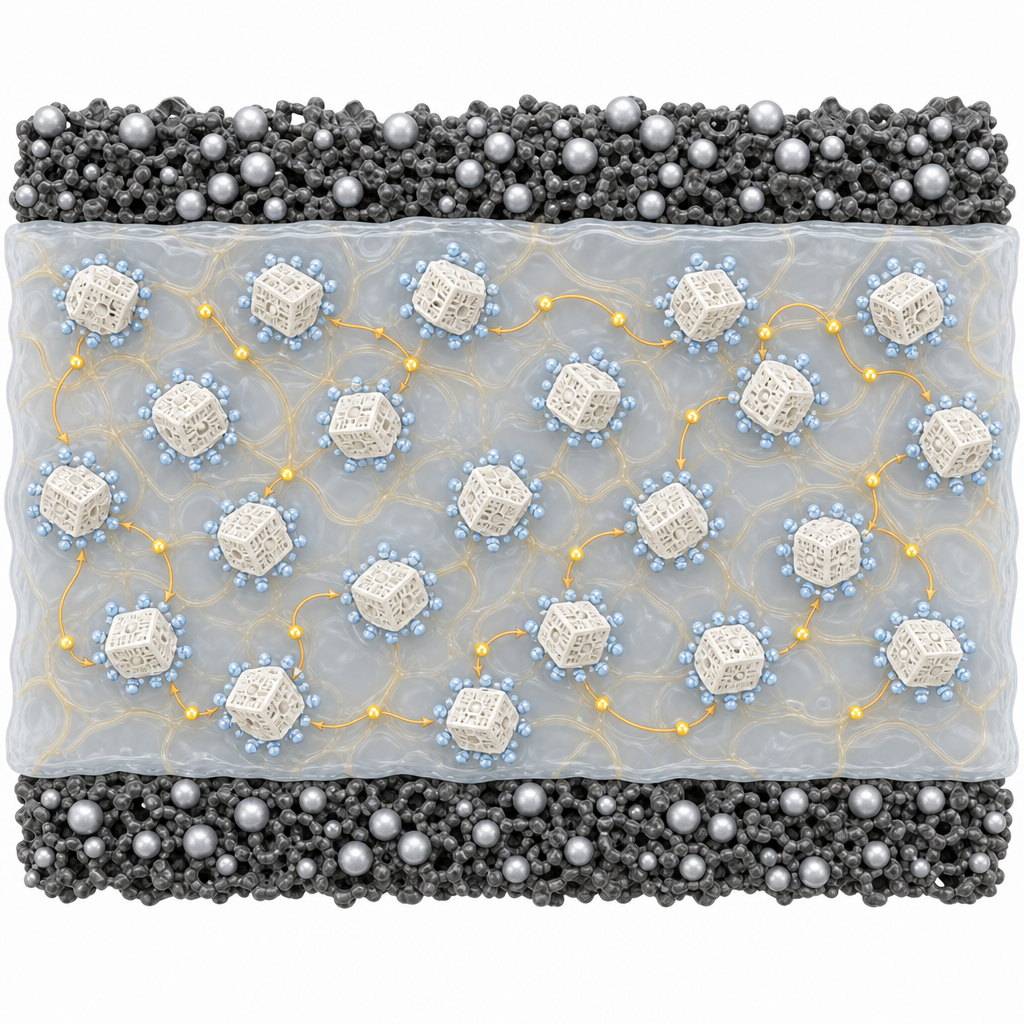
The composite membranes consistently outperformed pristine recast Nafion in the key transport metrics. Water uptake increased monotonically with zeolite content, reflecting the hydrophilic character and microporosity of the aluminosilicate filler that retains water within the ionomer at high temperature. Four-probe AC impedance measurements in air/water-vapor atmosphere showed proton conductivity rising with both temperature and zeolite loading, attributed to additional Grotthuss-type proton hopping pathways at the zeolite/Nafion interface and to suppressed dehydration. Thermal stability was likewise improved, with TGA showing the composites retaining structural integrity over a broader temperature range than pristine Nafion. In single-cell PEMFC testing on a 5 cm² active area MEA across 75–120 °C and at both 50% RH and fully humidified conditions, the Nafion/zeolite MEA delivered higher current and power densities than the pristine Nafion MEA, with the advantage most pronounced at elevated temperature and low humidity — exactly the regime in which Nafion fails. The optimized composite membrane was also more stable in operation than the virgin Nafion baseline.
These results indicate that Nafion/zeolite composites are a practical route to extend PEMFC operation to higher temperatures and drier feed conditions, easing thermal and water management requirements at the system level. Such membranes are directly relevant to automotive fuel cell stacks, backup power units, and portable hydrogen power systems, where higher operating temperatures improve catalyst CO tolerance, simplify heat rejection, and shrink balance-of-plant components. The work also points to further opportunities in optimizing zeolite particle size, Si/Al ratio, and surface functionality, and in pairing such composite membranes with advanced Pt-alloy electrocatalysts to push durability and power density.
For researchers working on composite proton exchange membranes, MEA development, or high-temperature PEMFCs, the zeolite used here — an aluminosilicate molecular sieve with SiO2/Al2O3 = 52 — is the type of well-characterized inorganic filler available from ACS Material's molecular sieves catalog. Reliable, consistent-quality zeolites and related framework materials support reproducible composite membrane processing and benchmarking against the Nafion standard reported in this study.How ACS Material products were used
- Zeolite (SiO2/Al2O3 = 52) (Molecular Sieves) — “Zeolite was obtained from ACS material (SiO2/Al2O3 = 52) was used as received.”
Product Performance in this StudyThe ACS Material zeolite was incorporated into Nafion to form composite proton exchange membranes. SEM confirmed uniform dispersion, and the zeolite filler improved water uptake, proton conductivity, and thermal stability versus pristine Nafion, enabling stable PEMFC operation at elevated temperature and reduced humidity.
Related product categories
Frequently asked questionsWhy add zeolite to Nafion for high-temperature PEM fuel cell membranes?
Zeolite is a hydrophilic aluminosilicate with regular microporosity and high thermal stability. When dispersed in Nafion, it retains water inside the ionomer at temperatures above 100 °C and provides additional proton-hopping pathways at the zeolite/Nafion interface. The result is higher water uptake, higher proton conductivity at low humidity, and better thermal stability than pristine Nafion, enabling PEMFC operation up to 120 °C.
What zeolite loading gives the best PEMFC performance in Nafion composite membranes?
In this study Nafion/zeolite membranes were prepared from 2.5 to 12.5 wt% zeolite (SiO2/Al2O3 = 52). Water uptake and proton conductivity increased with loading, but films above 12.5 wt% cracked. The 10 wt% composite gave the best combination of mechanical integrity, conductivity, and single-cell PEMFC performance at 75–120 °C under both 50% RH and fully humidified conditions.
How are Nafion/zeolite composite membranes prepared by solution casting?
A commercial 15 wt% Nafion solution is first evaporated at 60 °C, and the dry resin is redissolved in DMAc to form a 5 wt% Nafion solution. Zeolite powder is added and sonicated for at least one hour to ensure good dispersion. The mixture is cast onto a petri dish and dried slowly at 80 °C, yielding opaque white composite membranes about 70 µm thick that can be peeled and used as MEAs.