-
Nano H-ZSM-5 Composite Catalyst Supports - Tulane University, 2021
Jun 24, 2026 | ACS MATERIAL LLCAjumobi, O. et al. (2021). Integrating Halloysite Nanostraws in Porous Catalyst Supports to Enhance Molecular Transport. *ACS Applied Nano Materials*. https://doi.org/10.1021/acsanm.1c01678
Tulane University · ACS Applied Nano Materials · 2021
Tulane University integrates halloysite nanostraws and ACS Material nano H-ZSM-5 into MCM-41, boosting catalyst effectiveness by ~50% for nitrophenol reduction.
About this research
Researchers at Tulane University, working with collaborators at the University of Connecticut, used nano H-ZSM-5 supplied by ACS Material to demonstrate that embedding halloysite nanotubes (HNTs) as molecular 'nanostraws' inside mesoporous MCM-41 substantially improves access to interior catalytic sites. Published in ACS Applied Nano Materials (2021), the work introduces a one-step aerosol-assisted synthesis that co-encapsulates Ni-loaded ZSM-5 microcrystallites and HNTs in MCM-41 spheres. Compared with an HNT-free composite, the nanostraw-containing material delivered a ~50-63% higher observed rate constant in the model reduction of 4-nitrophenol, and the relative effectiveness factor improved from 0.6 to 0.9.
Diffusional limitations are a long-standing bottleneck in porous catalysis. When the kinetic diameter of a reactant is comparable to the pore size of a support, the Thiele modulus rises, the effectiveness factor falls, and only a fraction of the active sites contribute to the observed rate. Conventional remedies—shrinking the particle, enlarging the pores, or moving active sites to the exterior—often degrade mechanical integrity or increase pressure drop in packed-bed reactors. Strategies that preserve the structural advantages of ordered mesoporous silicas such as MCM-41 while expanding internal transport channels are particularly valuable for reactions involving bulky molecules in fine chemicals synthesis, biomass conversion, environmental remediation, and bifunctional zeolite/mesoporous catalytic reforming.
The ACS Material nano H-ZSM-5 (CAS 1318-02-1) was used as received and impregnated with 5 wt% Ni via incipient wetness using Ni(NO3)2·6H2O, then calcined at 550 °C to yield Ni@ZSM-5 with 5–10 nm Ni clusters on the external zeolite surface. This Ni@ZSM-5 was dispersed in an ethanol solution of cetyltrimethylammonium bromide (CTAB), tetraethoxysilane (TEOS), and HCl, with halloysite nanotubes (lumen diameter ~20 nm, length ~1 μm) added directly to the precursor. The mixture was atomized with a 1 mm nebulizer using N2 carrier gas (4 L/min) and passed through a 76 cm tube furnace at 400 °C with ~22 s residence time. Each droplet acted as a microreactor where CTAB-templated MCM-41 formed around both the zeolite microcrystallites and the HNTs. Subsequent calcination removed the surfactant, leaving Ni@ZSM-5 encapsulated within MCM-41 with HNT lumens protruding as open straws.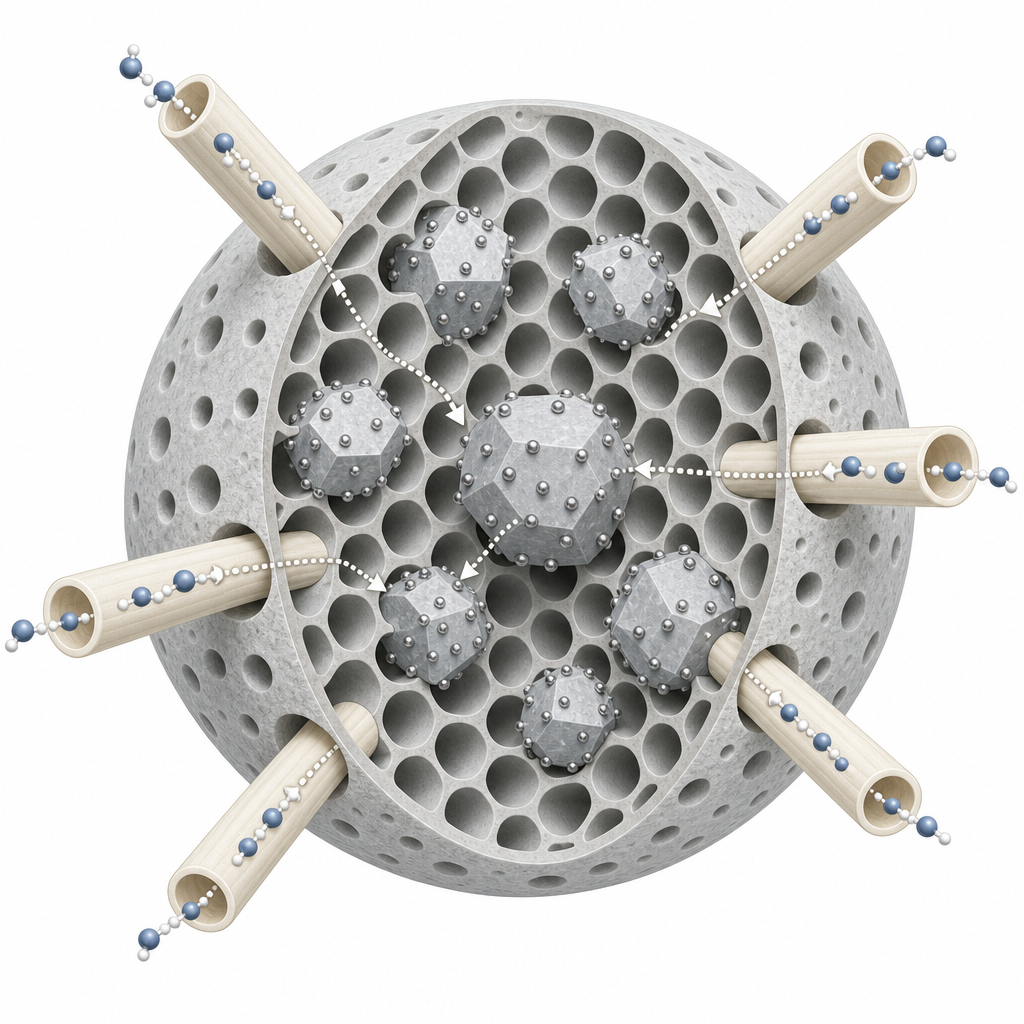
Characterization confirmed the architecture. Cut-section TEM and SEM showed Ni@ZSM-5 trapped inside the mesoporous matrix and HNTs oriented across the particle interior, with clear, unfilled lumens visible at the protrusion points. BET surface area was 1391 m²/g for M30NZ (30 wt% Ni@ZSM-5 in MCM-41) and 889 m²/g for M30NZ/30HNT, with pore volume rising from 0.22 to 0.35 cm³/g. The HNT-containing composite displayed a type IV isotherm with a hysteresis loop consistent with capillary condensation in the 20–30 nm HNT lumens. Small-angle XRD retained the MCM-41 (100) peak (d-spacing 3.2–3.4 nm), confirming preservation of the ordered mesostructure. In the aqueous reduction of 4-nitrophenol to 4-aminophenol by excess NaBH4, mass-normalized pseudo-first-order rate constants were 0.81 s⁻¹/g for pristine Ni@ZSM-5, 0.14 s⁻¹/g for M30NZ, and 0.23 s⁻¹/g for M30NZ/30HNT. Normalized to the active Ni@ZSM-5 fraction, rates rose from 0.46 s⁻¹/g (HNT-free) to 0.75 s⁻¹/g (with HNTs)—a 63% increase—despite the HNT particles being larger (~3 μm vs ~1.5 μm). Because a larger particle should give a higher Thiele modulus and lower effectiveness, the observed enhancement is attributed to nanostraw-mediated transport into the interior.
The ship-in-a-bottle aerosol approach is semi-continuous, scalable through parallel units, and adaptable to other zeolite-in-mesopore architectures. Possible applications include bifunctional catalytic reforming, biomass catalytic fast pyrolysis (where MCM-41/ZSM-5 composites have already shown promise), adsorption and separation of bulky molecules, and catalyst designs that use the mesoporous matrix as a sink for coke or catalyst poisons. The protruding HNTs also create inter-particle spacing that could reduce pressure drop in packed beds, addressing a practical limitation of fine-particle ZSM-5 systems.
For researchers developing hierarchical zeolite or mesoporous composite catalysts, nano H-ZSM-5 of the type used in this study is available from ACS Material as part of the molecular sieves catalog. Its small crystallite size and standard MFI-type structure make it suitable as a microcrystalline active phase for incorporation into mesoporous matrices, supported metal catalysts, and selective conversion of small oxygenates or aromatics where diffusion-controlled performance must be benchmarked.How ACS Material products were used
- Nano H-ZSM-5 (Molecular Sieves) — “Nanosized H-ZSM-5 was purchased from ACS Material, LLC (CAS no. 1318-02-1).”
Product Performance in this StudyThe nanosized H-ZSM-5 from ACS Material served as the zeolite microcrystallite scaffold that was loaded with 5 wt% Ni and then encapsulated within MCM-41. It provided the active catalytic sites for the 4-nitrophenol reduction model reaction and enabled the comparison demonstrating a ~50-63% increase in effective reaction rate when halloysite nanostraws were added.
Related product categories
Frequently asked questionsHow do halloysite nanotubes improve mass transport in MCM-41 catalysts?
Halloysite nanotubes have a 15–30 nm hollow lumen that is roughly an order of magnitude larger than the 2–4 nm pores of MCM-41. When embedded inside MCM-41 spheres via an aerosol ship-in-a-bottle synthesis, the HNT lumens act as open straws connecting the external surface to interior catalytic sites, reducing diffusional resistance and raising the relative effectiveness factor from 0.6 to 0.9 in the studied nitrophenol reduction.
Why is nano-sized H-ZSM-5 used instead of bulk ZSM-5 in mesoporous composites?
Nano H-ZSM-5 microcrystallites (50–100 nm primary particles) can be dispersed in an aerosol precursor droplet and physically trapped inside MCM-41 during silica condensation, because they are larger than the HNT lumens but small enough to be enveloped by the mesoporous matrix. This geometry ensures that Ni active sites sit in the silica matrix rather than inside the nanostraws, providing a clean comparison of catalytic activity with and without HNT transport channels.
What performance gain did the HNT nanostraw strategy deliver for 4-nitrophenol reduction?
Mass-normalized pseudo-first-order rate constants increased from 0.14 s⁻¹/g for the HNT-free MCM-41/Ni@ZSM-5 composite to 0.23 s⁻¹/g when 30 wt% halloysite nanotubes were integrated. Normalized to the active Ni@ZSM-5 fraction the increase was from 0.46 to 0.75 s⁻¹/g, about a 63% improvement. The relative effectiveness factor reached 0.9, approaching that of pristine powdered Ni@ZSM-5.