-
Nano ZSM-5 Zeolite Additive for Stable DSSCs - KIER, 2017
Jun 22, 2026 | ACS MATERIAL LLCSarwar, S. et al. (2017). Improved Long-Term Stability of Dye-Sensitized Solar Cell by Zeolite Additive in Electrolyte. *Electrochimica Acta*. https://doi.org/10.1016/j.electacta.2017.05.191
Electrochimica Acta · 2017
Researchers at KIER added Nano ZSM-5 zeolite from ACS Material to DSSC electrolytes, boosting Jsc 17% and sustaining performance at 60 °C for 1200 hours.
About this research
Scientists at the Korea Institute of Energy Research, in collaboration with Konkuk University and the University of Science & Technology (Daejeon), used Nano ZSM-5 zeolite (P-26) from ACS Material as an electrolyte additive in dye-sensitized solar cells (DSSCs), achieving a 17% increase in short-circuit photocurrent density and remarkable thermal stability over 1200 hours at 60 °C. Published in Electrochimica Acta in 2017, the work demonstrates that a commercially available nano-zeolite molecular sieve can simultaneously act as a light-scattering element and as a moisture scavenger inside the liquid electrolyte. The strategy avoids the need for a separate non-transparent scattering layer, preserves device transmittance for building-integrated photovoltaic (BIPV) use, and addresses one of the most persistent failure modes in DSSCs: dye detachment caused by trace water.
Long-term stability has remained the principal bottleneck preventing dye-sensitized solar cells from competing with silicon and perovskite technologies in commercial deployment. Although submodule efficiencies have surpassed 8.8% after more than two decades of development, real-world operation exposes DSSCs to elevated temperatures and humidity. Water that seeps through seals or is introduced during cell assembly hydrolyzes the TiO2-dye linkage, depletes iodine in the redox shuttle, and slows electron-transfer kinetics. One referenced study found up to 10 wt% water in the electrolyte after just one year of outdoor flexible-DSSC operation. Approaches that fully exclude water require inert assembly environments that raise manufacturing costs. A solid additive that captures residual water in situ, without sacrificing optical transmittance, therefore represents a practical route to bankable DSSC modules - particularly for semitransparent BIPV windows where added opacity is unacceptable.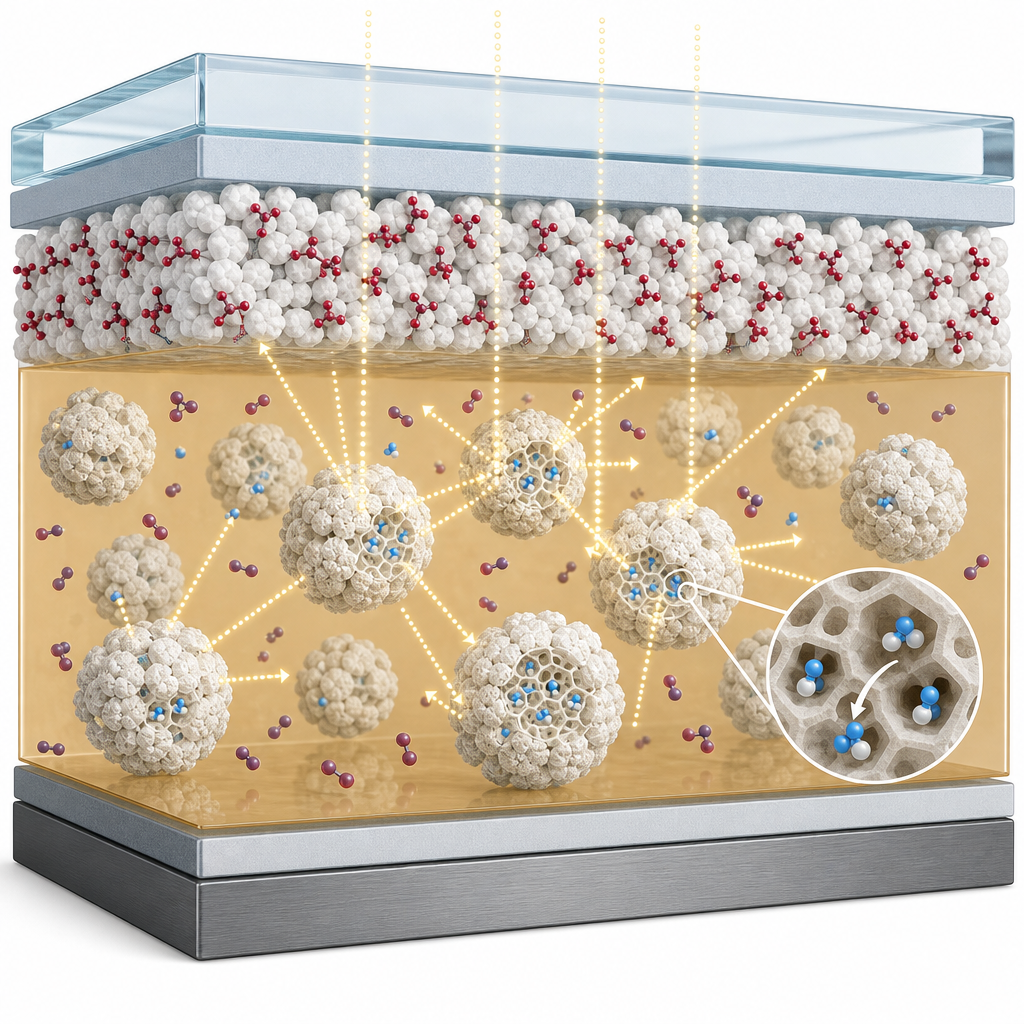
The team prepared the photoanode by doctor-blading a 5-6 µm TiO2 paste (20 nm particles) onto fluorine-doped tin oxide glass, sintering at 550 °C, and sensitizing with N719 ruthenium dye. The reference electrolyte combined 0.05 M I2, 0.1 M LiI, 0.48 M 4-tert-butylpyridine, 0.6 M 1-butyl-3-methylimidazolium iodide and 0.12 M NaSCN in 3-methoxypropionitrile. Nano ZSM-5 zeolite powder from ACS Material, specified at ~300 nm average particle size with 0.5 nm pores and water uptake up to 26 wt%, was hand-ground in an agate mortar for 30 minutes, then dispersed into the reference electrolyte at 0, 2.5, 5, 7.5, 10 and 20 wt%. SEM imaging confirmed that primary zeolite nanoparticles a few tens of nanometers in size aggregated into secondary clusters around 300 nm - a size range matched to the wavelength of visible light, which is what enables Mie scattering inside the cell. Thermogravimetric analysis showed the as-received powder lost ~5% mass between 20 and 300 °C, consistent with strong water adsorption capacity; samples were therefore vacuum-dried at 200 °C immediately before electrolyte preparation.
Devices with 5 wt% Nano ZSM-5 reached JSC = 13.02 mA cm⁻², VOC = 0.76 V, FF = 0.60 and overall efficiency η = 5.95%, compared with JSC = 11.13 mA cm⁻² and η = 5.52% for the additive-free reference. Incident photon-to-current conversion efficiency measurements confirmed a ~20% JSC enhancement consistent with the J-V data. UV-Vis transmittance scans on dummy cells showed that transmittance decreased monotonically with zeolite loading, especially between 400 and 530 nm, validating Mie scattering as the JSC-enhancement mechanism. Most importantly, in the 1200-hour stability test at 60 °C in the dark, additive-free DSSCs showed an initial JSC rise (attributed to a water-induced TiO2 conduction-band shift) followed by continuous degradation as dye molecules detached or thiocyanate ligands exchanged with water. The 5 wt% Nano-ZSM cells stabilized at ~9 mA cm⁻² after an initial decrease to 300 hours and held that value through the full 1200-hour run, demonstrating that the zeolite buffered water activity in the electrolyte at thermodynamic equilibrium.
The results have direct implications for commercializing DSSCs in building-integrated photovoltaics, semitransparent windows, indoor light-harvesting modules and flexible solar panels exposed to outdoor humidity. Because the zeolite functions as a dispersed additive rather than a deposited overlayer, it requires no extra processing step and does not compromise the transparency advantage of DSSCs. The TiO2 active layer in this study could be thinned to 5-6 µm without sacrificing photocurrent. The same additive concept could be transferred to quasi-solid-state and polymer-gel DSSC electrolytes, to perovskite devices that suffer comparable moisture-driven degradation, or to other electrochemical systems where trace water reduces lifetime. The authors highlight that combining selective adsorption with photonic-scale scattering in a single additive is a strategy that broadens the engineering envelope for stable photovoltaics.
For researchers exploring DSSC reliability, water-tolerant electrolytes, or BIPV applications, Nano ZSM-5 zeolite and related molecular sieves are available from ACS Material's molecular sieves catalog. The specific grade used here (Nano ZSM-5, P-26) provides the combination of sub-micron particle size, controlled pore aperture and high water capacity that this study shows is useful for both optical and moisture-management roles in working photovoltaic devices.How ACS Material products were used
- Nano H-ZSM-5 (Nano ZSM-5, P-26) (Molecular Sieves) — “Zeolite powder (Nano ZSM-5, P-26, ACS Materials, average particle size ~ 300 nm) was ground in Agate Mortar for 30 minutes before mixing with the reference electrolyte at various weight percent from 0 to 20”
Product Performance in this StudyThe Nano ZSM-5 zeolite from ACS Material was the key functional additive in the electrolyte, acting both as a Mie light scatterer (boosting JSC by ~17% at 5 wt% loading) and as a moisture scavenger that suppressed dye desorption and stabilized the cell at 60 °C for 1200 hours.
Related product categories
Frequently asked questionsHow does Nano ZSM-5 zeolite improve the stability of dye-sensitized solar cells?
Nano ZSM-5 zeolite added at 5 wt% to the DSSC electrolyte captures trace water that otherwise hydrolyzes the TiO2-dye linkage and causes dye detachment. In a 1200-hour test at 60 °C in the dark, additive-free cells degraded continuously, while cells with Nano ZSM-5 stabilized at around 9 mA cm⁻² after an initial settling period, demonstrating an equilibrium between adsorbed and free water in the electrolyte.
Why does adding a zeolite to the DSSC electrolyte increase short-circuit current density?
The ~300 nm secondary aggregates of Nano ZSM-5 are comparable in size to the wavelength of visible light, producing Mie scattering inside the electrolyte. This lengthens the photon path within the dye-sensitized TiO2 layer and increases absorption. At 5 wt% zeolite loading, the short-circuit current density rose by 17% on average compared with the reference electrolyte, without compromising open-circuit voltage or fill factor.
What grade of zeolite was used as the DSSC electrolyte additive?
The authors used Nano ZSM-5 (P-26) from ACS Material, with an average particle size of approximately 300 nm, a pore aperture of 0.5 nm and water adsorption capacity up to 26 wt%. The powder was ground in an agate mortar for 30 minutes and vacuum-dried at 200 °C before being dispersed in an ionic-liquid-based electrolyte at loadings between 0 and 20 wt%.